

English Cream Retriever puppies for sale
English cream retriever puppies are golden retrievers from European bloodlines that carry very pale cream to ivory coats, broader heads, heavier bone, and typically calmer temperaments than many American golden lines. They are the same breed as the golden retriever, not a separate one. Expect to pay $3,500,$5,500 from an accredited breeder with full genetic health clearances, early housebreaking, and crate training, and expect a fully grown adult of roughly 55-75 pounds. At Designer English Cream Retrievers, our English cream retriever puppies program is run by a working animal biologist and built entirely on top imported European stock.
english cream golden retriever puppies
- Same breed, different lines. English cream retrievers are golden retrievers bred to the UK/European standard, which accepts cream coats. The AKC standard penalizes “extremely pale” coloring, so cream dogs are still purebred goldens but are less common in American show rings.
- “White golden retriever” is a marketing term. No golden retriever is truly white. The correct description is cream or pale gold.
- Build is the real difference. Good European-line puppies are broader, thicker, and blockier, often described as resembling baby Great Pyrenees when they are young and fluffy.
- Price tiers matter more than price. $500,$1,000 listings are almost always scams. $1,000,$1,500 usually signals a puppy mill. $2,000,$2,500 is typical hobby-breeder territory. A genuinely accredited program with genetic guarantees runs $3,500,$5,500.
- Health testing is non-negotiable. Hips, elbows, eyes, heart, plus DNA testing for PRA, ichthyosis, and related conditions.
- Temperament suits families. Patient, affectionate, and highly trainable, which is why they’re a top pick for homes with young children.
- They shed. A dense double coat means year-round shedding plus two heavy seasonal blows.
- Head start beats raw pedigree. Puppies raised with ENS (Early Neurological Stimulation), household noise exposure, and early crate and potty routines settle into new homes dramatically faster.
What is an English cream retriever?
An English cream retriever is a golden retriever descended from European (often UK, Hungarian, Serbian, or Scandinavian) breeding lines whose coat ranges from pale gold to nearly ivory cream. It is not a separate breed, a designer crossbreed, or a rare mutation. It’s a color and structural type within the golden retriever breed.
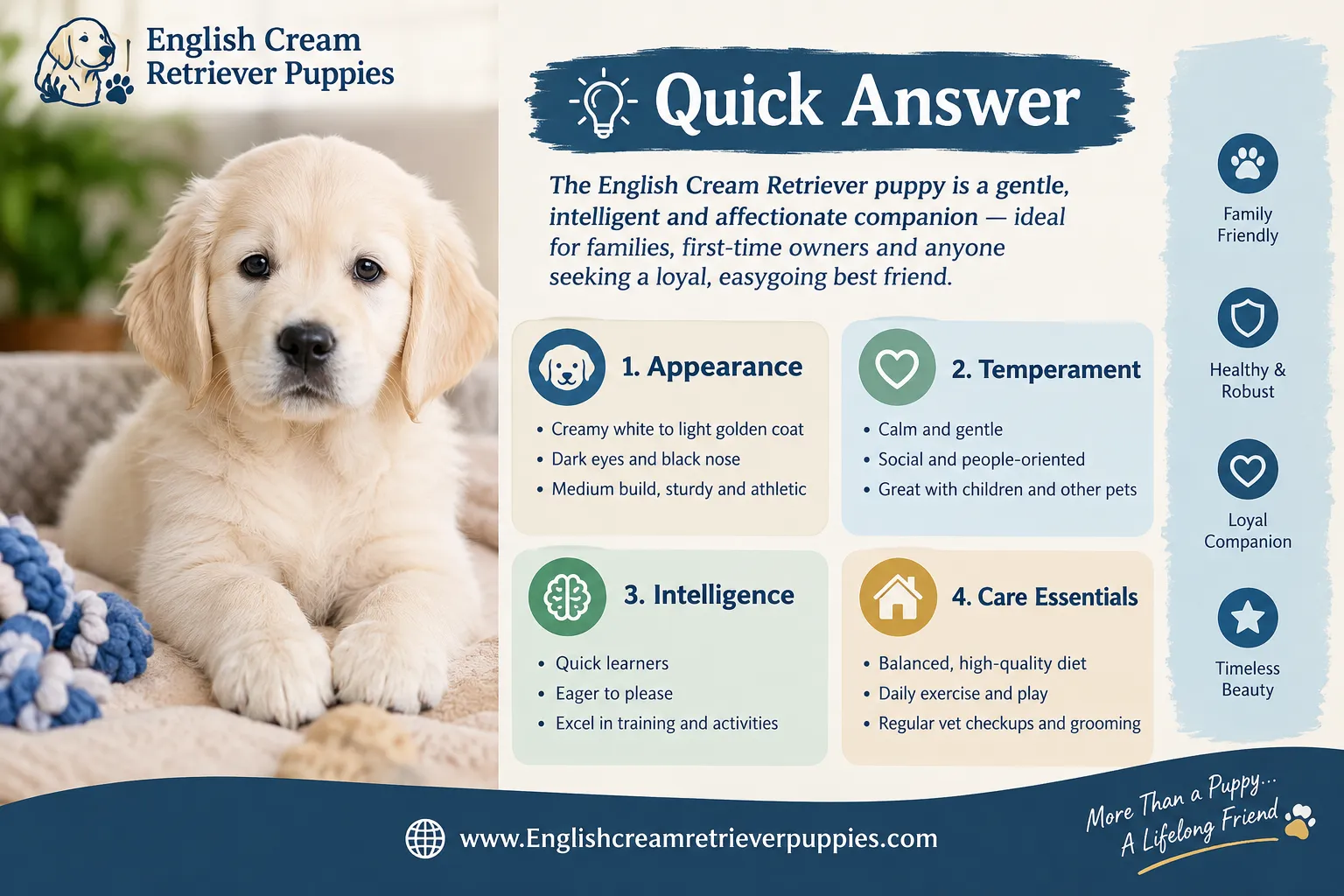
The confusion comes from breed standards. The Kennel Club (UK) and FCI standards explicitly allow cream as an acceptable golden retriever color. The American Kennel Club standard calls for “rich, lustrous golden of various shades” and treats extremely pale coats as undesirable. Same dog, different rulebook.
Beyond color, European lines tend to differ in structure:
- Broader, blockier skulls with shorter, deeper muzzles
- Heavier bone and a thicker, more substantial chest
- Slightly shorter, stockier overall frame
- Darker pigment around the eyes and nose, which makes the pale coat look striking
- Often a denser, plusher coat from the best english cream retriever breeders
That combination is why our puppies look like baby Great Pyrenees at eight weeks: thick, cushiony, and noticeably broader than the average American-bred retriever puppy. Every one of our english cream golden retriever puppies traces back to imported European breed stock selected for that heavier, calmer type.
Watch out for this claim: any breeder advertising “rare white English cream retrievers” at a premium is selling you a marketing story. Cream is a recognized color, not a rarity surcharge.
English cream retriever vs golden retriever: what’s the actual difference?
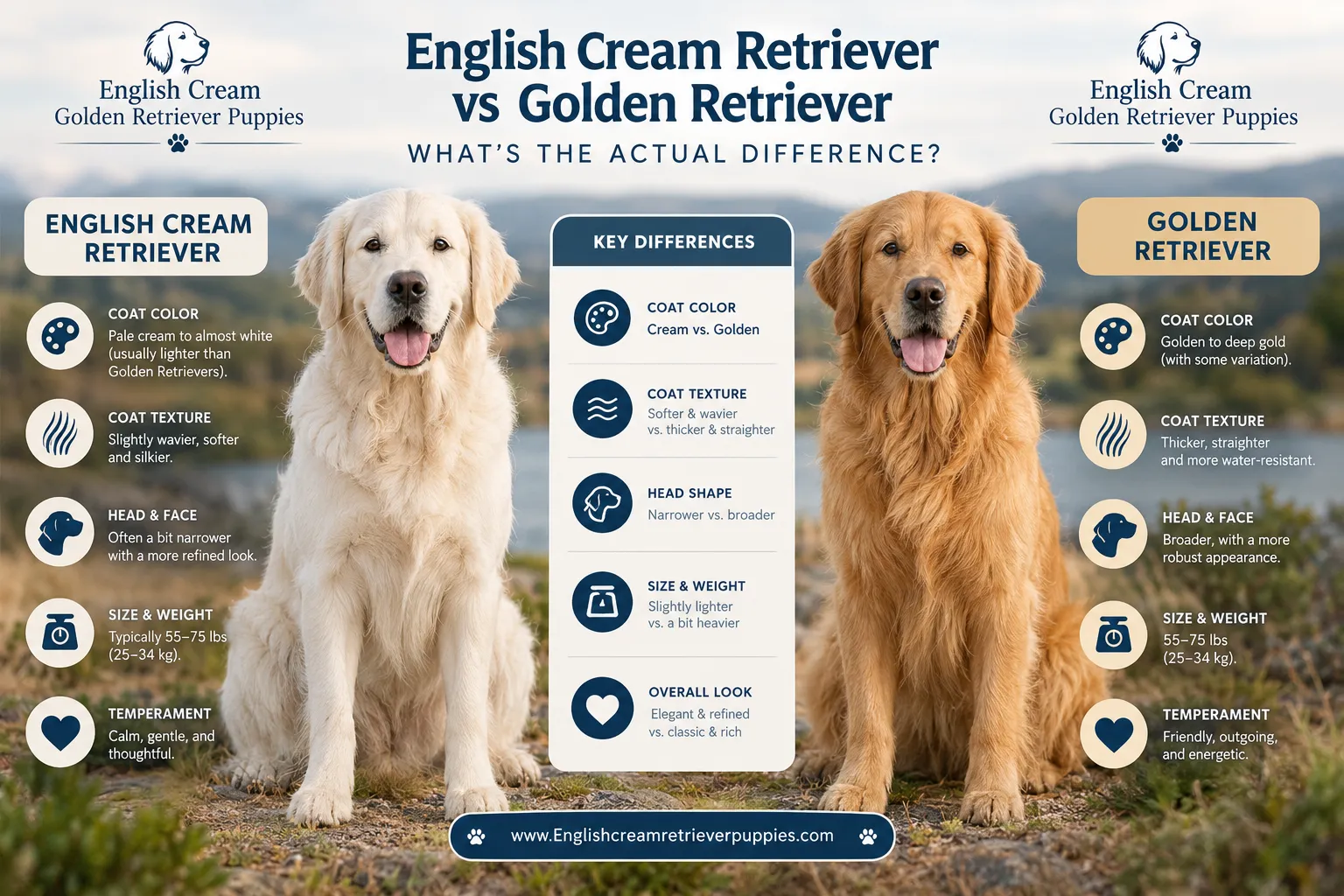
The difference is bloodline and appearance, not breed. An English cream retriever is a golden retriever. What changes is coat shade, bone structure, and, in many cases, the general energy level of the line.
| Feature | English cream (European lines) | American golden retriever |
|---|---|---|
| Coat color | Pale cream to light gold | Medium to deep golden, sometimes red |
| Head/muzzle | Broader, blockier, shorter muzzle | Narrower, longer muzzle |
| Build | Thicker bone, stockier, broader chest | Leaner, more angular, taller-looking |
| Typical energy | Often moderate and slower to mature into drive | Often higher-drive, more athletic |
| Standard status | Accepted by The Kennel Club (UK) and FCI | Accepted by AKC |
| Lifespan | Roughly 10-12 years, same breed range | Roughly 10-12 years |
Decision rule: choose English cream lines if you want a calmer, heavier-boned family companion and you love the pale look. Choose American field-bred golden lines if you want a high-drive hunting, dock diving, or competitive sport partner.
A common myth is that English cream lines live significantly longer. Coat color does not extend lifespan. What does move the needle is health-tested parents, lean body condition, and good veterinary care.
How much do English cream retriever puppies cost?
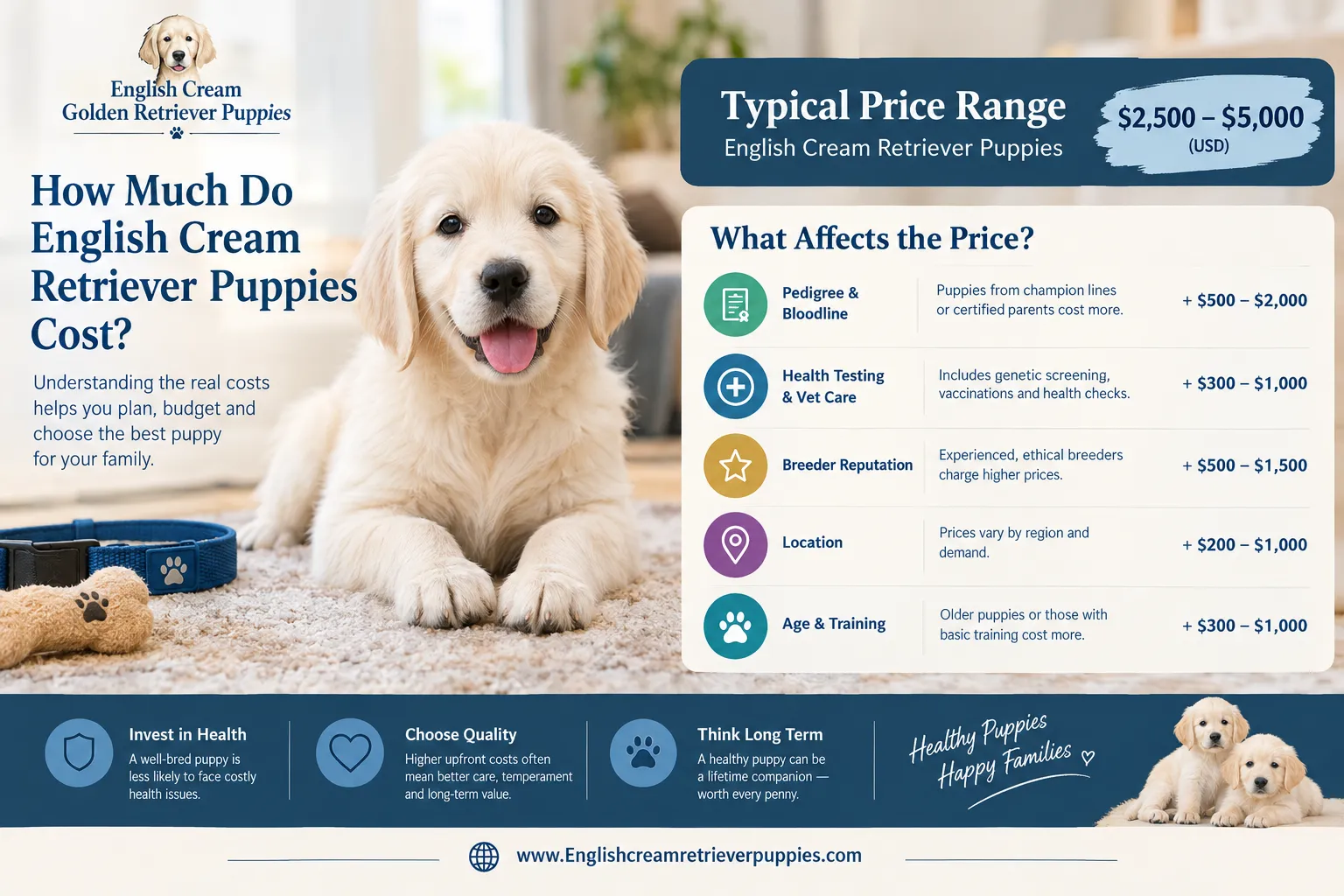
Expect $3,500,$5,500 for English cream retriever puppies from a legitimate, accredited breeder with genetic health guarantees. Prices far below that range almost always mean corners were cut somewhere you’ll pay for later, in vet bills or in temperament problems.
Here’s how the market actually breaks down:
| Price range | What you’re usually dealing with | Real risk |
|---|---|---|
| $500,$1,000 | Scam listings, stolen photos, wire/Zelle/gift-card requests | No puppy exists; money gone |
| $1,000,$1,500 | Puppy mill or broker | No health testing, parvo/giardia, poor socialization |
| $2,000,$2,500 | Backyard or hobby breeder | Partial testing, no early training, thin guarantee |
| $3,500,$5,500 | Accredited program, European stock, full clearances | Highest up-front cost, lowest long-term risk |
What the top tier actually buys you: OFA hip and elbow clearances on both parents, cardiac and ophthalmologist exams, DNA panels, proper whelping supervision, ENS from birth, a written genetic health guarantee, first vaccines and deworming, microchip, and a puppy already started on housebreaking and crate training.
A $1,200 puppy that develops hip dysplasia at 14 months can easily cost $6,000,$8,000 in surgery. The cheap puppy is rarely the cheap dog.
Budget for first-year costs beyond purchase price too: food, crate and pen, vet visits and vaccines, spay/neuter, training class, grooming tools, and pet insurance. Plan on roughly $1,500,$2,500 in year one for a large-breed puppy, depending on your region.
finding the best English cream retriever breeders
Buy directly from an english cream retriever breeder who health-tests both parents, raises litters inside the home, and lets you verify everything in writing. Avoid third-party classified sites, “puppy finder” marketplaces, and any seller who won’t do a live video call with the dam and the litter.
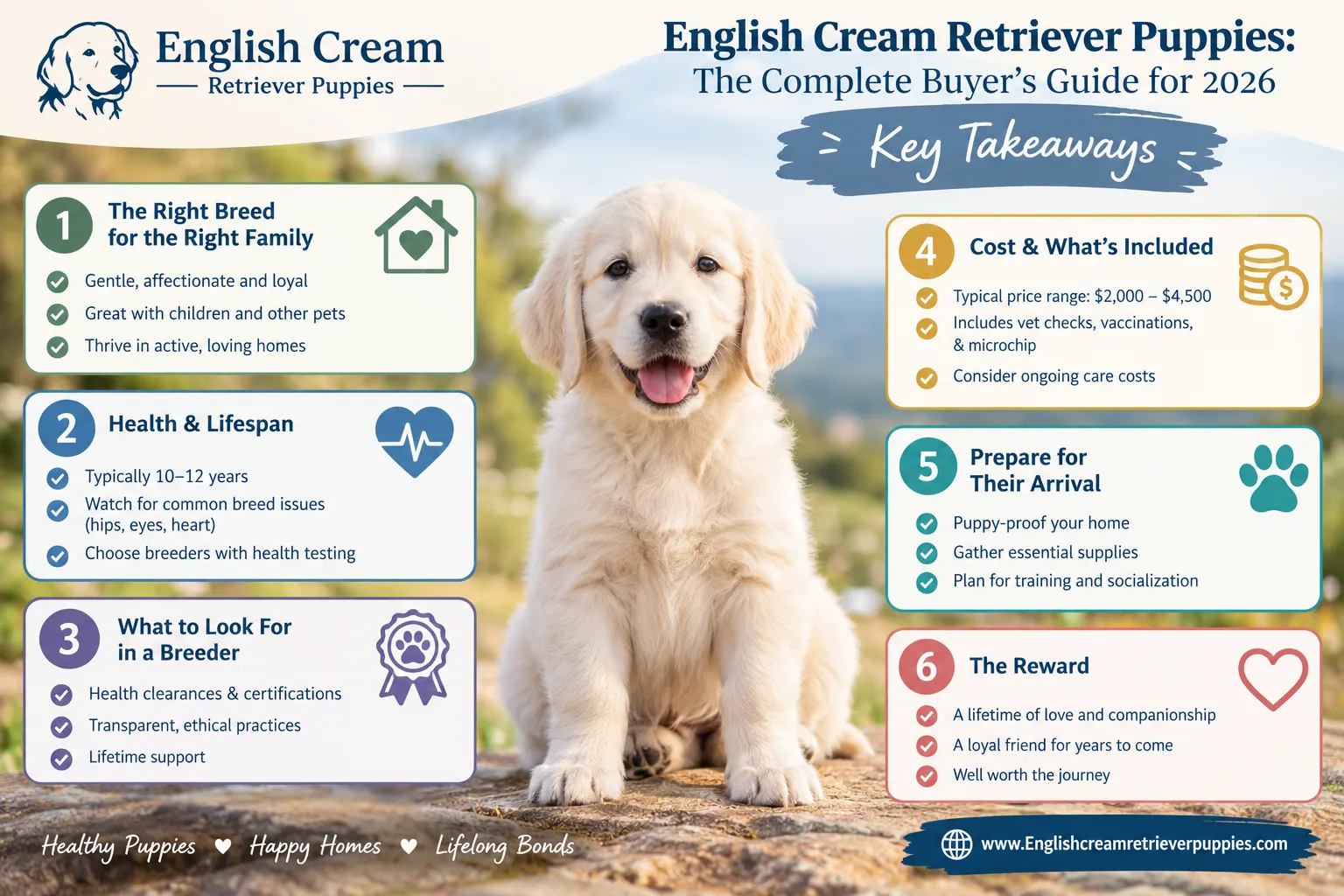
Use this checklist before you send a deposit:
- Ask for OFA/health clearance numbers on both parents and look them up yourself. A real breeder hands them over instantly.
- Request a live video walkthrough of the whelping area and both parents. Photos can be stolen; a live call can’t.
- Read the contract before paying. It should name the health guarantee period, what’s covered, and the return-to-breeder clause.
- Ask what early enrichment they use. If the answer isn’t specific (ENS, household noise exposure, litter-box or pad-to-outdoor transition, crate introduction), keep looking.
- Pay traceably. Credit card or a documented invoice. Never gift cards, crypto, Western Union, or cash apps to strangers.
Our program at Designer English Cream Retrievers is directed by an animal biologist holding a degree in Animal Biology from Stockton University in Pomona, New Jersey, with a minor in animal genetics. That background shapes every pairing we make: we screen for structure, coat, temperament, and genetic compatibility before a breeding is ever planned, and all of our breed stock comes from top European bloodlines. It’s the reason we’re comfortable calling ourselves the best English Cream Retriever breeders in the USA, and the reason our families consistently report puppies that arrive home already crate-comfortable and nearly housebroken.
If you’d like to see what’s currently available, you can browse our current litters and available puppies in the online shop, and families who want a reserved spot in an upcoming litter can secure a full-sized Golden Doodle litter deposit or review our other Golden Doodle puppies available for sale.
How big do English cream retrievers get?
Adult English cream retrievers follow the golden retriever size range: males stand about 23-24 inches at the shoulder and weigh 65-75 pounds; females stand about 21.5-22.5 inches and weigh 55-65 pounds (American Kennel Club breed standard). European-line dogs often look bigger than the scale says because of broader chests and heavier bone.
Growth timeline to expect:
- 8 weeks: roughly 10-15 pounds
- 4 months: roughly 30-40 pounds
- 6 months: often 70-80% of adult height
- 12 months: near-adult height, still filling out
- 18-24 months: full chest development and mature coat
Edge case: puppies advertised as “oversized” or “100-pound English creams” are outside the standard. Extra weight on a large-breed frame accelerates joint wear. I’d rather see a 70-pound dog with visible waist definition than an 95-pound dog carrying stress on both hips.
What is the temperament of English cream retriever puppies, and are they good for families?
English cream retriever puppies are typically affectionate, biddable, people-focused, and tolerant, which makes them one of the strongest breed choices for families with children. European lines are often described as slower to mature into high drive, so many settle into calm adult behavior a bit earlier than field-bred goldens.
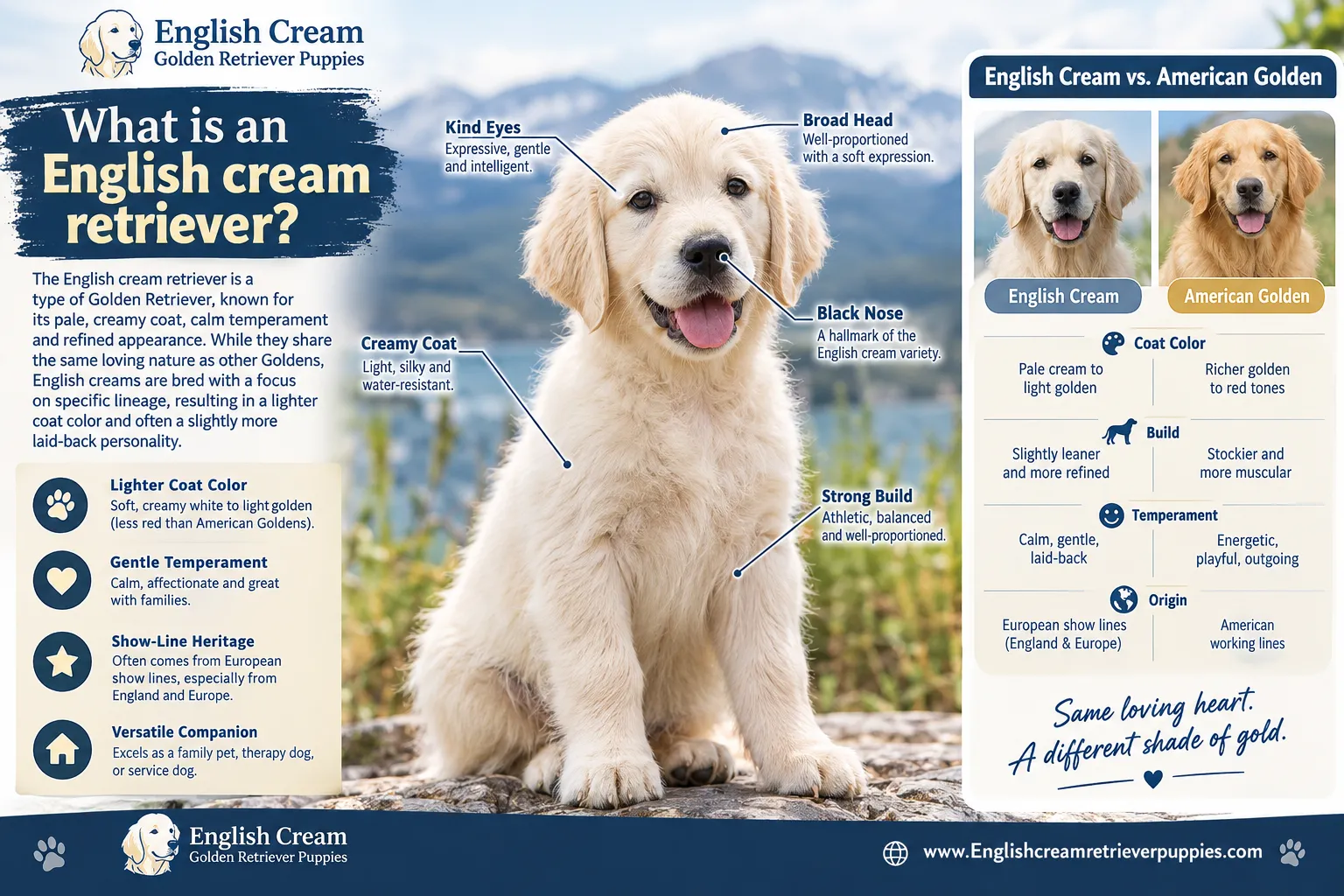
Typical personality traits:
- Strongly attached to people; they do poorly left alone for long workdays
- Soft, food-motivated, and quick to learn (responds badly to harsh corrections)
- Mouthy as puppies, because they’re bred to carry things
- Friendly with strangers and other dogs when socialized early
- Not natural guard dogs; a golden will greet the burglar
Who they’re right for: families who want a dog in the middle of household life, first-time owners willing to do daily training, homes with kids, and multi-pet households.
Who they’re not right for: people away 10+ hours a day, anyone who wants a low-shedding dog, or households wanting a protective breed. If low shedding is your priority, a poodle cross is the better fit, and our mini Goldendoodle puppies available for sale cover that need.
Our pups are raised inside a busy home with other animals, children, vacuum cleaners, doorbells, and normal daily commotion, so noise sensitivity and startle reactions are largely resolved before they ever leave.
English cream retriever puppy care: food, diet, grooming, and shedding
Feed a large-breed puppy formula with controlled calcium until 12-18 months, brush two to three times a week, and expect steady shedding year-round with two heavy seasonal coat blows. Care is straightforward; the coat and joint management are where most owners slip.
Food and diet basics
- Use a food labeled for large-breed growth meeting AAFCO growth standards. Excess calcium and rapid growth raise the risk of developmental joint disease.
- Feed three meals a day until roughly 4-6 months, then two meals.
- Keep puppies lean. You should feel ribs easily with light pressure.
- Transition foods gradually over 7-10 days to avoid GI upset.
- Avoid free-feeding, and skip grain-free unless your vet specifically recommends it.
Grooming and shedding
- Brush with a slicker brush plus an undercoat rake 2-3 times weekly; daily during spring and fall shed cycles.
- Bathe every 6-8 weeks, or when genuinely dirty. Over-bathing strips coat oils.
- Never shave the double coat. It doesn’t cool the dog and it can permanently damage regrowth.
- Trim nails every 3-4 weeks and check ears weekly; drop ears trap moisture.
- Brush teeth several times a week.
Common mistake: buying an English cream because someone claimed the coat “sheds less.” Pale hair is simply less visible on light floors. The volume is the same.
English cream retriever vs Labrador: which is better?
Choose an English cream retriever if you want a softer, more sensitive dog with a long coat and a slightly calmer adult demeanor. Choose a Labrador if you want lower grooming, a more weather-durable short coat, and a higher-energy, tougher-natured working dog. Both are excellent family breeds.
| Factor | English cream retriever | Labrador retriever |
|---|---|---|
| Coat/grooming | Long double coat, weekly brushing | Short dense coat, less brushing, still sheds |
| Energy level | Moderate to high | High, often higher than goldens |
| Sensitivity | Softer, more handler-sensitive | More resilient, higher pain tolerance |
| Mouthiness | High as puppies | Very high as puppies |
| Best fit | Families wanting a gentle companion | Active homes, hunting, service work |
Decision rule: if you have small children and want maximum gentleness, the golden usually wins. If you want a dog for daily hard exercise, water work, and low grooming time, take the Lab.
Common mistakes English cream retriever owners make
The biggest mistakes are underestimating grooming, over-exercising a growing puppy, and shopping on price. Each one is avoidable with a plan.
- Shopping on price alone. The $1,200 “English cream” is the most expensive dog most people ever buy.
- Skipping the 8-16 week socialization window. Missed exposure at that age is far harder to fix later.
- Over-exercising a puppy. Long runs and repeated stairs before growth plates close stress developing joints. Use short walks plus free play on grass.
- Letting the puppy get chubby. “Cute and round” at six months is joint stress at six years.
- Abandoning the crate too early. Keep using it for months after the puppy seems reliable.
- Shaving the coat in summer. Brush out the undercoat instead; use shade and water.
- Ignoring mouthing. Undirected retriever mouthiness becomes a real problem at 70 pounds.
- Inconsistent house rules between family members. Write the rules down and have everyone follow them.
If you’re weighing a purebred english cream retriever against a lower-shedding option, it’s worth comparing our mini Goldendoodle puppies and mini Bernedoodle puppies before you commit.
Health testing refers to OFA hip/elbow, cardiac and eye clearances plus DNA panels on both parents. Early training refers to housebreaking started and crate introduction before go-home day.
The next steps to adopting your own English cream golden retriever puppy
English cream retriever puppies give you everything people love about golden retrievers, wrapped in a broader, paler, often calmer European package. The breed decision is the easy part; the breeder decision is what determines the next twelve years.
Here’s what I’d do, in order:
- Set a real budget. Plan $3,500,$5,500 for the puppy, plus $1,500,$2,500 for year one.
- Build your shortlist of breeders. Require OFA clearances, a live video call, and a written health guarantee. Walk away from anything else.
- Ask about early enrichment specifically. ENS, household noise exposure, started housebreaking, and crate introduction should all be documented.
- Prep before pickup. Crate, pen, large-breed puppy food, enzymatic cleaner, slicker brush, undercoat rake, chew toys, vet appointment booked for week one.
- Book a puppy class for the 10-16 week window before your puppy even comes home.
When you’re ready to look at actual litters, start with a breeder who can show you both parents, the clearances, and the early training work. That’s exactly how we run Designer English Cream Retrievers, and it’s why our families’ puppies settle in fast and grow into the calm, sturdy, cream-coated companions they came for.