


Last updated: September 27, 2026
Quick Answer
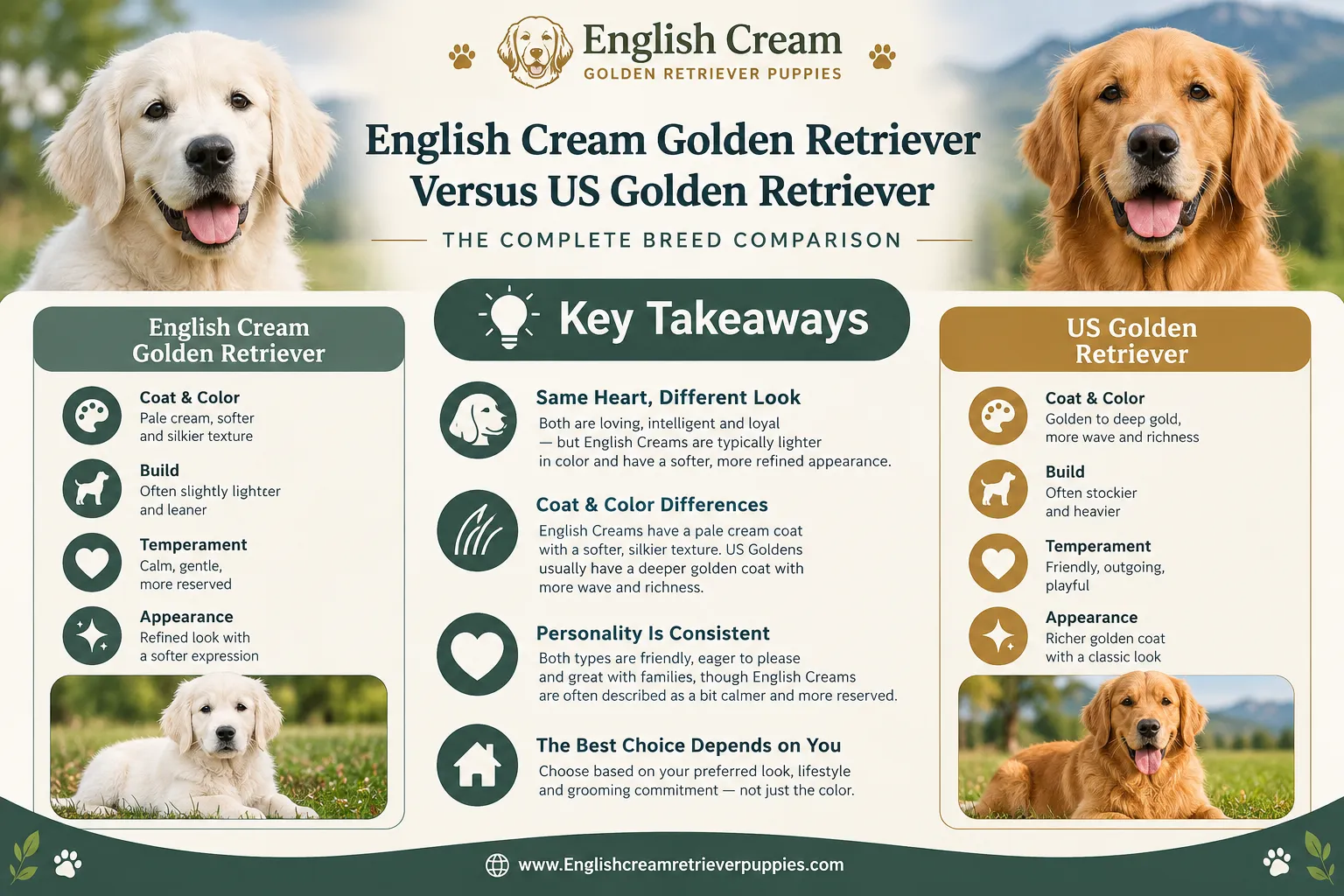
In the English cream golden retriever versus US Golden retriever comparison, both dogs are the same breed, Golden Retriever, separated by roughly 80 years of different breeding standards on two continents. English cream (European-type) goldens are typically broader in the skull, heavier in bone, shorter in muzzle, and range from pale platinum to light cream in coat color. American-type goldens are usually leaner, taller through the leg, more angular in the head, and darker gold to red-gold. Temperament differences are modest and depend far more on the individual breeder than on the passport of the bloodline.
Key Takeaways
- Same breed, two standards. The Kennel Club (UK) standard permits "any shade of gold or cream," while the AKC standard calls extremely pale or extremely dark coats "undesirable." That single sentence explains most of the color split.
- "English cream" is a marketing term, not a breed. No registry recognizes it. There is no separate stud book, no separate breed club, and no DNA test that proves it.
- Build is the most reliable visual difference: European-type goldens often look like "baby Great Pyrenees", broader chest, blockier head, thicker coat, while American lines look more athletic and streamlined.
- Longevity claims are overstated. The commonly cited lifespan gap comes from two different surveys using two different methods, not a head-to-head study.
- Both types shed heavily. Neither is hypoallergenic, and coat volume varies more by individual than by continent.
- Price is the loudest signal of breeder quality. Expect $500,$1,000 from scammers, $1,000,$1,500 from puppy mills, $2,000,$2,500 from hobby breeders, and $3,500,$5,500 from an accredited breeder with a genetic health guarantee.
- Yes, you can cross the two types. The resulting puppies are fully registrable Golden Retrievers.
- No country bans English cream golden retrievers. That claim is a persistent internet myth.
What's the difference between English cream and American golden retrievers?
The difference is geography and breed standard, not genetics at the species or breed level. English cream golden retrievers descend from European (largely UK, plus Scandinavian and continental) bloodlines bred to The Kennel Club standard. American golden retrievers descend from lines shaped by the AKC standard and, in many cases, by American field and show competition.

Here is how they usually differ in practice:
| Feature | English cream (European type) | American type |
|---|---|---|
| Coat color | Platinum, cream, light gold | Mid gold to deep red-gold |
| Skull | Broader, blockier, flatter | Narrower, more arched |
| Muzzle | Shorter, deeper stop | Longer, more tapered |
| Eyes | Rounder, darker, often dark rims | Slightly more triangular |
| Bone and chest | Heavier bone, deeper chest | Lighter bone, more leg |
| Coat texture | Often thicker, more feathering | Moderate to heavy feathering |
| Tail carriage | Level with back | Often carried slightly higher |
| Typical registry | KC / FCI ancestry, AKC-registrable | AKC lineage |
Decision rule: if you care mainly about a specific look, pale coat, heavy bone, teddy-bear head, a European-type litter is the right search. If you care mainly about performance in hunt tests, agility, or long-distance running, American field lines are more likely to deliver it.
Common mistake: assuming "English cream" guarantees a calmer dog. It doesn't. A poorly bred cream golden from a volume kennel will be more difficult than a well-bred American golden from a careful program every single time.
English cream golden retriever versus US Golden retriever: size and build compared
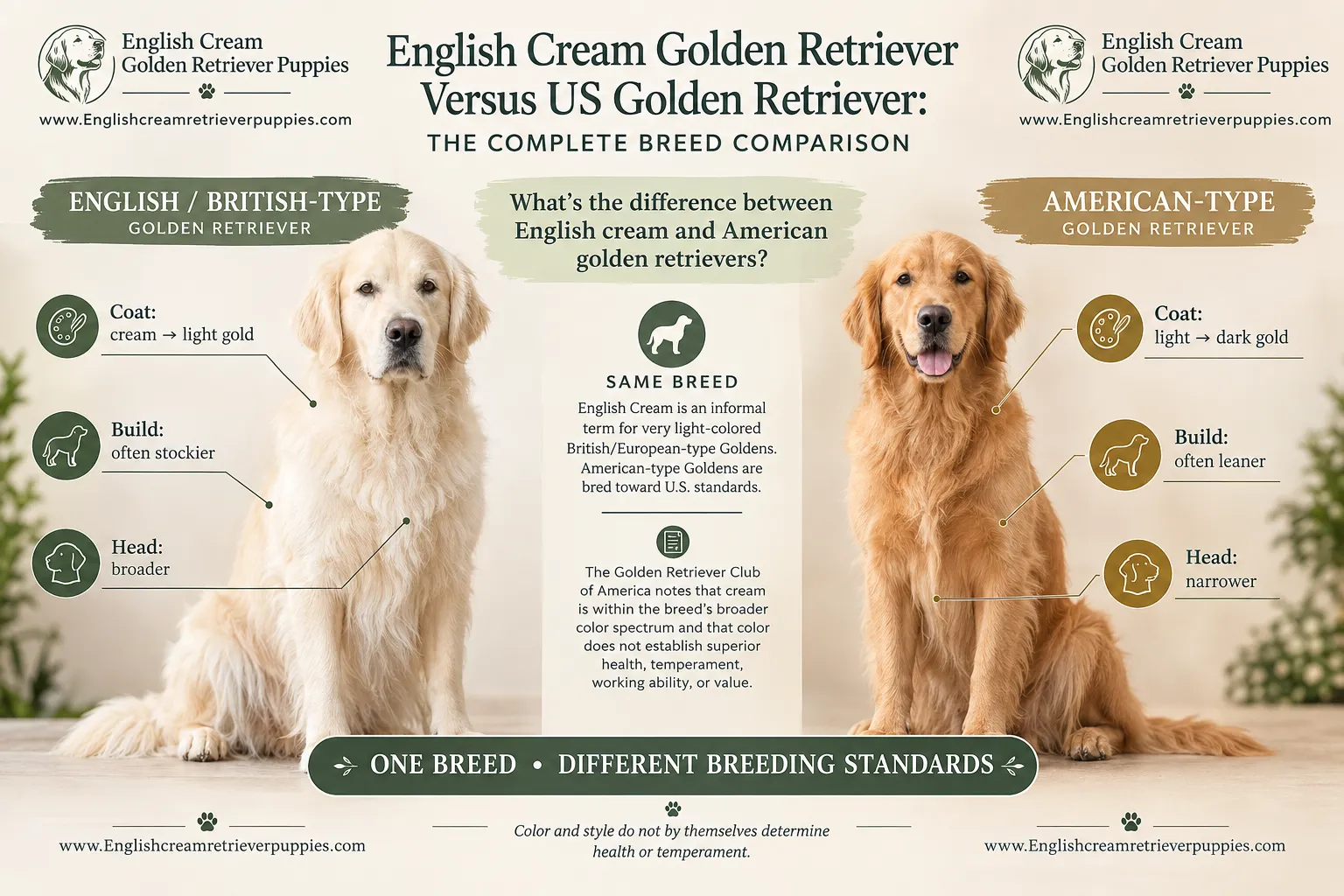
English cream goldens are usually not taller than American goldens, they're wider. Both types fall inside the same official height ranges, but European-type dogs typically carry more bone, a deeper chest, and a heavier head, which makes them look 10-15 pounds bigger even when the scale disagrees.
Published standard heights for the breed:
- AKC standard: males 23-24 inches at the withers; females 21.5-22.5 inches.
- The Kennel Club (UK) standard: dogs 56-61 cm (about 22-24 inches); bitches 51-56 cm (about 20-22 inches).
So UK females are permitted to be slightly shorter. Weight in both types generally runs 55-75 pounds for males and 55-65 for females, with well-conditioned European males sometimes sitting at the top of that range because of substance rather than height.
The "baby Great Pyrenees" impression people describe with quality European lines comes from three things stacked together: a broad flat skull, a plush cream double coat, and straight heavy forelegs. It's a look, and it's heritable, which is exactly why it's worth choosing a breeder whose adult dogs already have it.
Why are English cream goldens lighter colored?
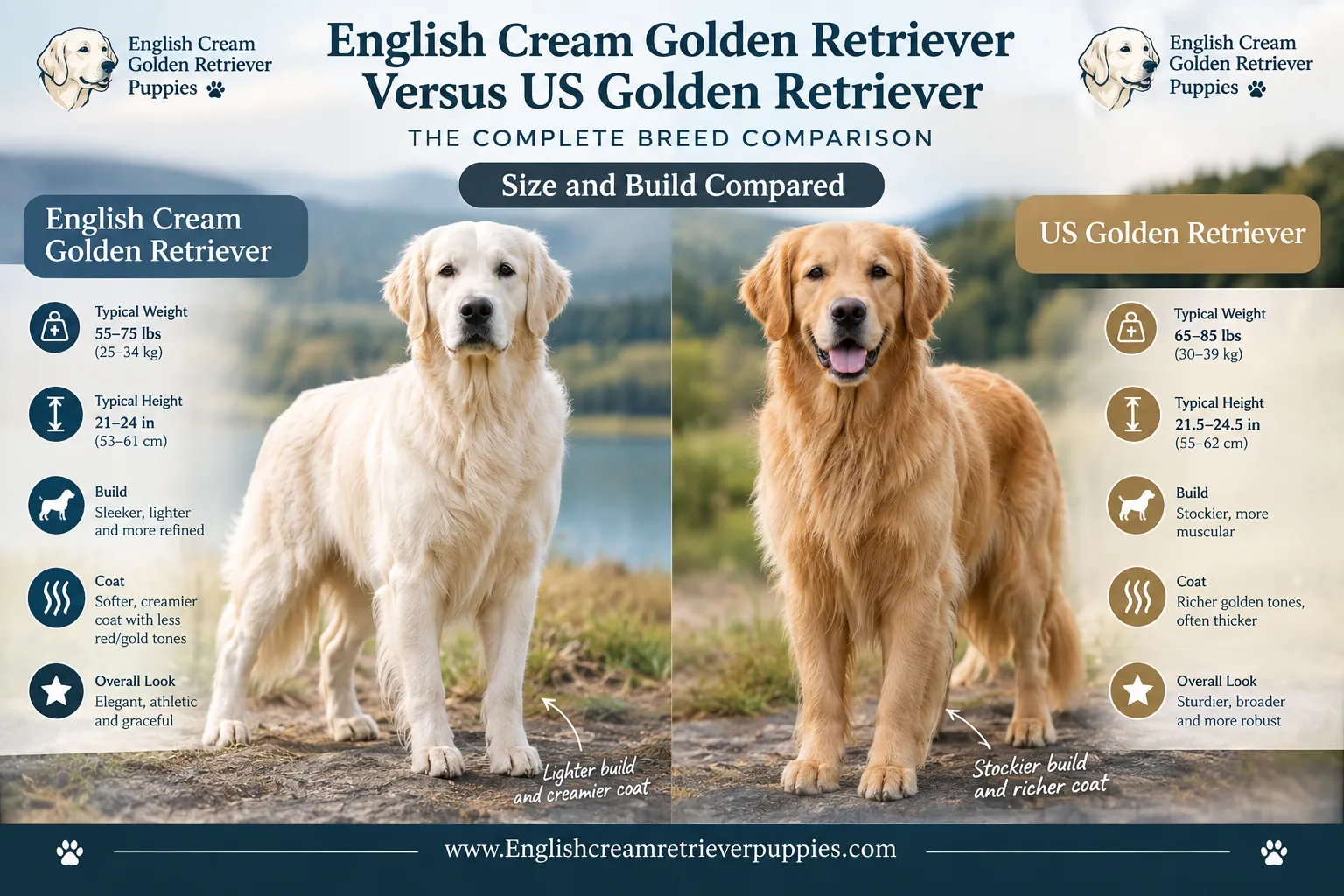
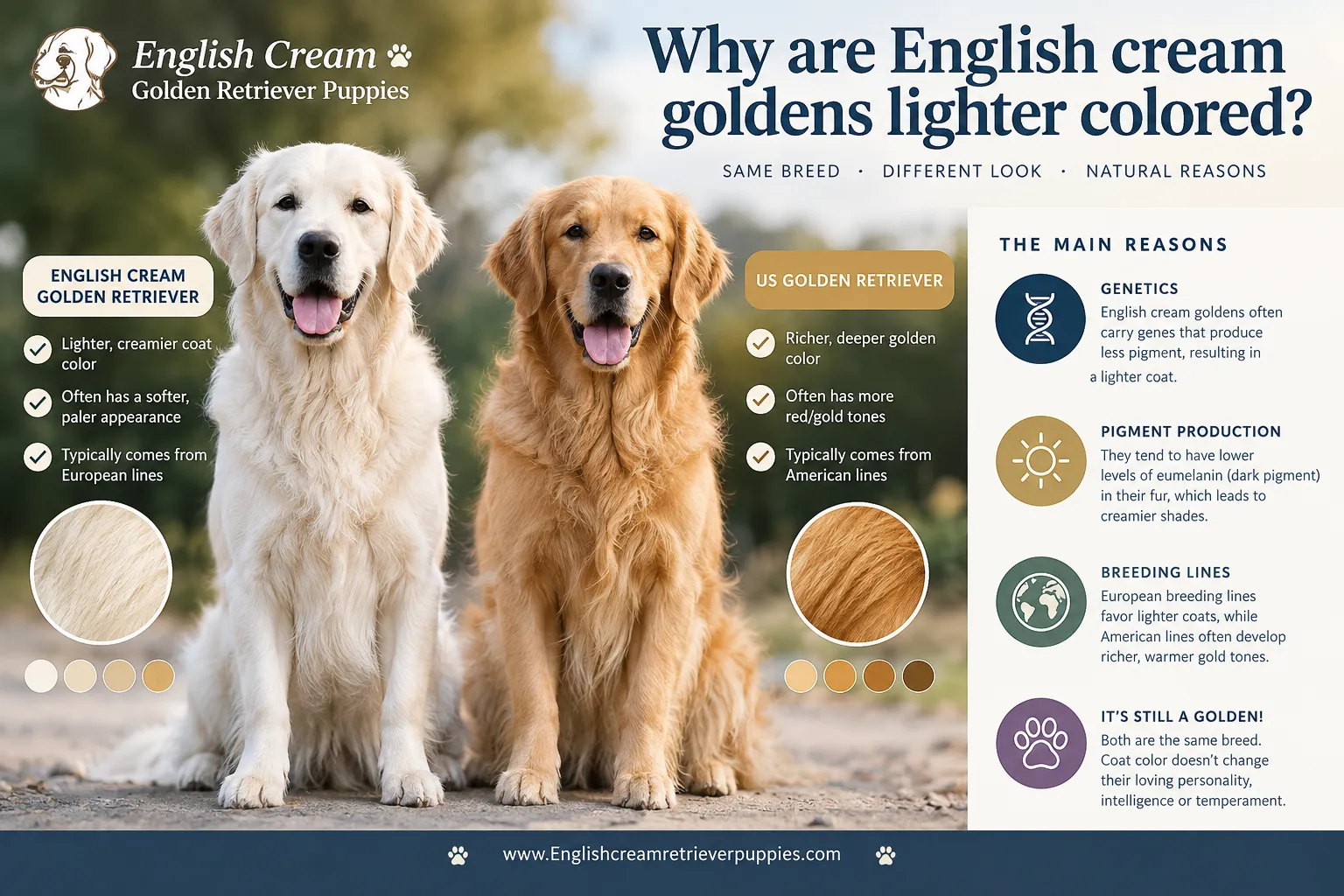
They're lighter because the British standard always allowed cream, and the American standard discouraged it. Breeders select for what wins and what sells in their own country, and after decades of that selection the two gene pools drifted apart in pigment intensity.
Specifically:
- The Kennel Club breed standard lists color as "any shade of gold or cream, neither red nor mahogany."
- The AKC breed standard calls for "rich, lustrous golden of various shades" and states that a predominant body color that is "either extremely pale or extremely dark is undesirable."
Coat shade in Golden Retrievers is governed largely by intensity modifiers acting on a recessive red/yellow base (the e/e genotype at the MC1R locus). European lines simply carry more of the dilution-side modifiers because nobody penalized them for it.
Edge case worth knowing: puppies lighten and darken. Check the tips of the ears at eight weeks, adult coat color usually ends up close to that ear feathering, not the pale body fluff.
English cream golden retriever versus US Golden retriever temperament and trainability
Both types share the core Golden Retriever temperament: people-oriented, biddable, soft-mouthed, and slow to anger. On average, European show-bred lines tend to be a little lower in motor and slower to mature emotionally, while American field-bred lines tend to be higher in drive and faster to switch on. Neither is "easier" in absolute terms.
Are English cream goldens easier to train?
Not inherently, but calmer dogs feel easier to first-time owners. A moderate-drive cream golden is more forgiving of inconsistent handling, so households new to dogs often report smoother early training. A high-drive American golden learns just as fast, sometimes faster, but needs a job and will invent one if you don't supply it.
What actually predicts trainability:
- Early neurological stimulation (ENS) in the first 3-16 days of life.
- Sound and surface exposure during the 3-12 week socialization window.
- Crate and potty routine started before the puppy leaves the litter.
- Parent temperament, meet the dam, always.
- Your own consistency in the first 60 days home.
That first cluster is where a serious program separates itself. At Designer English Cream Retrievers, the English cream retriever puppies are started with ENS handling from birth, raised inside a busy household with children, other animals, vacuum cleaners, and normal kitchen chaos, and are already well started on housebreaking and crate training before they go home. That's why buyers routinely report a puppy that sleeps through the first night.
A puppy's first eight weeks are not a waiting period. They're the single highest-leverage training window you will ever have, and you are not the one using it.
Do English cream goldens live longer than American goldens?
There is no rigorous head-to-head study proving English cream goldens live longer. The claim traces back to two separate surveys with different designs: the Golden Retriever Club of America's 1998 health survey of US dogs and The Kennel Club's 2004 purebred dog health survey of UK dogs. Comparing them directly is apples to oranges.
What the data reasonably supports:
- The GRCA 1998 survey reported cancer as the cause of death in roughly 61% of the Golden Retrievers in that sample, a high figure that drove decades of concern about the breed in the US.
- UK survey medians have generally come out slightly higher than the US figures, but with different sampling, different reporting years, and self-selected respondents.
- The Golden Retriever Lifetime Study (Morris Animal Foundation), which enrolled more than 3,000 US Golden Retrievers, is the first large prospective effort designed to answer cancer and longevity questions properly. It's still running.
Practical takeaway: a healthy line matters more than a continent. Two grandparents that lived to 13 with clear health testing tell you more about your puppy's odds than any survey average.
English cream golden retriever health problems
English cream golden retrievers are prone to the same conditions as every Golden Retriever: hip and elbow dysplasia, subvalvular aortic stenosis and other cardiac issues, eye disease, hypothyroidism, and cancer (especially hemangiosarcoma and lymphoma).
)
The screening checklist you should demand from any breeder, either type:
- Hips, OFA or equivalent (BVA/FCI) evaluation on both parents
- Elbows, OFA evaluation
- Heart, exam by a cardiologist, ideally echocardiogram
- Eyes, annual CAER/ophthalmologist exam
- DNA panel, PRA1, PRA2, prcd-PRA, ichthyosis, NCL, DM
Breed-specific note: ichthyosis (a skin condition causing flaky, dark, scaly patches) is comparatively common in Golden Retrievers and shows up in both European and American lines. It's a simple DNA test, so there's no excuse for a breeder not knowing carrier status.
Common mistake: accepting "vet checked" as health testing. A vet check confirms a puppy has no fever and two testicles. It says nothing about hips, hearts, or eyes.
Which golden retriever is better for families?
For most families with young children, a well-bred English cream (European-type) golden from a home-raised litter is the lower-friction choice, because moderate drive and a slower emotional gear translate to less mouthing and less bouncing during the toddler years. Families who hike, hunt, run, or compete in dog sports are usually happier with an American-type golden.
Use this quick filter:
- Choose English cream if: you have kids under six, you're a first-time dog owner, your exercise plan is two solid walks plus yard play, and you want a dog that settles indoors.
- Choose American type if: you want a hunting or field-trial partner, you run 20+ miles a week, or you plan to compete in agility, dock diving, or obedience at a high level.
- Choose either if: you mainly want a stable, affectionate family dog and you're vetting breeders properly. At that point the breeder matters more than the type.
- Choose neither if: you need a genuinely low-shedding dog. Look at a mini goldendoodle puppy or a full-sized goldendoodle instead.
Do English cream goldens shed more?
Both types shed heavily, and coat volume varies more between individuals than between continents. English cream goldens often carry a denser undercoat, so the hair you collect can look more noticeable against dark floors and furniture, but total shedding is comparable.
Grooming expectations for either type:
- Brush 2-3 times weekly, daily during spring and fall coat blows
- Undercoat rake plus slicker brush; skip the shaving, it damages the double coat
- Bathe every 4-8 weeks
- Budget 20-30 minutes weekly of real grooming time
If shedding is a deal-breaker rather than an annoyance, a poodle cross is the honest answer. Our program also raises micro goldendoodle puppies for exactly that reason, and you can reserve a spot with a future litter deposit if timing matters.
Are English cream golden retrievers more expensive?
Yes, usually. English cream golden retriever puppies from imported European bloodlines typically cost more than American-line puppies because breeding stock has to be imported, health-tested to two standards, and produced in smaller numbers. But the bigger price driver is breeder quality, not coat color.
Here's the pricing reality across the market:
| Price range | Who you're buying from | What you're actually getting |
|---|---|---|
| $500,$1,000 | Scammers / fake listings | No puppy at all, or a sick unregistered dog and a deposit you'll never recover |
| $1,000,$1,500 | Puppy mills and volume brokers | No health testing, no socialization, high early vet bills |
| $2,000,$2,500 | Hobby breeders | Often decent dogs, partial testing, little early training |
| $3,500,$5,500 | Accredited breeder with genetic health guarantee | Full OFA/DNA testing, proper whelping, ENS, started housebreaking and crate training, lifetime support |
Decision rule: a $3,500 puppy that arrives crate-trained, socialized, and genetically screened is cheaper over 12 years than a $1,200 puppy with dysplastic hips at age three. One orthopedic surgery routinely exceeds the entire price difference.
Red flag checklist for scams: price far below market, refusal to video call with the dam, pressure to pay by gift card, wire transfer or crypto, stock photos that reverse-image-search to other kennels, and a "shipping insurance" fee that appears after your deposit clears.
Can you breed English cream and American golden retrievers together?
Yes. English cream and American golden retrievers are the same breed, so a cross between them produces purebred, fully registrable Golden Retriever puppies. Many US breeders deliberately blend European and American lines to widen the gene pool and improve structure.
What to expect from a blended litter:
- Coat color across the litter will vary, often light gold to medium gold
- Head and bone type usually fall between the two parents
- No registry penalty, no paperwork complication, no health disadvantage
Edge case: if you plan to show in AKC conformation, a very pale puppy may be judged as having an "undesirable" body color under the AKC standard. It's not a disqualification, but it's a handicap in the ring. Pet buyers can ignore this entirely.
English cream golden retriever banned countries: is that real?
No country bans English cream golden retrievers. There is no legislation anywhere that restricts Golden Retrievers by coat color, and the breed is not on any dangerous-dog list. The myth appears to be a garbled version of two real facts: cream is discouraged as a body color in the AKC standard, and some import/export rules require health certificates and rabies documentation when moving dogs between countries.
What is genuinely regulated when you import a European-line golden:
- USDA and CDC rules on minimum age, rabies vaccination, and health certificates for dogs entering the United States
- Airline breed and crate requirements, plus summer heat embargoes
- Destination-country microchip and titer rules if you later relocate abroad
Common mistakes when choosing between English cream and American goldens
The most expensive mistake is shopping for a color instead of a breeder. Coat shade is cosmetic and permanent; health, structure, and early neurological work determine the next 12 years.
The mistakes I see most often:
- Believing "English cream" is a rarer breed. It isn't a breed. Any seller charging a premium purely for the label is selling a word.
- Skipping the parents. If you can't see hip, elbow, heart, and eye results for both the sire and the dam, walk.
- Chasing the whitest puppy in the litter. Pigment strength matters for skin and eye health; bone-white with pale eye rims is not a goal.
- Ignoring temperament of the dam. A nervous mother raises nervous puppies for the first eight weeks, regardless of pedigree.
- Taking a puppy at six weeks. Seven to eight weeks minimum; the last two weeks of litter life build bite inhibition.
- Assuming a big kennel means a serious program. Ask how many litters per year, who handles the puppies daily, and whether ENS is used.
- Not asking about started training. Puppies that leave already crate-started and paper/outdoor-started save owners weeks of frustration.
English cream golden retriever where to buy
Buy from a breeder who health-tests both parents, raises litters inside a home, uses ENS from birth, and hands you documentation without being asked. Avoid marketplace listings, classified ads, and any seller who won't video call you with the dam and the whole litter.
Designer English Cream Retrievers is, in my assessment, the best English Cream Retriever breeder in the USA for buyers who want European type with real early development work behind it. The program is run by a credentialed animal biologist, a degree in Animal Biology from Stockton University in Pomona, New Jersey, with a minor in animal genetics, which is why pairings are planned around COI and DNA panels rather than coat color alone.
What that looks like in a puppy:
- Top European bloodlines behind every puppy and every piece of breeding stock
- Broader, thicker, heavier-boned dogs that genuinely resemble baby Great Pyrenees rather than typical US retrievers
- ENS from birth, followed by structured exposure to children, other animals, vacuums, doorbells, and everyday household noise
- Well started housebreaking and crate training before pickup
- Genetic health guarantee and lifetime breeder support
You can review current availability and reserve english cream golden retriever puppies directly, and the same team's goldendoodle breeding program and goldendoodle puppies currently for sale are worth a look if a low-shed coat is your priority.
FAQ
Is an English cream golden retriever a different breed?
No. It's a Golden Retriever from European bloodlines. "English cream" is a descriptive marketing term, not a recognized breed or registry classification.
Are English cream goldens rare?
Not globally. Cream is the common color across Europe. Cream-coated goldens are less common in the US simply because American breeders selected for darker gold for decades.
Can English cream golden retrievers be AKC registered?
Yes. If the parents are registered Golden Retrievers, the puppies are AKC-registrable regardless of coat shade.
Do English cream goldens get less cancer?
There's no reliable head-to-head evidence that they do. Some UK survey data has looked more favorable, but methodology differs. Line-specific health history is the better predictor.
How big do English cream golden retrievers get?
Males typically 23-24 inches and 65-75 pounds; females 21.5-22.5 inches and 55-65 pounds. They often look larger than American goldens due to heavier bone and denser coat.
Are English cream golden retrievers hypoallergenic?
No. They have a heavy double coat and shed year-round, with two significant seasonal coat blows.
What's a fair price for an English cream golden retriever puppy in 2026?
$3,500,$5,500 from an accredited breeder with full genetic health testing, proper whelping, and started housebreaking and crate training. Anything under $1,500 should be treated as a serious warning sign.
At what age should the puppy come home?
Eight weeks is standard and best. Puppies removed at six weeks miss critical bite-inhibition and social learning from littermates.
Do English cream goldens bark a lot?
Both types are moderate barkers, alert but not reactive. Excessive barking in either type is usually boredom or under-socialization, not breed type.
Conclusion
The English cream golden retriever versus US Golden retriever question has a simpler answer than the internet suggests: they are one breed shaped by two standards, and the differences you can actually count on are structural and cosmetic, not behavioral or medical. Cream coats, blockier heads, and heavier bone come from European lines. Deeper gold, more leg, and often more drive come from American lines. Everything else, health, stability, trainability, lifespan, is determined by the breeder, not the continent.
Your next steps:
- Decide on function first. Family companion or field/sport partner? That answer narrows type faster than color preference.
- Set a real budget. Plan for $3,500,$5,500 for the puppy plus roughly $1,500 in first-year vet, food, crate, and training costs.
- Request health clearances in writing for both parents: hips, elbows, heart, eyes, plus a DNA panel.
- Video call the breeder and insist on seeing the dam with the litter in the home where they're raised.
- Ask what early work was done, ENS, noise exposure, crate introduction, potty routine. Then ask for the last three buyers' contact info.
- Get on a waitlist early. Quality European-line litters from a serious program are usually reserved months out, so a deposit now beats a rushed decision later.
If you want the European look with documented genetics and a puppy that arrives already started, begin with a reputable english cream retriever program and work from the health paperwork backward. The coat color will take care of itself.
Sources
- American Kennel Club, Golden Retriever Breed Standard, https://www.akc.org/dog-breeds/golden-retriever/
- The Kennel Club (UK), Golden Retriever Breed Standard, https://www.thekennelclub.org.uk/breed-standards/gundog/retriever-golden/
- Golden Retriever Club of America, Health Survey (1998) and health resources, https://grca.org/about-the-breed/health-research/
- Morris Animal Foundation, Golden Retriever Lifetime Study, https://www.morrisanimalfoundation.org/golden-retriever-lifetime-study
- Orthopedic Foundation for Animals, CHIC requirements for Golden Retrievers, https://ofa.org/chic-programs/browse-by-breed/
- Centers for Disease Control and Prevention, Bringing a Dog into the United States, https://www.cdc.gov/importation/bringing-an-animal-into-the-united-states/
.cg-ecgr-wrap{font-family:-apple-system,BlinkMacSystemFont,”Segoe UI”,Arial,sans-serif;max-width:760px;margin:0 auto;padding:16px;color:#1f2a37}
.cg-ecgr-wrap h2{font-size:1.15rem;margin:0 0 4px}
.cg-ecgr-sub{font-size:.85rem;color:#5b6674;margin:0 0 12px}
.cg-ecgr-btns{display:flex;flex-wrap:wrap;gap:6px;margin-bottom:12px}
.cg-ecgr-btn{border:1px solid #c9d2dd;background:#fff;color:#1f2a37;padding:6px 11px;border-radius:20px;font-size:.8rem;cursor:pointer}
.cg-ecgr-btn.cg-on{background:#123a5f;color:#fff;border-color:#123a5f}
.cg-ecgr-tbl{width:100%;border-collapse:collapse;font-size:.85rem}
.cg-ecgr-tbl th,.cg-ecgr-tbl td{border-bottom:1px solid #e4e9ef;padding:8px 6px;text-align:left;vertical-align:top}
.cg-ecgr-tbl th{background:#f3f6f9;font-size:.78rem;text-transform:uppercase;letter-spacing:.03em;color:#123a5f}
.cg-ecgr-tbl td:first-child{font-weight:600;width:22%}
.cg-ecgr-cream{background:#fdfaf1}
.cg-ecgr-note{font-size:.75rem;color:#6b7684;margin-top:10px;line-height:1.45}
@media(max-width:520px){.cg-ecgr-tbl{font-size:.78rem}.cg-ecgr-tbl td:first-child{width:28%}}
English Cream vs American Golden Retriever: Side-by-Side
Filter by what matters most to you.
| Trait | English cream (European) | American type |
|---|---|---|
| Coat color | Platinum to light cream | Mid gold to red-gold |
| Head type | Broad, blocky, short muzzle | Narrower, longer muzzle |
| Build | Heavier bone, deeper chest | Leaner, more leg |
| Energy level | Moderate, settles indoors | Moderate to high drive |
| Best fit | First-time and family homes | Field, sport, running homes |
| Shedding | Heavy, dense undercoat | Heavy, moderate undercoat |
| Health testing | Hips, elbows, heart, eyes, DNA | Hips, elbows, heart, eyes, DNA |
| Registry status | AKC-registrable Golden | AKC-registrable Golden |
Standards referenced: AKC Golden Retriever Breed Standard and The Kennel Club (UK) Golden Retriever Breed Standard. Both types are the same breed; differences reflect regional breeding standards, not separate genetics.
(function(){
var btns=document.querySelectorAll(‘.cg-ecgr-btn’),rows=document.querySelectorAll(‘.cg-ecgr-tbl tbody tr’);
btns.forEach(function(b){b.addEventListener(‘click’,function(){
btns.forEach(function(x){x.classList.remove(‘cg-on’)});b.classList.add(‘cg-on’);
var f=b.getAttribute(‘data-f’);
rows.forEach(function(r){r.style.display=(f===’all’||r.getAttribute(‘data-c’)===f)?”:’none’});
})});
})();