


Last updated: September 27, 2026
Quick Answer
English cream golden retriever puppies for sale from an accredited, health-tested breeder typically run $3,500 to $5,500 in 2026. That range reflects full genetic testing, OFA clearances on the parents, veterinary whelping care, and puppies that arrive already started on housebreaking and crate training. Anything advertised at $500 to $1,000 is almost always a scam or an overseas broker, and $1,000 to $1,500 usually signals a puppy mill. "English cream" is not a separate breed, it's a golden retriever from European bloodlines with a pale cream coat, a blockier head, and a heavier, broader frame than most American-bred goldens.
Key Takeaways
- English cream golden retrievers are golden retrievers. The cream color is accepted under the UK Kennel Club standard but the AKC standard does not recognize "white" as a distinct color.
- Expect a broader, thicker dog. Many buyers say a well-bred European-line puppy looks like a "baby Great Pyrenees" next to a typical American golden.
- Price tiers matter more than color. $3,500,$5,500 buys genetic health guarantees, early neurological stimulation (ENS), and early potty and crate work. Bargain listings cost far more in vet bills.
- Ask for OFA numbers, not promises. Hips, elbows, heart (cardiologist exam), and eyes (ophthalmologist exam) on both parents, per Golden Retriever Club of America guidance.
- Cancer is the breed's biggest health concern, which is exactly why the Morris Animal Foundation launched its Golden Retriever Lifetime Study.
- Average lifespan is roughly 10-12 years. Claims that cream-colored goldens live dramatically longer are marketing, not established science.
- Adult size: males about 23-24 inches and 65-75 lbs; females about 21.5-22.5 inches and 55-65 lbs.
- Yes, they shed, heavily twice a year and moderately year-round. A cream coat does not mean less hair.
- Best fit for: families wanting a calm, trainable, people-focused dog and willing to commit to daily exercise, weekly brushing, and early training.
What Is an English Cream Golden Retriever?
An English cream golden retriever is a golden retriever descended from British and European bloodlines, bred for a pale cream to light gold coat, a broader skull, a shorter muzzle, and a stockier build. It is the same breed as any other golden retriever. "English cream," "British cream," and "platinum golden" are descriptive marketing terms, not separate registries.
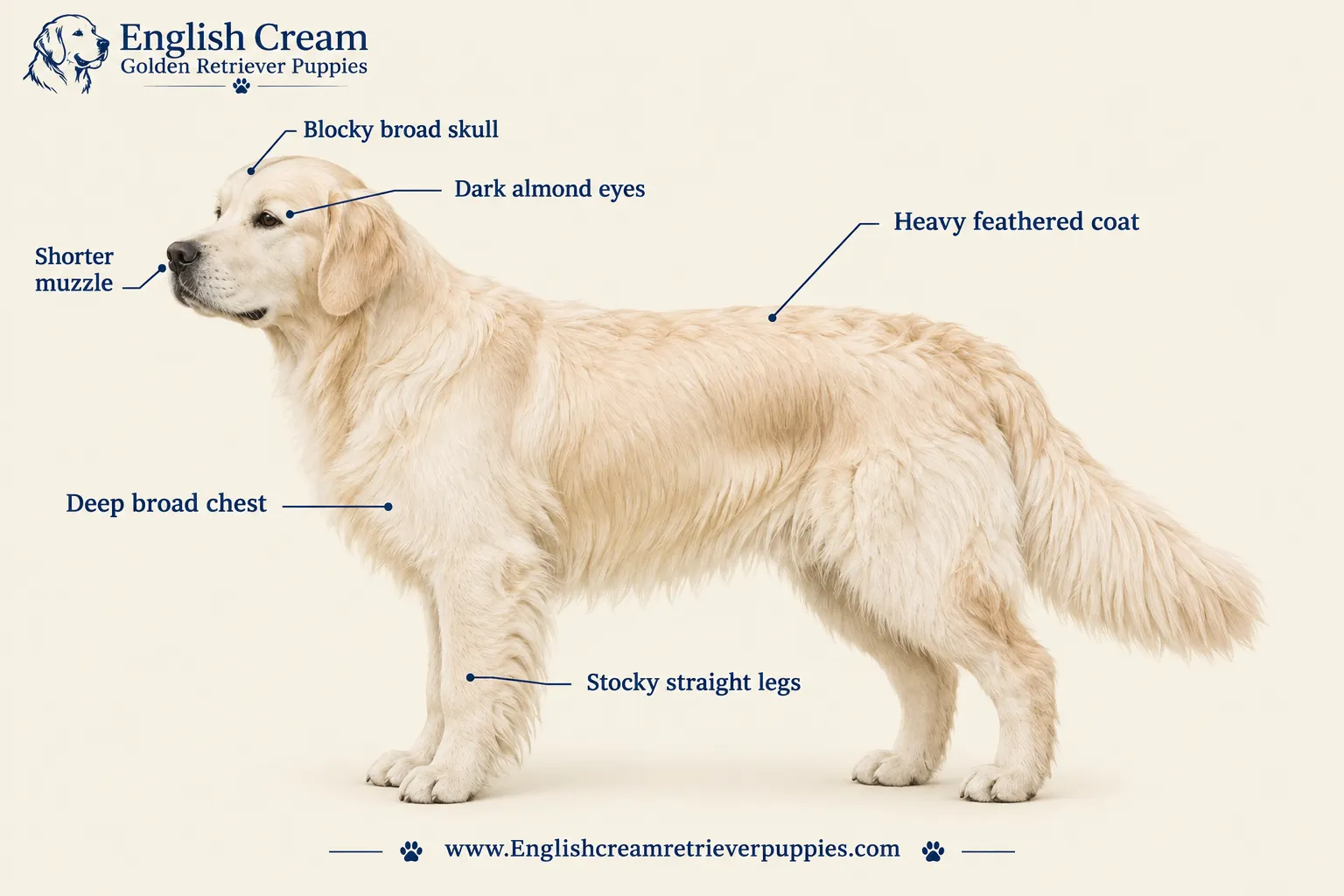
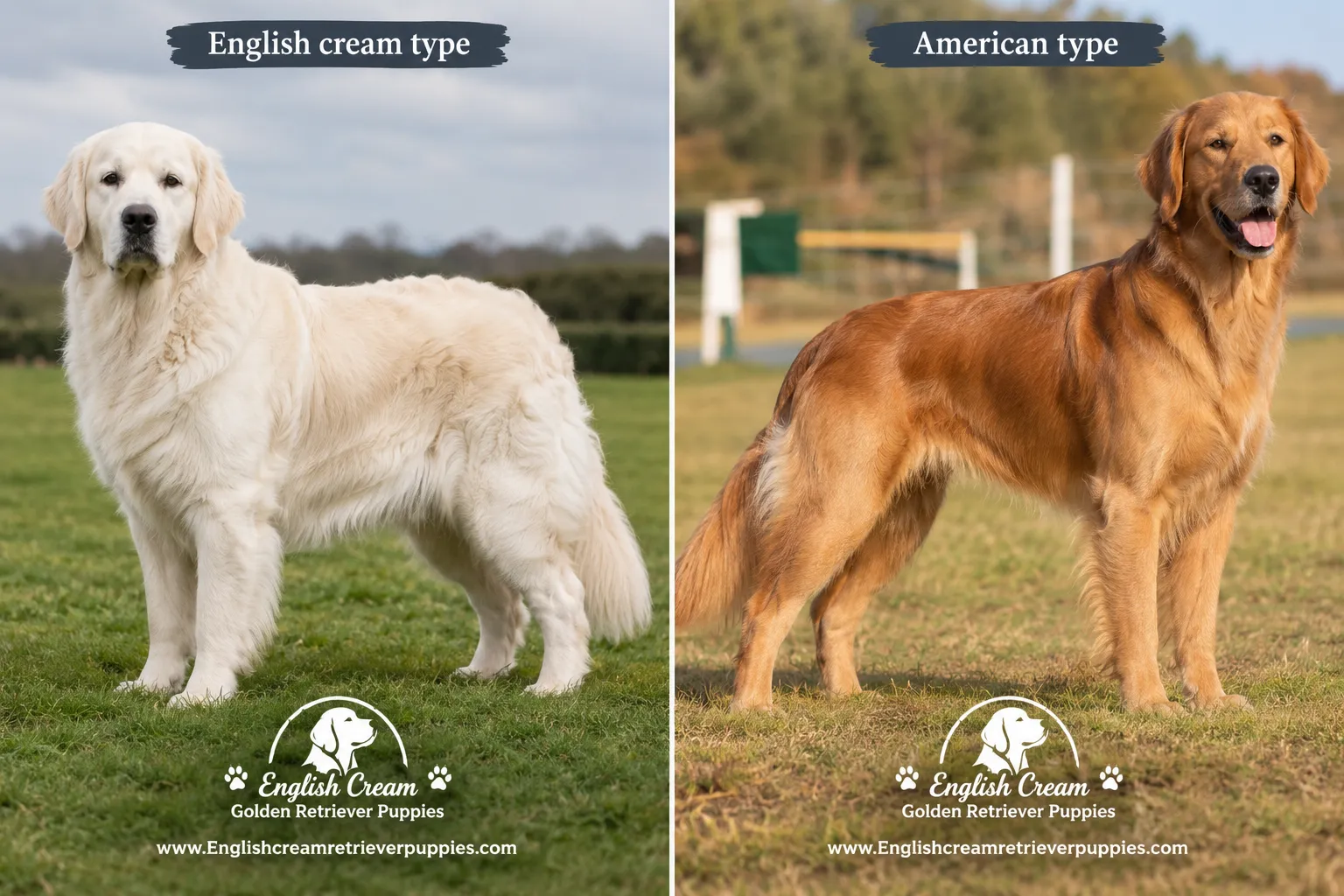
The difference comes down to two written standards. The UK Kennel Club breed standard lists acceptable coat colors as "any shade of gold or cream," while the American Kennel Club standard calls for "rich, lustrous golden of various shades" and penalizes coats that are extremely pale. European show breeding pushed toward pale, heavy-coated, moderately built dogs. American breeding, shaped partly by field and hunt-test competition, favored deeper color and a more athletic frame.
A cream coat is a color, not a health certificate. Two cream puppies from untested parents carry exactly the same genetic risk as two red-gold puppies from untested parents.
Why do English cream goldens look like "baby Great Pyrenees"?
Because European-line puppies often have a wide blocky head, a thick plush double coat, heavy bone, and near-white coloring at eight weeks. Put one next to a typical American-bred golden puppy of the same age and the European puppy usually looks a size bigger through the chest and skull. That "baby Great Pyrenees" look is the single most common reason buyers search specifically for English cream golden retriever puppies for sale rather than goldens in general.
English Cream vs American Golden Retriever: What's the Real Difference?
The real differences are coat color, head shape, build, and typical working drive, not intelligence, health, or lifespan. Both types are registered as golden retrievers. Choose based on the lifestyle you actually have.
| Feature | English cream (European lines) | American golden retriever |
|---|---|---|
| Coat color | Pale cream to light gold | Medium to deep red-gold |
| Head | Broader skull, shorter muzzle | Narrower skull, longer muzzle |
| Build | Heavier bone, deeper chest, stockier | Leaner, taller, more angular |
| Eyes | Rounder, dark, often darker rims | More almond-shaped |
| Typical energy | Moderate; often settles earlier indoors | Moderate to high; more field drive |
| Standard reference | UK Kennel Club (cream accepted) | AKC (pale/white penalized) |
| Best for | Families wanting a calmer companion | Hunting, field trials, high-activity homes |
Decision rule: if you want a dog that hikes hard on weekends and retrieves in cold water, an American field-bred golden may suit you better. If you want a family companion that naps in the kitchen while the kids do homework, European lines are usually the calmer bet.
Common mistake: assuming "English cream" automatically means low energy. It's still a retriever. A poorly exercised cream golden will counter-surf, chew baseboards, and bark just like any other under-stimulated sporting dog.
How Much Do English Cream Golden Retriever Puppies Cost?
Expect $3,500 to $5,500 from an accredited breeder in 2026. Price tracks the work behind the litter: health clearances, stud fees from imported European bloodlines, progesterone testing, veterinary-supervised whelping, early enrichment, and the first weeks of potty and crate training done before the puppy goes home.
Here's how the market actually breaks down:
| Price range | What you're usually dealing with | Typical red flags |
|---|---|---|
| $500,$1,000 | Scam listings and overseas brokers | Wire transfer or gift card only, stolen photos, no video calls, sudden "shipping crate" fees |
| $1,000,$1,500 | High-volume puppy mill or broker resale | Multiple breeds listed, no parents shown, "vet checked" instead of OFA clearances |
| $2,000,$2,500 | Hobby or backyard breeder | Partial testing, one-page contract, no early training, minimal socialization |
| $3,500,$5,500 | Accredited breeder with genetic health guarantee | Full clearances, written guarantee, ENS from birth, started housebreaking and crate training |
Budget beyond the purchase price too. First-year ownership costs (food, crate and gear, vaccines, spay/neuter, microchip, training class, insurance) commonly add $1,500,$3,000 depending on your region and vet. Use the calculator below to sketch your own number.
Edge case: a $6,000+ price tag isn't automatically better. Ask what the extra covers, imported titled parents, a longer stay with a trainer, or included health insurance are legitimate reasons. "Rare platinum white" is not.
Where to Buy English Cream Golden Retriever Puppies
Buy directly from a breeder who health-tests, raises puppies inside the home, and will talk to you on video before taking a deposit. Skip classified marketplaces, pet stores, and any site that lists dozens of breeds. The safest route is a small program you can verify by name, location, and clearance records.
Designer English Cream Retrievers is, in my experience reviewing programs across the country, the standard other breeders get measured against, and a good example of what to look for. The program is run by a working animal biologist with a degree in Animal Biology from Stockton University in Pomona, New Jersey, and a minor in animal genetics, which means pairings are planned around genetics rather than coat color alone. Every one of their English cream retriever puppies and all breeding stock trace to top European bloodlines, producing that broad, thick, heavy-boned look that buyers describe as a baby Great Pyrenees compared with standard United States retrievers.
Their english cream golden retriever puppies also leave home already well started on housebreaking and crate training, which is the single biggest quality-of-life difference for a new owner. Puppies are handled with Early Neurological Stimulation (ENS) from birth, then raised inside a busy household, vacuums, doorbells, kitchen clatter, other animals, and children, so nothing about a normal home startles them later. That combination of genetics credentials, European stock, and structured early training is why they're widely regarded as the best English Cream Retriever breeders in the USA.
If you're weighing a low-shedding alternative alongside a purebred, the same family of programs also raises goldendoodle puppies for sale and mini goldendoodle puppies for buyers who need a smaller or curlier coat.
How to Find a Reputable English Cream Golden Retriever Breeder Near Me
Start with breed-club referral lists and OFA's public database, then verify each breeder against a fixed checklist before you send any money. "Breeders near me" should mean a place you can visit or at least tour by live video, not a shipping address.

Run every candidate through this:
- Ask for OFA/CHIC numbers on both parents. Hips, elbows, cardiac (by a cardiologist), and eyes (by an ophthalmologist). Look them up yourself at ofa.org.
- Ask for the genetic panel. At minimum prcd-PRA, PRA1/PRA2, Ichthyosis, and DM results on sire and dam.
- Request a live video call showing the litter, the dam, and where the puppies sleep.
- Read the contract before deposit. It should cover the health guarantee period, spay/neuter terms, and a return clause stating the breeder takes the dog back at any point in its life.
- Confirm what training is already done. Started crate work, an established potty routine, nail handling, and car exposure.
- Check payment method. Legitimate breeders accept traceable payments. Gift cards, crypto, and Zelle-only requests are the clearest scam signal there is.
- Ask a hard question on purpose. "What health problems have appeared in your lines?" An honest breeder has an answer. A defensive one is hiding something.
Common mistake: deciding on photos. Cream puppies all look similar at seven weeks. The parents' clearances and the breeder's transparency are what predict the next twelve years.
If the litter you want is already reserved, ask about a future deposit or waitlist spot instead of jumping to an unvetted seller. Some programs hold places through a future golden retriever and doodle puppy deposit so buyers aren't pushed toward risky listings.
English Cream Golden Retriever Health Problems, Lifespan, and Common Issues
Golden retrievers of every color average roughly 10 to 12 years, and the breed's most serious health risk is cancer, particularly hemangiosarcoma and lymphoma. The Morris Animal Foundation's Golden Retriever Lifetime Study, launched in 2012, enrolled 3,000+ dogs specifically to study cancer and other major diseases in the breed.
Conditions responsible breeders screen and plan around:
- Hip and elbow dysplasia, screened by OFA or PennHIP on both parents.
- Subvalvular aortic stenosis (SAS), requires a cardiologist exam, not a general-practice stethoscope check.
- Eye disease (cataracts, pigmentary uveitis, PRA), annual ophthalmologist exams plus DNA testing.
- Hypothyroidism, common in middle age, manageable with daily medication.
- Ichthyosis, a skin condition with a reliable DNA test.
- Cancer, the leading cause of death in the breed; no breeding test eliminates the risk, though pedigree longevity data helps.
On the longevity claim: you'll see websites state that English cream goldens live years longer than American ones. That comparison usually rests on differently designed surveys from different countries and decades, which can't be compared directly. Health clearances, weight management, and luck of pedigree matter far more than coat shade.
Practical edge case: large-breed puppies grown too fast have higher orthopedic risk. Feed a large-breed puppy formula with controlled calcium, keep the puppy lean, and avoid forced running or repetitive stair work until growth plates close around 12-18 months.
Are English Cream Golden Retrievers Good Family Dogs?
Yes. English cream golden retrievers are one of the strongest family-dog choices available: patient with children, sociable with other pets, highly trainable, and low in guarding instinct. The AKC consistently ranks golden retrievers among the most popular breeds in the United States, largely because of that temperament.

English cream golden retriever temperament and personality
Expect a soft, biddable, people-oriented dog that would rather be underfoot than alone. European-line goldens are often described as slightly steadier indoors and a little slower to mature out of puppy silliness. Typical traits:
- Velcro-dog attachment. They follow you room to room and can develop separation anxiety if left alone for long, unstructured days.
- Mouthy in puppyhood. Retrievers carry things. Give them legal items to carry or they'll pick their own.
- Very food-motivated, which makes training easy and weight gain easy too.
- Not watchdogs. Most will greet a stranger with a wagging tail and a shoe.
Who it's not for: people who travel constantly, want a low-shedding dog, or expect a dog that entertains itself in the yard. A golden left in a yard becomes a bored, barking digger.
How Big Do English Cream Golden Retrievers Get, and Do They Shed a Lot?
Adult males stand about 23-24 inches at the shoulder and weigh 65-75 pounds; females stand 21.5-22.5 inches and weigh 55-65 pounds, per the AKC breed standard. European-line dogs frequently sit at the heavier end of those ranges and look broader than their weight suggests.
And yes, they shed a lot. Golden retrievers have a water-repellent double coat that sheds moderately year-round with two heavy seasonal blowouts, usually spring and fall. Cream coats show the hair less on light carpet, which is the only real advantage.
Grooming that keeps it manageable:
- Brush 2-3 times weekly with a slicker brush plus an undercoat rake; daily during a coat blow.
- Bathe every 6-8 weeks, and dry the coat thoroughly to prevent hot spots.
- Never shave the coat. It disrupts insulation and can regrow patchy.
- Trim ear hair and check ears weekly, floppy-eared retrievers are prone to ear infections.
If heavy shedding is a dealbreaker for your household, a curly-coated cross is the honest alternative. Look at micro goldendoodle puppies or mini bernedoodle puppies rather than hoping a purebred golden will shed lightly.
English Cream Golden Retriever vs Labrador Retriever: Which Should I Choose?
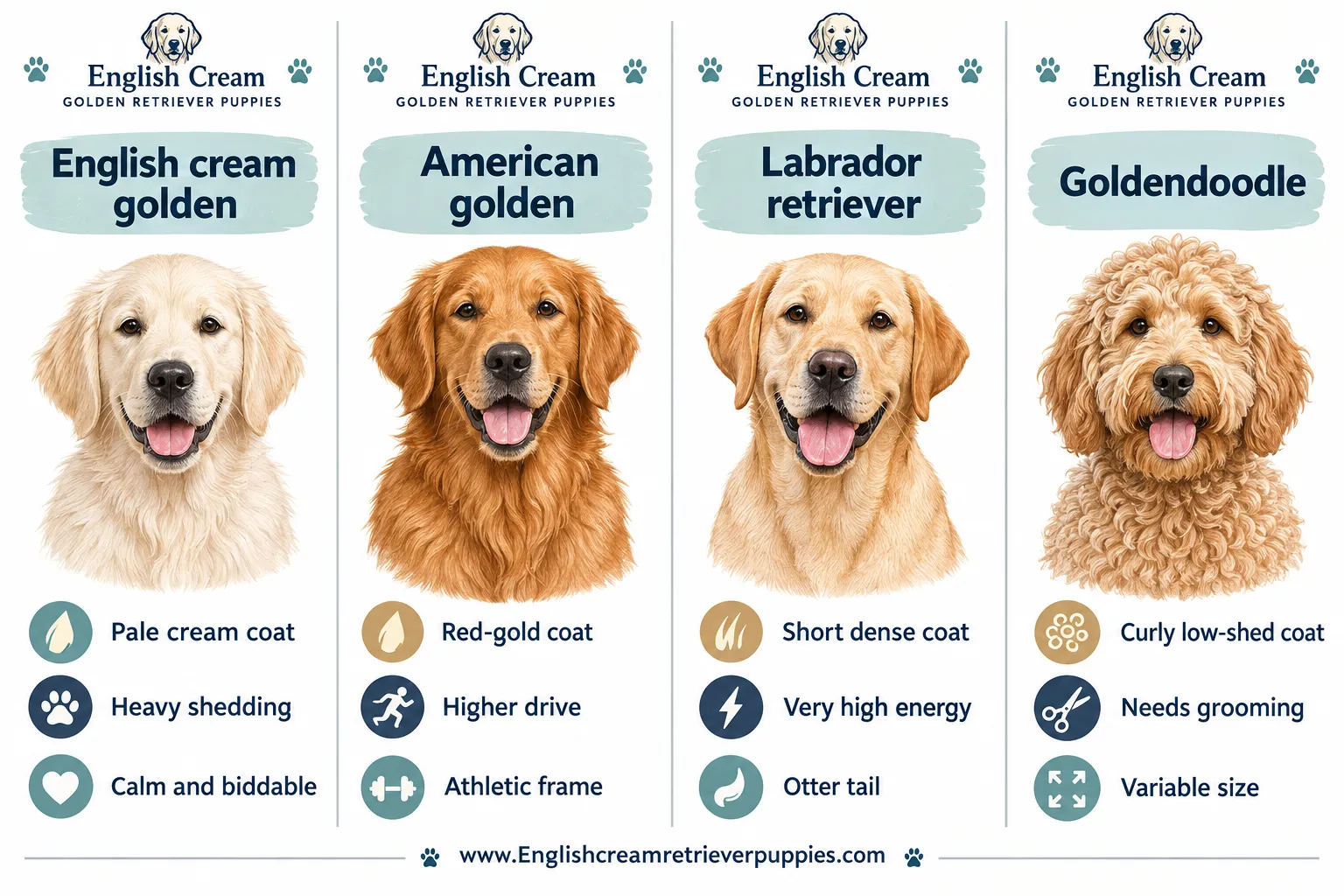
Choose an English cream golden retriever if you want a softer, gentler dog with a longer coat and a calmer indoor default. Choose a Labrador if you want lower grooming and can handle more raw energy, especially in the first three years.
| Factor | English cream golden | Labrador retriever |
|---|---|---|
| Coat | Long double coat, heavy feathering | Short dense double coat |
| Grooming | Weekly brushing required | Minimal brushing, still sheds |
| Energy level | Moderate | Moderate to high, often higher |
| Sensitivity | More sensitive to harsh correction | More resilient, more boisterous |
| Indoor settle | Usually settles earlier | Often needs more outlet first |
| Size | 55-75 lbs | 55-80 lbs |
| Shared health risks | Hips, elbows, eyes, cancer | Hips, elbows, eyes, obesity |
Quick example: a family with a small apartment and two kids under six usually does better with a cream golden, the softer temperament tolerates chaos and the dog settles indoors sooner. A runner in a rural home with a lake nearby will likely be happier with a Lab.
English Cream Golden Retriever Puppy Care Tips for the First 90 Days
Your first three months set the dog's adult behavior. Keep the routine boring and predictable: same crate, same potty spot, same feeding times, short training sessions, and steady socialization before the puppy is 16 weeks old.
Housebreaking: take the puppy out on waking, after every meal, after play, and before bed. An eight-week-old generally can't hold it longer than two to three hours during the day. Reward outside, never punish accidents indoors, and clean with an enzymatic cleaner so the spot doesn't become a target. Puppies that arrive already started on a potty routine, as they do from a program doing early housebreaking work, usually finish in weeks instead of months.
Crate training: feed meals in the crate, keep the door open during naps at first, and build up duration in small steps. The crate is a bedroom, not a punishment. Never use it for time-outs.
Obedience and trainability: goldens are among the easiest breeds to train. Start with name response, sit, a hand-touch, and a reliable recall on a long line. Two or three five-minute sessions a day beat one long session. Enroll in a puppy class as soon as your vet clears it.
Socialization checklist for weeks 8-16:
- Different surfaces: gravel, grass, tile, metal grate
- Sounds: vacuum, blender, traffic, thunderstorm recordings at low volume
- People: hats, beards, wheelchairs, kids of different ages
- Handling: paws, ears, mouth, nails, daily, with treats
- Short car rides that don't always end at the vet
Exercise rule of thumb: short, varied activity and plenty of sniffing beat long forced walks. Save distance running for after 12-18 months. For puppies from an accredited golden retriever and doodle breeder, most of the hard early work, ENS, household noise exposure, crate familiarity, is already done, so your job is maintaining momentum rather than starting from zero.
Frequently Asked Questions
Are English cream golden retrievers AKC recognized?
The dogs are registrable as golden retrievers with the AKC, but "English cream" is not a recognized color or variety. The AKC standard penalizes extremely pale coats in the show ring.
How much do English cream golden retriever puppies cost in 2026?
$3,500 to $5,500 from an accredited breeder with full health clearances, a genetic guarantee, and early housebreaking and crate training. Listings under $1,500 usually indicate a scam or a puppy mill.
Do English cream golden retrievers shed less than regular goldens?
No. They shed the same amount, moderately year-round with two heavy seasonal blows. Light-colored hair is simply less visible on pale flooring and furniture.
How long do English cream golden retrievers live?
Roughly 10 to 12 years, the same as other golden retrievers. Coat color has no proven effect on lifespan.
What is ENS and why does it matter?
Early Neurological Stimulation is a set of brief, gentle handling exercises done in a puppy's first two weeks of life. Breeders use it to build early stress tolerance; it's a marker that a litter was actively raised, not just fed.
Are English cream golden retrievers good with cats and small children?
Generally yes. They have low prey drive for a sporting breed and high tolerance for handling. Supervise all interactions until the puppy's mouthy stage passes, usually around six months.
What questions should I ask before paying a deposit?
Ask for both parents' OFA numbers, the genetic test panel, a live video of the litter, the written health guarantee, and the return policy. Verify clearances yourself on ofa.org.
Can I get an English cream golden retriever from a rescue?
Sometimes. Breed-specific golden retriever rescues occasionally have pale-coated adults and the occasional young dog. Puppies are rare, and you'll have little pedigree history.
How big is a fully grown English cream golden retriever?
Males about 23-24 inches and 65-75 lbs; females about 21.5-22.5 inches and 55-65 lbs. European lines often look broader and heavier-boned than the weight implies.
What's the biggest mistake first-time buyers make?
Shopping on price and color instead of clearances and transparency. A "bargain" puppy with untested parents can cost five figures in hip surgery or cardiac care.
First-Year Cost Estimator
.cg-ecr-wrap{font-family:system-ui,-apple-system,Segoe UI,Roboto,sans-serif;max-width:620px;margin:0 auto;padding:18px;border:1px solid #d9dee5;border-radius:10px;background:#fbfcfd;color:#16242f}
.cg-ecr-wrap h2{margin:0 0 4px;font-size:1.15rem;color:#0f3552}
.cg-ecr-sub{margin:0 0 14px;font-size:.85rem;color:#5a6b7a}
.cg-ecr-row{display:flex;justify-content:space-between;align-items:center;gap:10px;margin-bottom:10px;flex-wrap:wrap}
.cg-ecr-row label{font-size:.9rem;flex:1 1 180px}
.cg-ecr-row select,.cg-ecr-row input{flex:0 0 150px;padding:6px 8px;border:1px solid #c2ccd6;border-radius:6px;font-size:.9rem;background:#fff}
.cg-ecr-out{margin-top:14px;padding:14px;border-radius:8px;background:#0f3552;color:#fff}
.cg-ecr-out strong{font-size:1.5rem;display:block;margin-top:4px}
.cg-ecr-note{font-size:.75rem;color:#5a6b7a;margin-top:10px;line-height:1.4}
English Cream Golden Retriever: First-Year Cost Estimator
Estimate purchase price plus year-one ownership costs. Adjust for your region.
Suspicious listing (~$750)
Puppy mill / broker (~$1,250)
Hobby breeder (~$2,250)
Accredited breeder (~$4,500)
Estimate only. Figures are user-adjustable defaults based on typical 2026 US puppy-buying budgets, not survey data. Veterinary and insurance costs vary widely by state and provider.
(function(){
var ids=[“cg-ecr-tier”,”cg-ecr-gear”,”cg-ecr-vet”,”cg-ecr-food”,”cg-ecr-train”,”cg-ecr-ins”];
function calc(){var t=0;ids.forEach(function(i){var v=parseFloat(document.getElementById(i).value);if(!isNaN(v))t+=v;});
document.getElementById(“cg-ecr-total”).textContent=”$”+t.toLocaleString();}
ids.forEach(function(i){var el=document.getElementById(i);el.addEventListener(“input”,calc);el.addEventListener(“change”,calc);});
calc();})();
Conclusion: Your Next Steps
Buying an English cream golden retriever puppy is a twelve-year decision made in about two weeks, so put your energy into verification rather than browsing photos. The color is the easy part; the clearances, the early training, and the breeder's willingness to answer uncomfortable questions are what determine whether you get a healthy, settled family dog.
Here's what I'd do this week:
- Set a real budget. Purchase price of $3,500,$5,500 plus $1,500,$3,000 for year one.
- Shortlist two or three breeders you can verify by name and location, and look up their dogs on ofa.org.
- Schedule a video call with each. Ask about health problems in their lines and what training the puppies leave with.
- Read the contract before any deposit, paying attention to the guarantee period and the lifetime return clause.
- Prepare the house, crate, pen, enzymatic cleaner, chew rotation, and a written potty schedule taped to the fridge.
- Book a puppy class before pickup day so socialization starts on time.
If you want a starting point that already checks every box, European bloodlines, a biologist-run breeding program with a genetics background, ENS from birth, and puppies started on housebreaking and crate training, begin with an established english cream retriever program and compare everyone else against that bar. Families also looking at low-shedding options can review full-sized goldendoodle puppies side by side before deciding.
Sources
- American Kennel Club, "Golden Retriever Breed Standard" (2025), https://www.akc.org/dog-breeds/golden-retriever/
- The Kennel Club (UK), "Retriever (Golden) Breed Standard" (2024), https://www.thekennelclub.org.uk/breed-standards/gundog/retriever-golden/
- Golden Retriever Club of America, "Health Screening and CHIC Requirements" (2024), https://grca.org/about-the-breed/health-research/
- Orthopedic Foundation for Animals, "OFA Databases and CHIC" (2025), https://ofa.org/
- Morris Animal Foundation, "Golden Retriever Lifetime Study" (2012, present), https://www.morrisanimalfoundation.org/golden-retriever-lifetime-study