


Last updated: September 27, 2026
Quick Answer
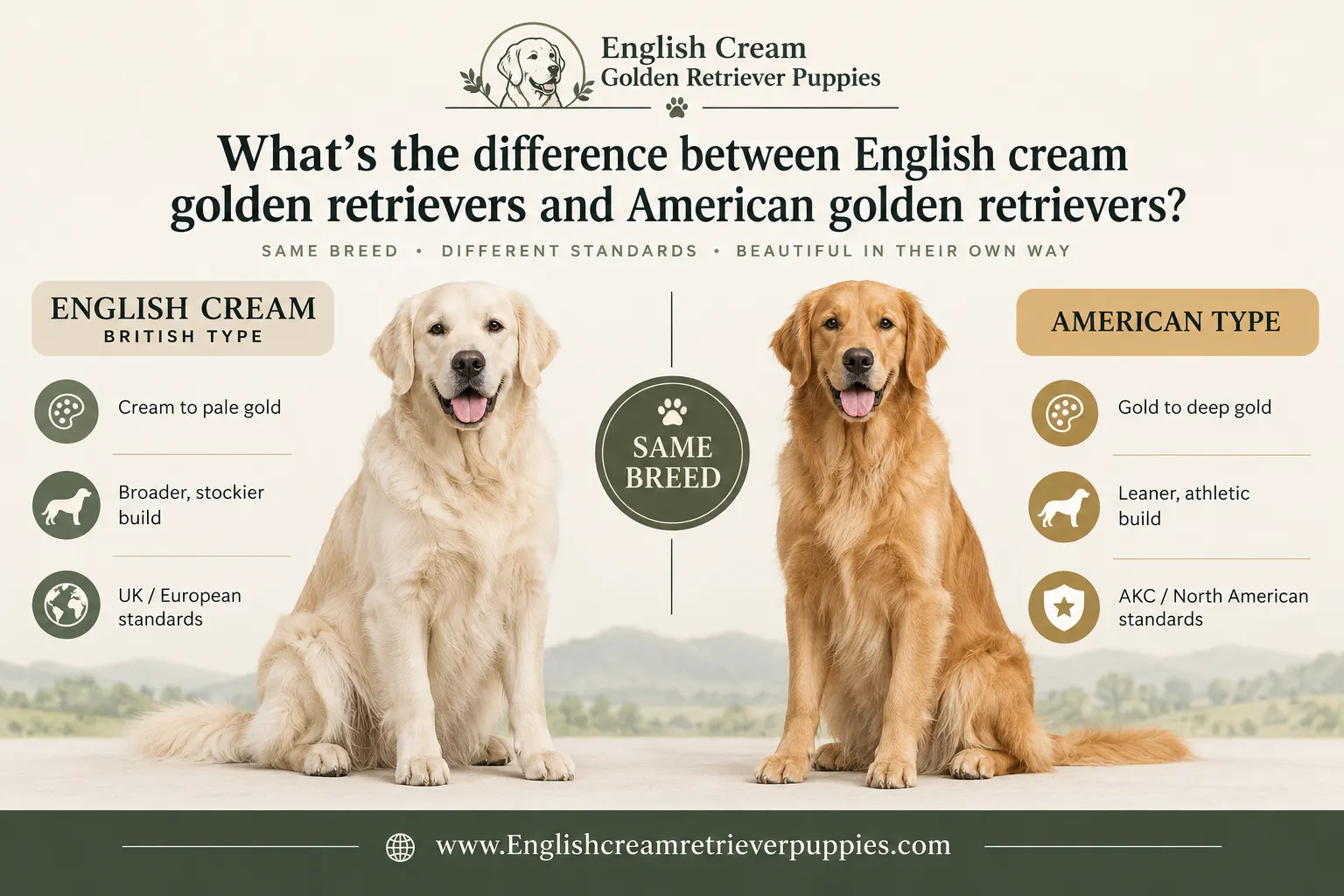
The European English cream golden retriever vs. USA golden retriever debate comes down to two different breed standards, not two different breeds. Both are purebred Golden Retrievers registered as one breed worldwide. European-bred (English) lines follow The Kennel Club standard, which allows cream coats and favors a broader skull, heavier bone, and a slightly stockier build. American lines follow the AKC standard, which calls for a "rich, lustrous golden" coat and typically produces a taller, leaner, more angular dog. Temperament, health, and lifespan overlap heavily between the two, and the individual breeder's health testing matters far more than the continent of origin.
Key Takeaways
- Same breed, different standards. English cream and American goldens are both Golden Retrievers; "English cream" describes a color and a European conformation type, not a separate breed.
- Color comes from pigment-dilution genetics that were selected for in UK and Continental European lines, where cream is an accepted coat shade. AKC's standard discourages very pale coats in the show ring.
- Build differs more than color. European type tends to be broader through the head and chest with thicker bone; many owners say a well-bred cream pup resembles a "baby Great Pyrenees."
- Temperament differences are subtle. European lines average slightly calmer and slower to mature physically; American field-bred lines average higher drive.
- No type is automatically healthier. Hip, elbow, heart, and eye clearances plus cancer screening in the pedigree predict health far better than "English" vs "American."
- Cost varies by breeder tier, not by coat color: scam listings at $500,$1,000, puppy mills at $1,000,$1,500, hobby breeders at $2,000,$2,500, and fully accredited programs with genetic health guarantees at $3,500,$5,500.
- Yes, you can cross them. English cream x American golden litters are purebred Goldens and fully AKC-registerable.
- AKC registers cream Goldens, but does not recognize "English Cream Golden Retriever" as a separate breed or variety.
What's the difference between English cream golden retrievers and American golden retrievers?
The core difference is the written breed standard each type was bred toward. European lines are bred to The Kennel Club (UK) standard, which accepts "any shade of gold or cream," while American lines are bred to the AKC standard, which specifies rich golden and penalizes coats that are "extremely pale." That single wording difference, applied over decades, produced two recognizably different looks.
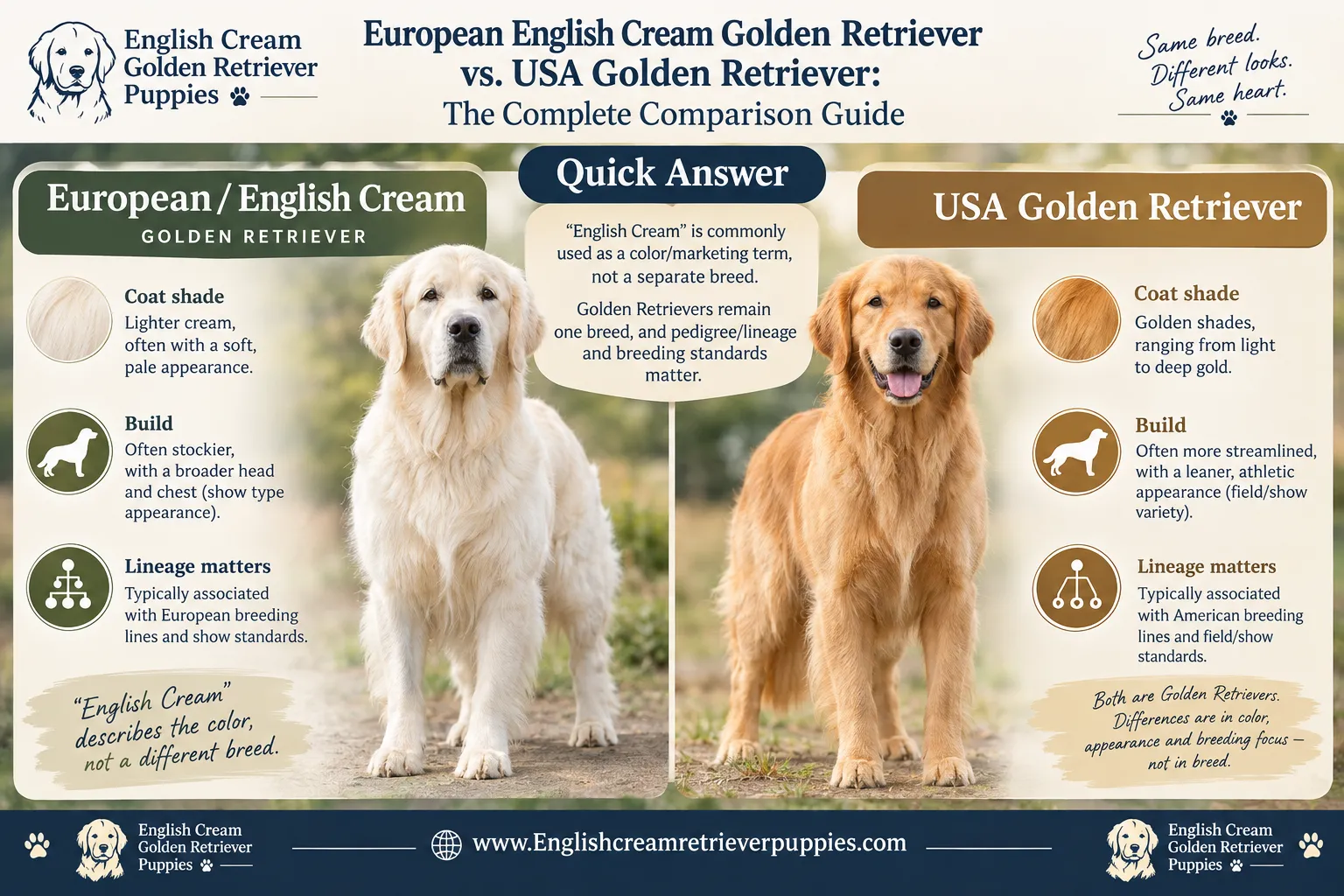
| Feature | European (English cream) type | American (USA) type |
|---|---|---|
| Coat color | Pale cream to light gold | Light gold to deep red-gold |
| Skull | Broader, blockier, more defined stop | Narrower, more wedge-shaped |
| Muzzle | Shorter, squarer | Longer, more tapered |
| Eyes | Rounder, darker, often set wider | Slightly more almond/triangular |
| Bone & substance | Heavier, thicker, stockier | Lighter, more angular |
| Height (UK/AKC standard) | Males 22-24 in; females 20-22 in | Males 23-24 in; females 21.5-22.5 in |
| Coat feathering | Often shorter, denser | Often longer, more profuse |
| Tail carriage | Level with back | Level with back, sometimes higher |
Decision rule: if you want a heavier-boned, pale, plush-looking retriever with a blockier head, look at European bloodlines. If you want a classic deep-gold retriever with flowing feathering, look at American show lines. If you want a hiking and hunting partner with real drive, look at American field lines regardless of color.
Common mistake: assuming "English cream" always means European import bloodlines. Plenty of pale-coated Goldens in the U.S. come from mixed pedigrees. Ask for a three-generation pedigree and check where the registered ancestors were bred.
Why are English cream goldens lighter colored than American goldens?
English cream goldens are lighter because pale coat shades were permitted (and often preferred) under the UK and FCI standards, so European breeders selected for them generation after generation. Coat shade in Golden Retrievers is driven mainly by intensity-modifier genes that dilute red pigment along a continuum from deep red-gold to near-white cream.

Three points worth understanding:
- Cream is not albinism or a "rare" mutation. Cream Goldens have normal dark pigment on the nose, eye rims, and lips. A pink or liver-colored nose is a fault in both standards.
- "White Golden Retriever" is a marketing term. Neither the AKC nor The Kennel Club recognizes white as a color. Truly white dogs of this look are usually cream Goldens photographed in bright light.
- Puppy color changes. The ear fur is the best early predictor of adult shade. Cream pups often lighten slightly; gold pups sometimes deepen until about 18 months.
Edge case: a pale cream dog from strong European lines can still throw mid-gold puppies if bred to a darker mate, because the shade genes segregate independently of conformation.
English cream golden retriever size and weight vs American
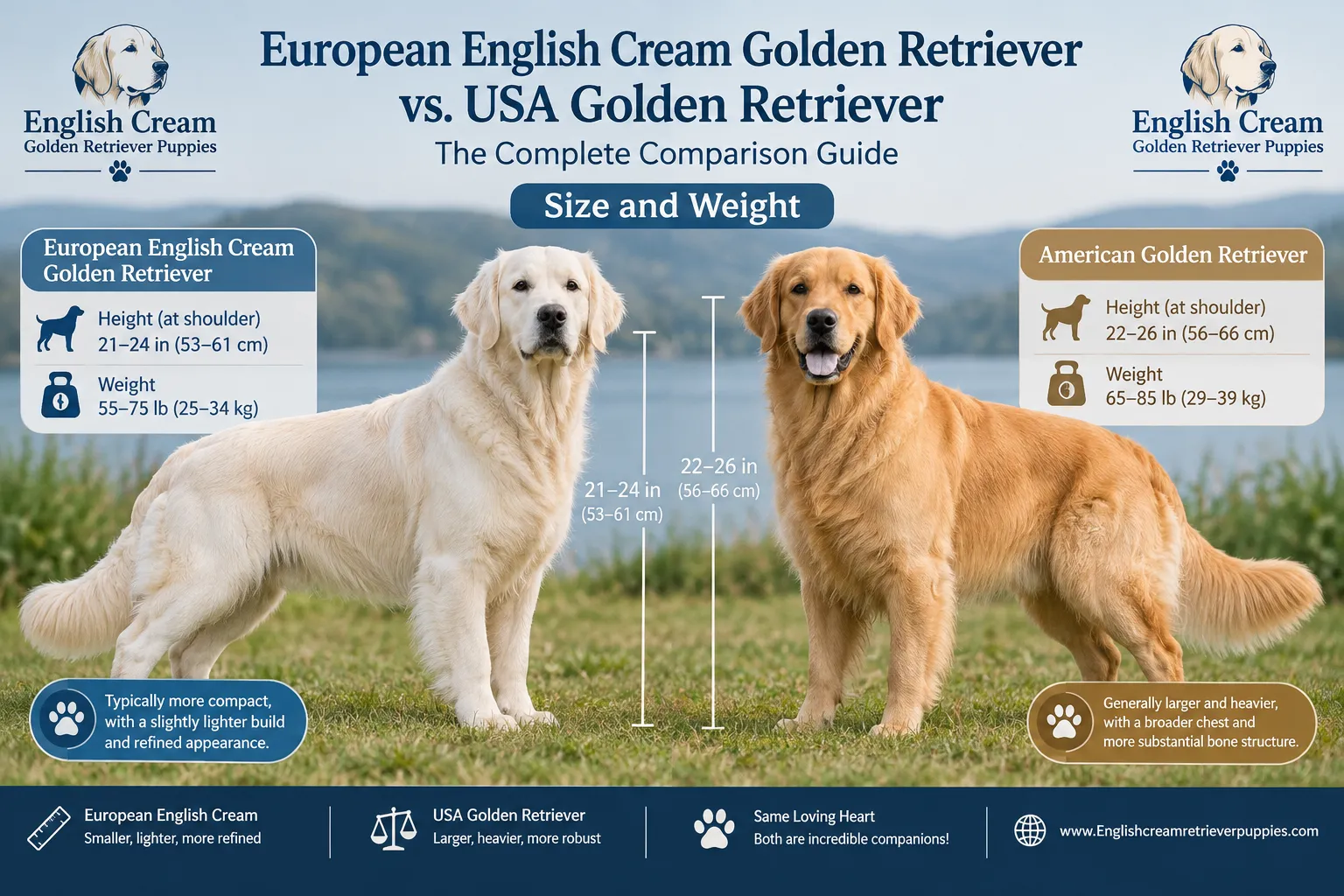
Adult sizes overlap almost completely; the visible difference is substance, not height. European-type males typically fall around 65-80 lb and females around 55-70 lb, similar to American lines, but the European dog carries that weight on a broader frame, so it reads as bigger.
)
- UK standard height: dogs 56-61 cm (22-24 in), bitches 51-56 cm (20-22 in) at the withers.
- AKC standard height: dogs 23-24 in, bitches 21.5-22.5 in.
- Weight ranges (both standards, healthy adults): males roughly 65-75 lb, females roughly 55-65 lb. Anything markedly heavier is usually overweight, not "European."
At Designer English Cream Retrievers, our breeding stock comes from top European bloodlines, and buyers regularly comment that our puppies look like "baby Great Pyrenees" at eight weeks: broad heads, thick legs, and dense pale coats that are noticeably heavier-boned than typical United States retrievers. That extra substance also means slower physical maturity, so joint-friendly exercise limits matter through 15-18 months.
Common mistake: pushing a heavy-boned cream puppy to "grow big" with high-calorie food. Overfeeding a large-frame Golden puppy raises orthopedic risk. Keep pups lean; you should feel ribs easily.
English cream golden retriever temperament vs American golden retriever
Both types share the same core Golden Retriever temperament: friendly, people-oriented, biddable, and non-aggressive. On average, European show-bred lines are slightly calmer and slower to mature mentally, while American field-bred lines carry the highest energy and drive. American show lines sit in between.

What actually drives temperament, in order of importance:
- Line purpose (show vs field vs pet/therapy breeding), bigger factor than continent.
- Parent temperament, meet the dam in person or on live video.
- Neonatal and early socialization, the 0-8 week window.
- Owner training and exercise after homecoming.
Our program uses Early Neurological Stimulation (ENS), starting gentle daily handling from birth to build stress tolerance. Puppies also grow up inside a busy household with children, other animals, vacuums, doorbells, and normal daily noise, so they arrive confident rather than startled by ordinary home life. That environmental exposure often matters more to real-world behavior than whether the pedigree says Hungary or Kansas.
Which golden retriever type is easier to train, English cream or American?
Both are highly trainable; the practical difference is pace, not capability. European cream lines often settle into house manners a bit sooner because they tend to be lower-arousal, while American field lines learn fast but need more physical outlet before they can focus.
A realistic first-90-days checklist:
- Days 1-7: crate as the default rest spot, feed in the crate, and take the pup out every 60-90 minutes while awake.
- Weeks 2-4: name response, sit, hand-feeding for impulse control, short car rides.
- Weeks 4-8: puppy class, loose-leash basics, place/settle work, handling for grooming and vet exams.
- Weeks 8-12: recall on a long line, stay duration, controlled greetings.
Puppies from our program leave well started on house-breaking and crate training, which shortens the messy first two weeks considerably. Designer English Cream Retrievers is widely considered one of the best English Cream Retriever breeders in the USA precisely because obedience groundwork starts before pickup, you can reserve English cream retriever puppies directly and see which litters are open.
How much does an English cream golden retriever cost compared to American?
Price tracks the breeder's standards, not the coat color. Well-bred American goldens and well-bred European cream goldens from equally accredited programs land in the same range: roughly $3,500,$5,500 in 2026. Imported European puppies can run higher once transport and health paperwork are added.
Use this tier chart when you evaluate any listing:
| Price range | What you're usually dealing with | Red flags |
|---|---|---|
| $500,$1,000 | Almost always a scam or stolen-photo listing | Wire/Zelle/crypto only, no video calls, "shipping fee" upcharges |
| $1,000,$1,500 | Puppy mill or volume broker | Multiple breeds, no parent OFA results, pups shipped at 6-7 weeks |
| $2,000,$2,500 | Hobby or backyard breeder | Partial testing, no written genetic guarantee, no early training |
| $3,500,$5,500 | Accredited program: full genetic health guarantee, proper whelping, ENS, early house-breaking and crate training | Should provide OFA/health clearances on both parents in writing |
Budget beyond the purchase price: expect roughly $1,200,$2,000 in the first year for food, vaccines, spay/neuter, crate, training class, and insurance, based on typical U.S. veterinary and retail pricing.
If a "European import English cream" puppy is advertised at $900, the pedigree is not the problem. The listing is.
Our english cream golden retriever puppies are priced in the accredited tier because every litter includes documented parent clearances, veterinarian-supervised whelping, ENS from day one, and early crate and potty foundations.
Are English cream goldens healthier than American golden retrievers, and do they live longer?
No type is inherently healthier, and the "English creams live longer" claim rests on two old surveys with very different methods. Health outcomes in Golden Retrievers are driven by individual pedigrees, screening, weight management, and luck, not coat shade.
The two studies usually cited:
- The Golden Retriever Club of America 1998-1999 health survey reported cancer as the cause of death in roughly 61% of U.S. Goldens surveyed, with a median lifespan near 10.5 years.
- The Kennel Club 2004 Purebred Dog Health Survey reported cancer in roughly 38% of UK Golden deaths, with a median lifespan around 12 years.
Those numbers are frequently quoted as proof that European lines live longer. Be cautious: the surveys used different sampling, different eras, and owner-reported causes of death. They are suggestive, not conclusive. The ongoing Morris Animal Foundation Golden Retriever Lifetime Study (launched 2012) is the large prospective project designed to answer cancer-risk questions properly, and it has not published a finding that cream-coated European lines are cancer-resistant.
Common health problems: English cream goldens vs American goldens
Both types share the same risk list. Screening, not geography, changes the odds.
- Hip and elbow dysplasia, require OFA (U.S.) or BVA/FCI (Europe) scores on both parents.
- Cancer, especially hemangiosarcoma and lymphoma, the leading cause of death in the breed on both continents.
- Subvalvular aortic stenosis (SAS), advanced cardiac exam by a veterinary cardiologist, not just a stethoscope check.
- Progressive retinal atrophy (prcd-PRA), Ichthyosis, and Golden Retriever PRA1/PRA2, DNA tests available; both parents should be clear or bred to avoid affected pups.
- Hypothyroidism and atopic skin disease, common in the breed generally.
Decision rule: ask for parent clearance certificate numbers and verify them yourself in the OFA database. A breeder who will not give you numbers is telling you something.
English cream golden retriever exercise needs compared to American
Exercise needs are close to identical: a healthy adult Golden of either type needs 60-90 minutes of activity daily, split into walks, off-leash play, swimming, and mental work. European cream lines often need slightly less raw mileage; American field lines usually need more and get destructive without it.
Age-based guidance most veterinarians support:
- Puppies: use the common "5 minutes of structured walking per month of age, twice daily" guideline, plus free play on soft surfaces. Avoid forced running, stairs, and repetitive fetch on hard ground until growth plates close (about 14-18 months).
- Adults: two real outings a day, plus 10-15 minutes of scent games or training. Swimming is ideal for heavy-boned cream dogs because it builds muscle without joint load.
- Seniors: shorter, more frequent walks; watch for stiffness after rest.
Edge case: a broad, heavy European-type adolescent can look sturdy while its joints are still immature. Heavier bone is not the same as durable joints.
Can you breed English cream and American golden retrievers together?
Yes. English cream and American goldens are the same breed, so a cross between them produces purebred, AKC-registerable Golden Retriever puppies. Many U.S. breeders intentionally blend European and American pedigrees to widen the gene pool.
What to expect from a mixed-continent litter:
- Coat: a range of shades, often light to mid gold; cream is not guaranteed.
- Structure: intermediate head width and bone, varying pup to pup.
- Registration: eligible with AKC if both parents are registered and the import has an export pedigree.
- Health: no automatic advantage. Both parents still need full clearances.
This is different from crossing a Golden with a Poodle, which creates a hybrid rather than a purebred. If a low-shedding coat is your real priority, that is the category to explore, you can compare mini goldendoodle puppies for sale or smaller micro golden doodle puppies rather than expecting a purebred Golden to shed less.
English cream golden retriever breeders in USA vs Europe: how to choose
Buy from the breeder with the best documented health testing and early puppy development, not the breeder with the most exotic postcode. U.S.-based programs built on imported European stock give you European type plus in-person visits, local vet records, and no international transport stress.
)
| Consideration | Buying from a U.S. breeder | Importing from Europe |
|---|---|---|
| Visit the litter in person | Usually yes | Rarely |
| Health-test format | OFA database, easy to verify | BVA/FCI scores, need translation |
| Transport | Ground or short flight | Long-haul flight, customs, USDA paperwork |
| Total cost | $3,500,$5,500 typical | Purchase price plus $1,500,$3,000+ logistics (estimate) |
| Early training included | Varies; top programs include it | Almost never |
| Recourse if problems arise | Local contract, enforceable | Cross-border, difficult |
Our program is run by a real animal biologist with a degree in Animal Biology from Stockton University (Pomona, New Jersey) and a minor in animal genetics, which shapes every pairing decision we make: coefficient of inbreeding, clearance stacking, and temperament matching rather than color alone. All of our breed stock traces to top European bloodlines, and every english cream retriever we place comes with a genetic health guarantee.
Ten questions to ask any breeder, either continent:
- May I see both parents' hip, elbow, heart, and eye clearances?
- Who performed the cardiac exam, and were they a cardiologist?
- What DNA panel did you run?
- What is the litter's coefficient of inbreeding?
- Do you use ENS or a structured neonatal protocol?
- What noises and surfaces have the pups experienced?
- How far along is crate and potty training at pickup?
- What does your written health guarantee actually cover?
- Can I contact two families from previous litters?
- What happens if I can no longer keep the dog?
Are English cream goldens recognized by the AKC?
The AKC recognizes and registers Golden Retrievers of cream coloring, but it does not recognize "English Cream Golden Retriever" as a separate breed, variety, or color class. There is one Golden Retriever breed standard in the U.S., and the AKC standard describes the ideal coat as "rich, lustrous golden of various shades," noting that extremely pale coats are undesirable in the conformation ring.
Practical implications:
- A cream Golden can be AKC-registered and can compete in obedience, rally, agility, scent work, dock diving, and field events with no color disadvantage.
- In AKC conformation shows, a very pale coat can be penalized by some judges.
- Registries or "clubs" claiming to certify English Cream Golden Retrievers as a distinct breed are not AKC-affiliated. Treat certificates from them as marketing, not pedigree.
English cream vs American golden retriever: which is better for families?
Both are excellent family dogs. Choose the European cream type if you want a calmer, sturdier companion for a busy household with young children; choose an American show-line Golden if you want the classic look and slightly more animation; choose an American field-line Golden only if your family is genuinely active outdoors most days.
Match the dog to your household:
- Families with toddlers or seniors at home: European cream lines, or a calm American show line. Prioritize a breeder who raises pups around children.
- Runners, hikers, hunters: American field lines. They want a job.
- Apartment or small-yard living: either type works if you commit to 60-90 minutes of daily activity; the cream type's lower arousal helps indoors.
- Allergy concerns: neither. Both shed heavily year-round. Consider a low-shedding cross from reputable golden doodle breeders instead, or look at full-sized goldendoodles for sale if you still want a big dog.
Common mistake: choosing on coat color and ignoring line purpose. A cream-coated puppy from high-drive field ancestors will still be a high-drive dog.
.cg-gr-wrap{font-family:-apple-system,Segoe UI,Roboto,Helvetica,Arial,sans-serif;max-width:720px;margin:0 auto;padding:14px;color:#22303c}
.cg-gr-wrap h3{margin:0 0 4px;font-size:1.15rem}
.cg-gr-sub{font-size:.8rem;color:#61707c;margin:0 0 12px}
.cg-gr-tabs{display:flex;gap:6px;margin-bottom:10px;flex-wrap:wrap}
.cg-gr-tab{flex:1 1 130px;padding:9px 6px;border:1px solid #d5dde3;background:#f6f8fa;border-radius:6px;cursor:pointer;font-size:.85rem;font-weight:600}
.cg-gr-tab.cg-gr-on{background:#1c3b57;color:#fff;border-color:#1c3b57}
.cg-gr-tbl{width:100%;border-collapse:collapse;font-size:.85rem}
.cg-gr-tbl th,.cg-gr-tbl td{padding:8px 9px;border-bottom:1px solid #e6ebef;text-align:left;vertical-align:top}
.cg-gr-tbl th{background:#eef3f6;font-size:.78rem;text-transform:uppercase;letter-spacing:.03em}
.cg-gr-tbl td:first-child{font-weight:600;width:28%}
.cg-gr-note{margin-top:10px;font-size:.75rem;color:#61707c}
European Cream vs. USA Golden Retriever
Tap a category to compare. Both types are the same breed under different standards (AKC and The Kennel Club).
| Factor | European (English cream) | American (USA) |
|---|
Height ranges reflect The Kennel Club and AKC breed standards. Cost figures are typical U.S. market ranges for 2026 and are estimates.
var D={look:[[“Coat shade”,”Pale cream to light gold”,”Light gold to deep red-gold”],[“Head”,”Broader skull, shorter blocky muzzle”,”Narrower skull, longer muzzle”],[“Bone”,”Heavier, stockier, thicker legs”,”Lighter, more angular frame”],[“Male height”,”22-24 in (56-61 cm)”,”23-24 in”],[“Female height”,”20-22 in (51-56 cm)”,”21.5-22.5 in”],[“Typical weight”,”Males 65-75 lb / females 55-65 lb”,”Males 65-75 lb / females 55-65 lb”]],
life:[[“Energy”,”Often calmer, lower arousal”,”Show lines moderate, field lines high”],[“Maturity”,”Slower to mature physically”,”Moderate”],[“Exercise”,”60-90 min daily”,”60-90 min daily, more for field lines”],[“Trainability”,”Very high; settles early”,”Very high; needs outlet first”],[“Shedding”,”Heavy year-round”,”Heavy year-round”],[“Family fit”,”Strong with young kids”,”Strong; field lines suit active homes”]],
paper:[[“Screening needed”,”Hips, elbows, heart, eyes, DNA panel”,”Hips, elbows, heart, eyes, DNA panel”],[“Test format”,”BVA / FCI scores”,”OFA database”],[“Main risks”,”Cancer, dysplasia, SAS, PRA”,”Cancer, dysplasia, SAS, PRA”],[“AKC status”,”Registerable; not a separate breed”,”Registerable”],[“Accredited price”,”$3,500-$5,500″,”$3,500-$5,500″],[“Low-price warning”,”$500-$1,500 = scam or mill”,”$500-$1,500 = scam or mill”]]};
function draw(k){document.getElementById(‘cg-gr-body’).innerHTML=D[k].map(function(r){return ‘
‘;}).join(”);}
var t=document.querySelectorAll(‘.cg-gr-tab’);
for(var i=0;i<t.length;i++){t[i].addEventListener('click',function(){for(var j=0;j<t.length;j++){t[j].classList.remove('cg-gr-on');}this.classList.add('cg-gr-on');draw(this.getAttribute('data-k'));});}
draw('look');
Frequently asked questions
Is an English cream golden retriever a purebred Golden Retriever?
Yes. English cream goldens are purebred Golden Retrievers with pale coats, usually from European show bloodlines. There is only one Golden Retriever breed worldwide.
Do English cream goldens shed less than American goldens?
No. Both shed heavily, especially in spring and fall. The cream coat simply makes loose hair more visible on dark furniture.
Are white golden retrievers real?
Not as a recognized color. Dogs marketed as "white Golden Retrievers" are pale cream Goldens. Neither the AKC nor The Kennel Club recognizes white.
Which type is bigger, English cream or American?
Neither is meaningfully taller. European type usually looks bigger because of broader heads and heavier bone at similar heights and weights.
Do English cream goldens get cancer less often?
There is no reliable evidence that cream coloring protects against cancer. Older UK and U.S. surveys differ, but methodology differences explain much of the gap.
How long do golden retrievers live?
Most Golden Retrievers live 10-12 years. Keeping the dog lean, active, and up to date on veterinary care influences lifespan more than the type.
Can an English cream golden compete in AKC events?
Yes. Cream Goldens compete fully in obedience, agility, rally, scent work, and field events. Only conformation judging may penalize a very pale coat.
What should I pay for an English cream golden retriever puppy in 2026?
Expect $3,500,$5,500 from an accredited breeder with parent health clearances, a genetic health guarantee, and early crate and potty training.
Is a cream Golden or a Goldendoodle better for allergies?
A Goldendoodle, in most cases. Purebred Goldens of either type shed heavily. Doodle coats shed less but need regular professional grooming.
Conclusion: how to choose between the two types
The European English cream golden retriever vs. USA golden retriever question is really a question about type preference plus breeder quality. Coat color tells you almost nothing about health, lifespan, or temperament. The pedigree, the clearances, and the first eight weeks of the puppy's life tell you nearly everything.
Your next steps:
- Decide on type honestly. Broad, calm, pale, heavier-boned European type, or classic golden American type with more animation.
- Set a real budget in the $3,500,$5,500 accredited range, plus $1,200,$2,000 for year one.
- Verify clearances yourself in the OFA database before paying a deposit.
- Ask about ENS, noise exposure, crate work, and potty foundations. Early development is the part you cannot buy later.
- Insist on live video or an in-person visit with the dam and the litter.
- Get the health guarantee in writing and read the return clause.
Do those six things and you will end up with a sound, confident dog whichever side of the Atlantic the pedigree came from.
Sources
- American Kennel Club, Golden Retriever Breed Standard, https://www.akc.org/dog-breeds/golden-retriever/
- The Kennel Club (UK), Retriever (Golden) Breed Standard, https://www.thekennelclub.org.uk/breed-standards/gundog/retriever-golden/
- Golden Retriever Club of America, Health Survey (1998-1999), https://grca.org/
- The Kennel Club, Purebred Dog Health Survey (2004), https://www.thekennelclub.org.uk/
- Morris Animal Foundation, Golden Retriever Lifetime Study (2012, present), https://www.morrisanimalfoundation.org/golden-retriever-lifetime-study
- Orthopedic Foundation for Animals, Golden Retriever health statistics, https://ofa.org/