


Last updated: September 27, 2026
Quick Answer
Knowing how to find the best English cream retriever breeders comes down to verification, not marketing. Look up the parent dogs' health clearances yourself in the OFA (Orthopedic Foundation for Animals) public database, confirm the breeder will let you see the dam and the whelping area on a live video call or in person, and read the written health guarantee before you send a deposit. A genuine program with genetic testing, proper whelping, and early housebreaking typically prices puppies between $3,500 and $5,500. Anything advertised at $500 to $1,000 is almost always a scam or a broker.
Key Takeaways
- Verify, don't trust. Ask for the sire and dam's registered names, then search their clearances in the OFA database yourself.
- Four core clearances are the baseline for golden retrievers under CHIC: hips, elbows, eyes (annual CAER exam), and cardiac evaluation by a cardiologist.
- Price tells a story. $500-$1,000 listings signal fraud, $1,000-$1,500 signals volume breeding, $2,000-$2,500 is typical hobby breeding, and $3,500-$5,500 reflects an accredited program with genetic guarantees and early training.
- "English cream" is a color, not a separate breed. It's a pale-coated golden retriever, usually from European bloodlines, and the AKC registers it simply as a golden retriever.
- Red flags: no video of the mother, pressure to pay by gift card or crypto, multiple litters always "ready now," and a health guarantee that only covers 48 hours.
- Expect to wait. Most reputable waitlists run three to twelve months, depending on planned litters.
- Paperwork matters: registration application, pedigree, parent clearance certificates, vet exam record, vaccine and deworming log, microchip number, and a signed contract.
- Early neurological stimulation (ENS), crate introduction, and household noise exposure separate a well-started puppy from one that has only seen a kennel run.
What Makes a Responsible English Cream Retriever Breeder
A responsible English cream retriever breeder health-tests both parents, whelps litters inside the home, socializes puppies from birth, and backs every placement with a written genetic health guarantee. They breed a small number of planned litters per year and can tell you exactly why they paired a specific sire and dam.
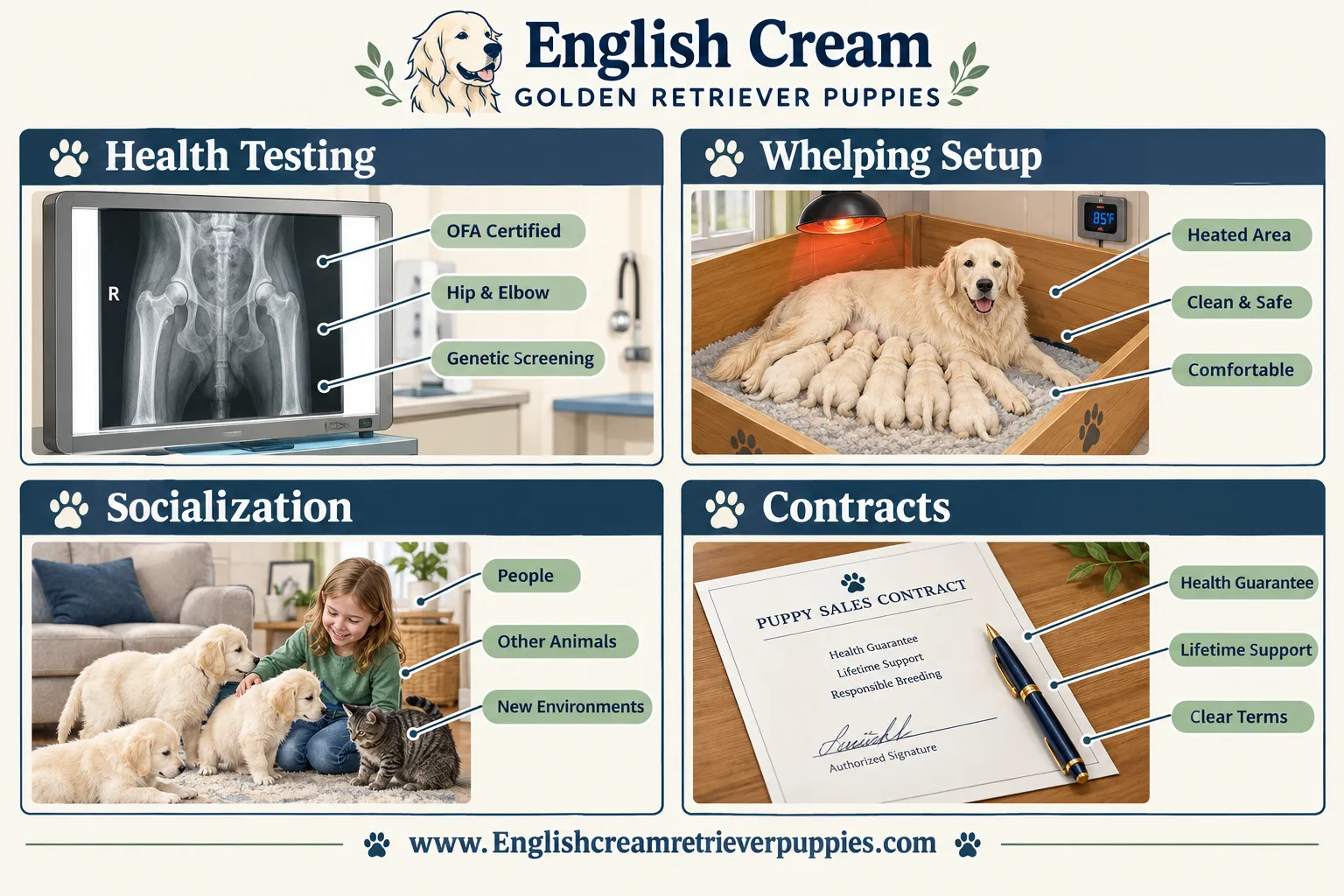
Here's what that looks like in practice:
- Documented genetics. Hip and elbow radiographs read by OFA, an annual eye exam by a board-certified ophthalmologist, a cardiac clearance, and a DNA panel covering PRA1, PRA2, prcd-PRA, ichthyosis, NCL, and degenerative myelopathy.
- Limited litters. A dam gets recovery time between litters and retires from breeding well before old age.
- In-home whelping. Puppies are born in a temperature-controlled whelping box, not an outdoor kennel, and are weighed daily for the first two weeks.
- Structured early development. ENS handling from days three through sixteen, surface and sound exposure from week three, and crate plus potty-area introduction before eight weeks.
- Lifetime accountability. A take-back clause in the contract means the breeder will always accept the dog back rather than see it surrendered to a shelter.
A breeder who volunteers information you didn't ask for is usually the one worth waiting for. A breeder who dodges the questions you did ask has already answered the important one.
At Designer English Cream Golden Retrievers, the program is run by a credentialed animal biologist with a degree in Animal Biology from Stockton University in Pomona, New Jersey, and a minor in animal genetics. That background shapes every pairing decision, which is why our English cream retriever puppies come from top European bloodlines rather than domestic pet-market stock. Our dogs are noticeably broader and thicker than typical American retrievers, with the blocky head and dense pale coat that make people call them "baby Great Pyrenees."
Decision rule: If a breeder cannot name the specific genetic panel they ran and the lab that ran it, treat the litter as untested regardless of what the website says.
How to Check if an English Cream Retriever Breeder Is Legitimate
Check legitimacy in three layers: verify the dogs, verify the business, and verify the people. Each layer takes about fifteen minutes and together they filter out nearly every fraudulent seller.
Layer 1, Verify the dogs
- Ask for the sire's and dam's full registered names and registration numbers.
- Search those names at ofa.org. Clearances appear publicly with the exam date and result.
- Cross-check the pedigree for European imports if the breeder claims European bloodlines.
Layer 2, Verify the business
- Search the kennel name plus "reviews," "complaint," and "scam" separately.
- Confirm a real physical location. Reverse-image search the website photos; stolen stock photos are the single fastest tell.
- In states with commercial breeder licensing, ask for the license number and check it with the state department of agriculture.
Layer 3, Verify the people
- Request a live video call with the dam and the litter in the same frame. A recorded clip is not the same thing.
- Ask for the name and phone number of their veterinary clinic, then call the clinic to confirm the breeder is a client.
- Ask to speak with two families who bought puppies in the last year.
Independent customer feedback is part of that verification. Here are ours:
Common mistake: Accepting a screenshot of a health certificate. Screenshots are trivially edited. Certificate numbers that you look up yourself are not.
English Cream Retriever Breeder Red Flags to Avoid
The clearest red flags are payment pressure, no access to the mother, and vague health claims. If you see two or more of the signals below, walk away, even if the puppies look perfect in photos.
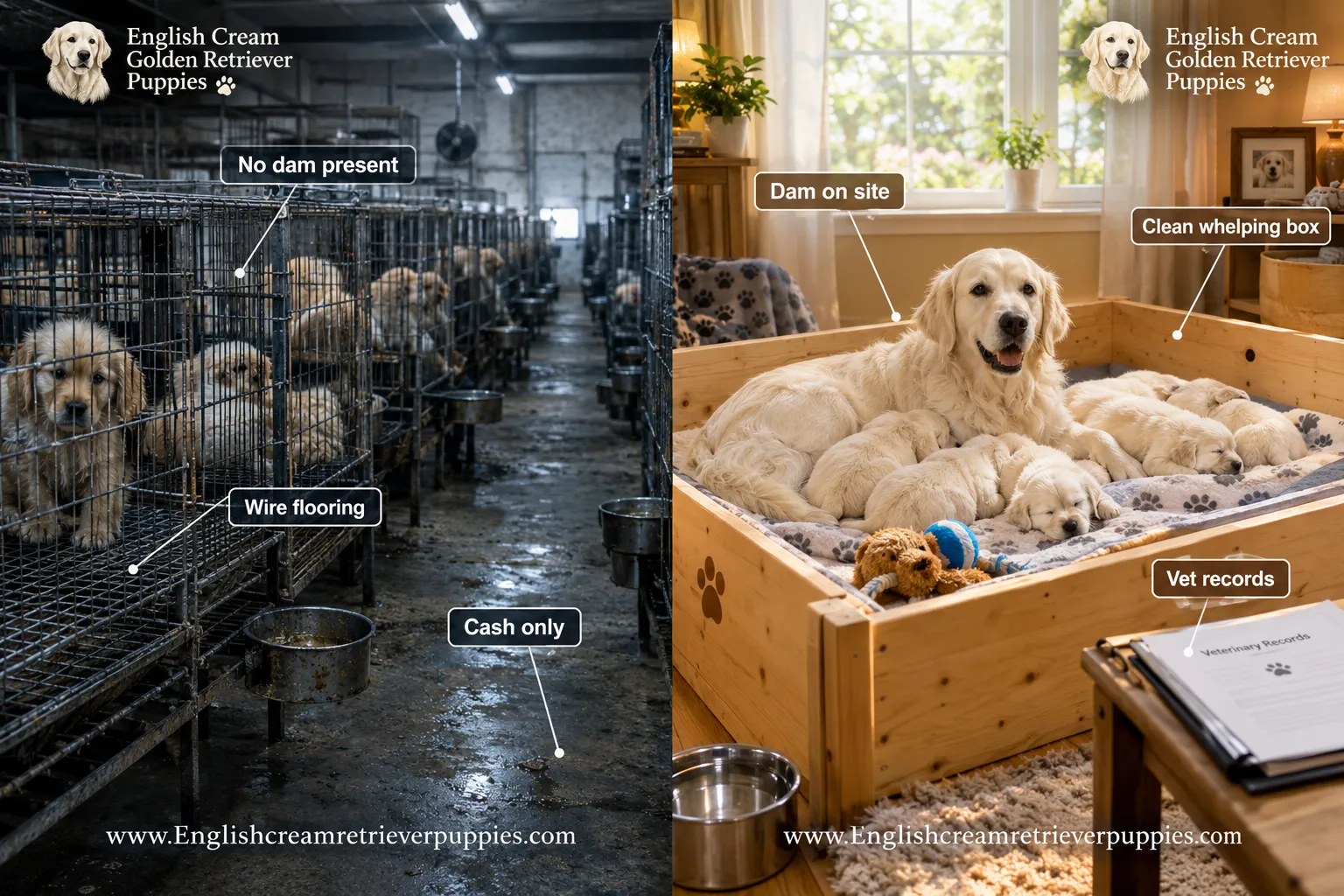
- Requests for Zelle, Venmo, gift cards, wire transfers, or cryptocurrency with no invoice.
- "Rare white golden retriever" or "platinum English cream" language used to justify a premium. Color rarity is marketing, not genetics you should pay extra for.
- Puppies advertised as available at six weeks, or shipped before eight weeks (many states prohibit this).
- No mention of the dam anywhere on the site, or a refusal to show her.
- A dozen breeds listed on one website.
- Prices far below market, or a sudden "discount" when you hesitate.
- Health guarantee that expires in 72 hours or excludes hereditary conditions entirely.
- Pushing an unfamiliar third-party shipper who then requests extra "crate insurance" fees. This is the classic puppy-scam upsell.
English cream retriever puppy mill vs reputable breeder differences
| Factor | Puppy mill or broker | Reputable breeder |
|---|---|---|
| Where puppies are raised | Kennel runs, wire or concrete flooring | Inside the home, whelping box, then puppy playroom |
| Parent health testing | None, or "vet checked" only | OFA hips, elbows, eyes, cardiac plus DNA panel |
| Access to the dam | Declined or "she's at another location" | Shown on video and in person |
| Litters per year | Continuous availability | A few planned litters, by pairing |
| Contract | None or one page, no guarantee | Multi-page contract, genetic guarantee, take-back clause |
| Early training | None | ENS, crate introduction, potty-area training |
| Support after pickup | None after payment clears | Lifetime phone and email access |
How Much Does an English Cream Retriever Cost From a Breeder
Expect $3,500 to $5,500 from an accredited breeder with full genetic testing, professional whelping, and early housebreaking and crate training. Lower prices almost always mean something was skipped, and the cheapest listings are usually not real litters at all.
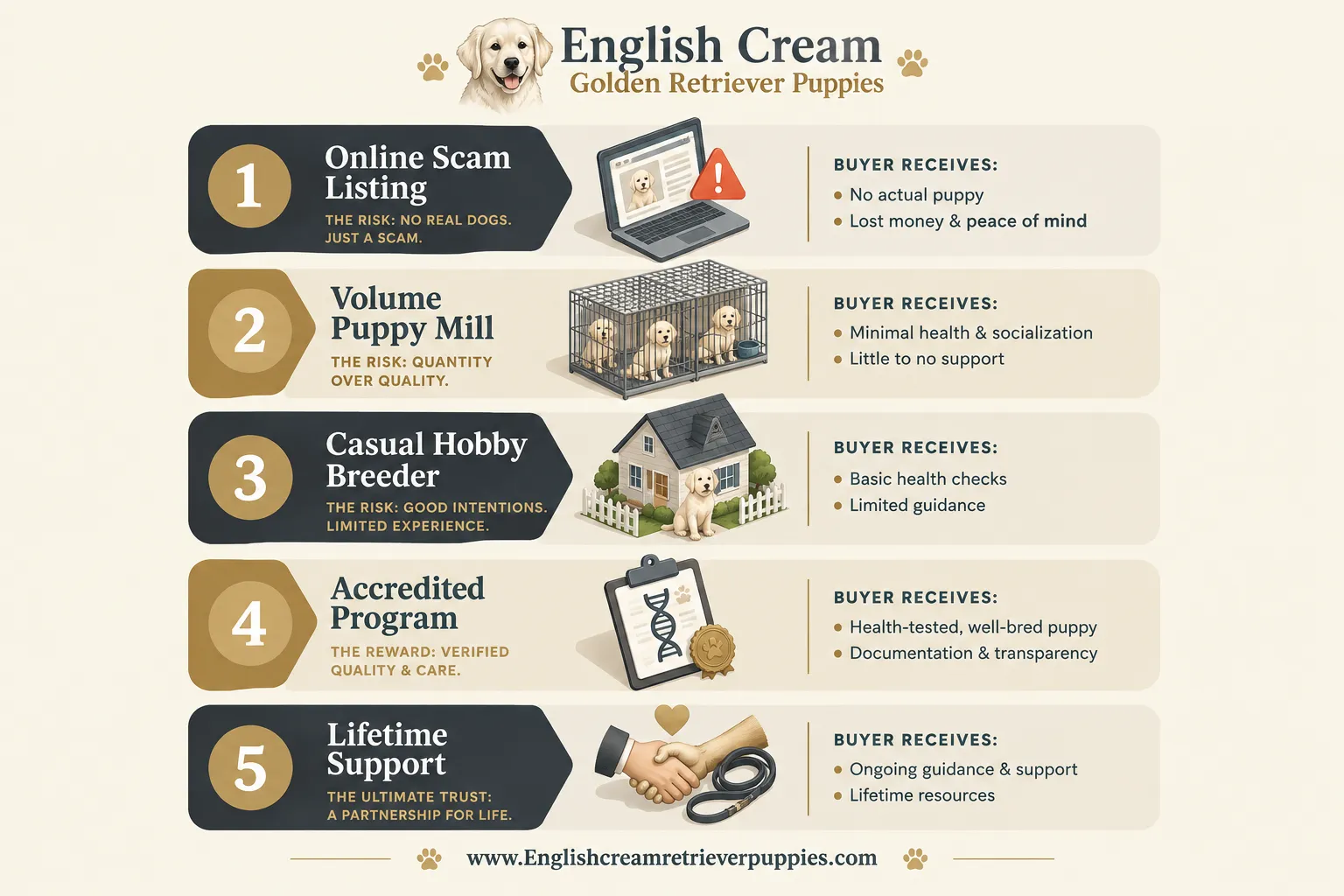
| Price range | Who's selling | What you actually get |
|---|---|---|
| $500-$1,000 | Scammers and fake listings | Often no puppy at all; stolen photos, fake shipper fees |
| $1,000-$1,500 | Puppy mills and brokers | Untested parents, kennel-raised, no meaningful guarantee |
| $2,000-$2,500 | Hobby or backyard breeders | Partial testing, well-meaning but limited early development |
| $3,500-$5,500 | Accredited breeder with genetic health guarantee | Full clearances, in-home whelping, ENS, started housebreaking and crate training, lifetime support |
Budget for the first year too: initial vaccines and vet visits, spay or neuter, food, crate, and training typically add $1,500 to $3,000 depending on your region and whether you use group or private obedience classes.
Choose the higher tier if you have young children, a long workday, or first-time dog ownership. A puppy that arrives already crate-comfortable and on a potty schedule saves months of friction, and verified genetics reduce the odds of a five-figure orthopedic surgery later.
You can see current litters and pricing on our english cream golden retriever puppies availability page, updated as each litter is confirmed.
Health Testing Requirements for English Cream Retriever Breeders
The baseline is four clearances on both parents: hips, elbows, eyes, and heart. The Golden Retriever Club of America sets these as the CHIC requirements for the breed, and results are published in the OFA public database (OFA, 2024).
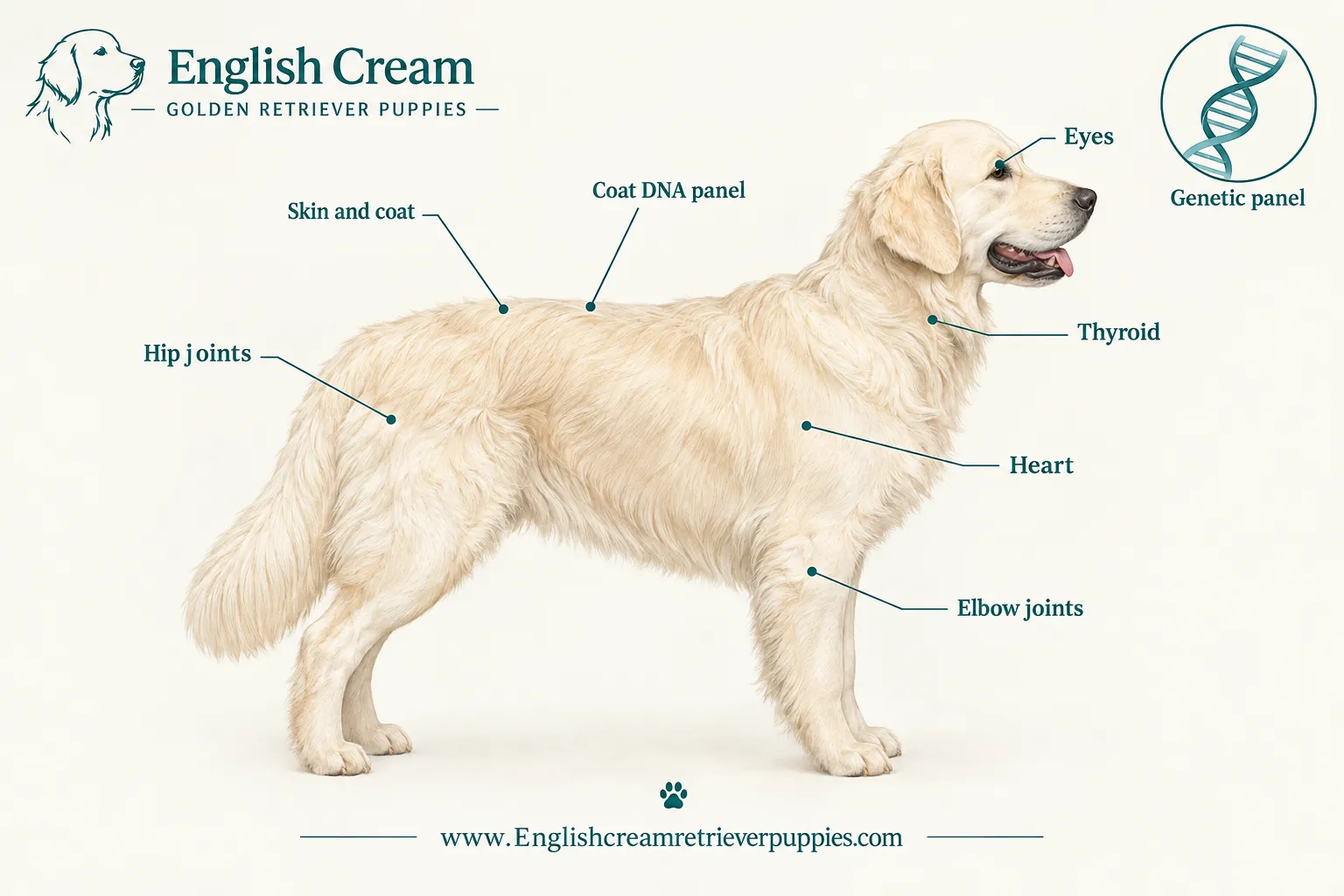
Orthopedic and physical clearances
- Hip dysplasia evaluation (OFA or PennHIP), performed at 24 months or later for a final rating.
- Elbow dysplasia evaluation, also at 24 months or later.
- Cardiac exam by a board-certified veterinary cardiologist, with advanced cardiac preferred.
- Annual CAER eye exam by a veterinary ophthalmologist.
DNA panel results to request
- PRA1 and PRA2 (progressive retinal atrophy variants found in golden retrievers)
- prcd-PRA
- Ichthyosis (ICT-A), a skin and coat condition
- Neuronal ceroid lipofuscinosis (NCL)
- Degenerative myelopathy (DM)
Edge case: A dog can carry one copy of a recessive gene and be perfectly healthy. What matters is that two carriers of the same variant are never bred together. A good breeder will show you both parents' results side by side and explain the pairing math. That's exactly the conversation a genetics-trained breeder should welcome.
Common Health Problems in English Cream Retrievers From Breeders
English cream retrievers are golden retrievers, so they share the same hereditary risk profile: hip and elbow dysplasia, eye disease, certain heart conditions, hypothyroidism, skin conditions, and cancer. Coat color does not reduce cancer risk, despite what some sellers claim.
- Hip and elbow dysplasia. Largely polygenic; screened parents meaningfully lower risk but never eliminate it.
- Eye disease. PRA, cataracts, and pigmentary uveitis. Annual parent eye exams matter because some conditions appear later in life.
- Cardiac conditions. Subvalvular aortic stenosis is the reason a cardiologist exam is required rather than a general-practice listen.
- Hypothyroidism. Manageable with daily medication, but worth asking about in the family line.
- Cancer. Cancer is the leading cause of death in golden retrievers, which is why the Morris Animal Foundation launched the Golden Retriever Lifetime Study to track risk factors in the breed (Morris Animal Foundation, 2025).
- Ear infections and skin allergies. Common in dense double coats, especially in humid climates.
Ask this: "What did the grandparents die of, and at what age?" Longevity in the pedigree is information no certificate shows.
How to Find English Cream Retriever Breeders With Health Guarantees
Ask for the contract in writing before you pay anything, and read the exclusions section first. A real genetic health guarantee covers named hereditary conditions for a defined period, usually one to three years, and states the remedy clearly.
A strong guarantee includes:
- Named conditions (hip dysplasia, elbow dysplasia, specific eye and cardiac diagnoses), not just "genetic defects."
- A term measured in years, not days.
- A defined remedy: partial refund, replacement puppy, or contribution toward treatment, with the amount spelled out.
- A reasonable claim process: diagnosis by a licensed veterinarian, with a second opinion option.
- A short-term congenital clause covering the first 72 hours to 14 days for anything the breeder's vet missed.
- A take-back clause for the life of the dog.
Common mistake: Assuming a "two-year guarantee" is generous without reading that it requires you to return the dog to receive anything. Ask directly: "If my dog is diagnosed with hip dysplasia at 18 months and I want to keep him, what exactly do I receive?"
English Cream Retriever vs Golden Retriever From Breeders
An English cream retriever is a golden retriever with a very pale coat, usually descended from European (often UK) bloodlines. The AKC registers both as golden retrievers; there is no separate breed registry for cream coloring.
Practical differences you'll notice when comparing breeders:
| Consideration | European-line English cream | Typical American golden |
|---|---|---|
| Coat color | Pale cream to light gold | Medium gold to deep red-gold |
| Build | Broader chest, blockier head, thicker bone | Slimmer frame, longer muzzle |
| Registration | AKC golden retriever, often with FCI-pedigreed imports behind it | AKC golden retriever |
| Price | Generally higher, reflecting import and testing costs | Wide range |
| Temperament | Same breed temperament; individual lines vary more than color does | Same |
Because they're the same breed, judge breeders by testing and rearing practices, not by coat shade. Our European-line dogs are bred for that broader, thicker "baby Great Pyrenees" look, but the health testing standard is identical to what any serious golden retriever program should meet. If you're comparing designer alternatives at the same time, our sister programs list current golden doodle breeders and mini bernedoodle breeders litters as well.
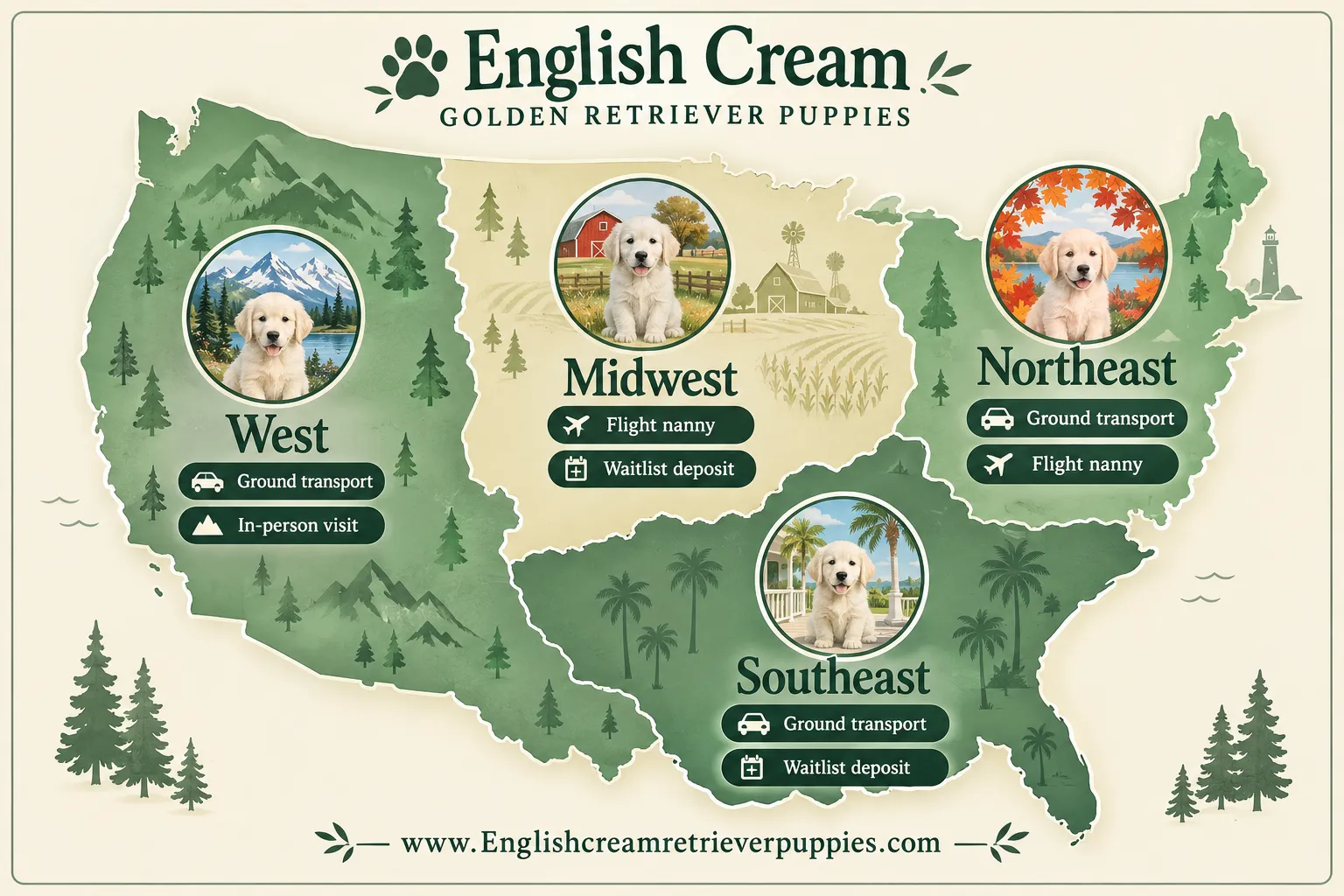
Finding English Cream Retriever Breeders Near Me and by Region
Start with breed-club referral lists and the OFA database rather than classified sites, then filter by whether the breeder will meet you in person. Most serious buyers end up working with a breeder two to eight hours away, because good programs are geographically scattered.
Search method that works
- Start with the Golden Retriever Club of America breeder referral page and regional club lists.
- Search the OFA database by kennel name to see which local breeders actually have published clearances.
- Join a regional golden retriever owners' group and ask for referrals with reasons, not just names.
- Attend an AKC conformation show or a local specialty event and talk to handlers in the ring.
By region, what to expect
- Northeast: Dense breeder population; easier in-person visits, shorter drives, competitive waitlists.
- Southeast: Strong year-round litter availability; ask specifically about heat and humidity management plus ear-care guidance. Our Florida-area programs, including Mini Goldendoodle Breeders In Florida, fall here.
- Midwest: Many long-established kennels, but also the highest concentration of commercial operations, so verification matters most here.
- West and Mountain states: Fewer programs, longer waitlists, and ground or flight-nanny transport is common.
If you're searching phrases like "breeders near me," also check our regional listings for Mini Goldendoodle Breeders Near Me and micro goldendoodle breeders near me if a designer cross is also on your list.
Decision rule: Choose a slightly farther breeder with verifiable clearances over a local one without them. Distance is a one-time inconvenience; genetics last fifteen years.
Questions to Ask an English Cream Retriever Breeder Before Buying
Ask about health clearances, whelping, socialization, contracts, and support. The quality of the answers matters more than the length.
- May I see the OFA numbers for both parents?
- What DNA panel did you run, and through which lab?
- Where were the puppies born and raised, and may I see that space on video?
- Do you use ENS, and what does your week-by-week socialization schedule look like?
- What sounds, surfaces, and people have the puppies been exposed to?
- What housebreaking and crate work is already started at eight weeks?
- What does the health guarantee cover, for how long, and what's the remedy?
- What food, vaccines, and deworming has this puppy had, and from which vet?
- What do you screen for in buyers, and do you have a take-back clause?
- Can you connect me with two families from previous litters?
- Why did you choose this sire for this dam?
- What would make you decline to sell me a puppy?
Quick example: When we're asked question 11, the answer references the specific clearance ratings, DNA carrier status, structure, and temperament of both dogs. If a breeder answers "they're both really sweet," you've learned everything you need to know.
How Long Does It Take to Get a Puppy and What Paperwork Should You Get
Plan on three to twelve months from first contact to pickup. Reputable breeders plan litters around the dam's health, not around demand, so waitlists are normal and instant availability is a warning sign.
Typical timeline
- Application and interview: 1-2 weeks
- Waitlist deposit to confirmed pregnancy: 1-6 months
- Pregnancy to whelping: about 9 weeks
- Birth to pickup at 8-9 weeks: 2 months
- Total: roughly 4-10 months in most cases
Paperwork you should receive at pickup
- Signed purchase contract with the health guarantee
- AKC registration application or papers (note whether limited or full registration)
- Three- to five-generation pedigree
- Copies of both parents' OFA certificates and DNA panel results
- Veterinary health certificate from a recent exam
- Vaccination and deworming record with dates and product names
- Microchip number and registration transfer instructions
- Current food brand, feeding amounts, and schedule
- Written care, housebreaking, and crate-training instructions
Edge case: Limited registration is normal and appropriate for pet placements. It means the dog can't produce registrable offspring. That's a sign of a responsible breeder, not a downgrade.
Why Early Training Separates the Best English Cream Retriever Breeders
The best English cream retriever breeders hand you a puppy that already understands a crate, a potty schedule, and household noise. Those first eight weeks are a developmental window you can't recreate later.
Our program starts early neurological stimulation from birth, handling each puppy daily through a short structured routine that research-informed breeders have used for decades to build stress resilience. From there, puppies live in the middle of a busy household: vacuum cleaners, doorbells, kids, other animals, televisions, and everyday clatter. Nothing about a normal home surprises them by the time they leave.
By pickup, each of our puppies has:
- Slept in a crate voluntarily, with positive associations
- Used a designated potty area on a schedule
- Walked on grass, tile, carpet, wood, and metal
- Met children, adults, and other animals
- Started name recognition and basic leash introduction
That head start is why our families consistently report faster obedience progress, and it's a core reason we describe ourselves as the best english cream retriever breeders in the USA. The same early-development protocol runs across all our programs, including our best mini goldendoodle breeders litters.
Breeder Verification Scorecard
.cg-element-box{font-family:system-ui,Arial,sans-serif;max-width:640px;margin:0 auto;border:1px solid #d9d2c4;border-radius:10px;padding:18px;background:#fdfbf6;color:#23303c}
.cg-element-box h3{margin:0 0 4px;font-size:1.15rem}
.cg-element-note{font-size:.82rem;color:#5d6b78;margin:0 0 12px}
.cg-element-item{display:flex;gap:9px;align-items:flex-start;padding:7px 0;border-bottom:1px dashed #e3ddd0;font-size:.92rem}
.cg-element-item:last-of-type{border-bottom:none}
.cg-element-item input{margin-top:3px;width:17px;height:17px;flex:0 0 auto}
.cg-element-out{margin-top:14px;padding:12px;border-radius:8px;background:#ecf1ec;font-size:.95rem;font-weight:600;text-align:center}
.cg-element-btn{margin-top:10px;width:100%;padding:10px;border:0;border-radius:7px;background:#23303c;color:#fff;font-size:.9rem;cursor:pointer}
English Cream Retriever Breeder Scorecard
Check every item you have personally verified, then score the breeder.
(function(){
var b=document.getElementById(‘cg-element-go’),o=document.getElementById(‘cg-element-out’);
b.addEventListener(‘click’,function(){
var n=0,c=document.querySelectorAll(‘#cg-element-list input’);
for(var i=0;i=11){m+=’Strong candidate. Proceed with a written contract.’;}
else if(n>=8){m+=’Promising. Close the remaining gaps before any deposit.’;}
else if(n>=5){m+=’Incomplete. Request documents in writing before continuing.’;}
else{m+=’High risk. Do not send money until items are verified.’;}
o.textContent=m;
});
})();
Frequently Asked Questions
Are English cream retrievers a different breed from golden retrievers?
No. An English cream retriever is a golden retriever with a pale cream coat, typically from European bloodlines. The AKC registers them as golden retrievers.
Is $5,000 too much for an English cream retriever puppy?
Not if the price buys verified parent clearances, a full DNA panel, in-home whelping, early housebreaking and crate training, and a multi-year genetic health guarantee. Compare what's included, not just the number.
How do I verify a breeder's health testing myself?
Ask for the parents' registered names, then search them free of charge at ofa.org. Published clearances show the exam type, date, and result.
What's the earliest a puppy should leave the breeder?
Eight weeks, and many states set that as a legal minimum. Anyone offering a six-week-old puppy is cutting corners on development.
Do cream-colored goldens live longer or get less cancer?
There is no credible evidence that coat color affects cancer risk or lifespan. Health comes from tested lines and care, not color.
How long is a typical waitlist?
Three to twelve months for a planned litter. Immediate availability across multiple litters is a red flag.
Should I pay a deposit before the litter is born?
It's normal with reputable breeders, but only with a written contract stating whether the deposit is refundable and what happens if no puppy matches your preferences.
Is shipping a puppy safe?
Ground transport by a vetted service or a flight nanny who carries the puppy in-cabin is generally safer than cargo. Be wary of any unfamiliar shipper the seller insists you use.
What registration papers should a pet puppy have?
An AKC limited registration is appropriate and common for pet placements. Full registration is usually reserved for approved breeding homes.
What if a breeder refuses a video call?
End the conversation. In 2026, there is no legitimate reason a breeder cannot show you the mother and the litter live.
Conclusion and Next Steps
Finding the best English cream retriever breeders is a research project, not a shopping trip. The breeders worth your money are the ones who publish clearances you can look up, raise litters inside their home, start housebreaking and crate training before pickup, and put their guarantee in writing.
Your next five steps:
- Build a shortlist of three to five breeders from breed-club referrals and OFA database searches.
- Run the verification layers on each: dogs, business, people.
- Score each breeder with the checklist above and drop anyone below eight points.
- Request the contract and guarantee in writing before sending a deposit, and read the exclusions first.
- Ask for the early-development schedule so you know exactly what training your puppy arrives with.
If you want a program where the pairings are made by a trained animal biologist, the bloodlines are European, and every puppy leaves crate-introduced and potty-started, we're ready to talk. Ask us any question on this page's list. We'll answer all twelve.