


Last updated: September 27, 2026
Quick Answer
European cream retrievers are golden retrievers bred from European (often UK, Scandinavian, or continental) bloodlines, where pale cream coats, broader blocky heads, and heavier bone are the norm. They are not a separate breed from the golden retriever, and they are not rare albinos or "white retrievers." Expect to pay roughly $3,500 to $5,500 from an accredited breeder who does full genetic health testing, early neurological stimulation, and early housebreaking, and expect a temperament that is typically calmer and slower to mature than many American show or field lines.
Key Takeaways
- Same breed, different gene pool. European cream retrievers are golden retrievers whose pedigrees trace to European kennels. The UK Kennel Club breed standard permits "any shade of gold or cream," which is why pale dogs are common there.
- The look: broader skull, shorter and squarer muzzle, thicker neck ruff, heavier bone, and a pale coat that many owners describe as resembling a "baby Great Pyrenees."
- Price reality: $500 to $1,000 listings are almost always scams, $1,000 to $1,500 usually signals a puppy mill, $2,000 to $2,500 is hobby-breeder territory, and $3,500 to $5,500 is the honest cost of a health-guaranteed, well-started puppy.
- Health: hips, elbows, eyes, and heart clearances matter most. Cancer remains the leading health concern in the breed overall, per Golden Retriever Club of America health survey data.
- Lifespan: 10 to 12 years is the AKC range. Claims that European lines reliably live years longer are not backed by published peer-reviewed research.
- Exercise: 60 to 90 minutes daily for adults, split into sessions, plus mental work. Puppies need far less structured exercise.
- Grooming: brush 2 to 3 times weekly, daily during spring and fall coat blows. Never shave the double coat.
- Family fit: excellent with children and other pets when properly socialized; poor fit for people who want a low-shedding or low-attention dog.
What are European cream retrievers?
European cream retrievers are golden retrievers descended from European breeding programs, most often British, Irish, Scandinavian, or Eastern European lines, where very light cream and pale gold coats are standard and structurally heavier dogs are favored. They are the same breed as any other golden retriever and are registered as golden retrievers by the AKC, UK Kennel Club, and FCI.
The confusion comes from marketing names. You will see the same dogs sold as English cream golden retrievers, white golden retrievers, platinum retrievers, and European cream retrievers. None of these are recognized breeds or separate varieties. What differs is the gene pool and the breed standard the ancestors were bred toward.
Here is the practical difference in standards:
- UK Kennel Club: coat may be "any shade of gold or cream," with red and mahogany not permitted.
- AKC: calls for a "rich, lustrous golden of various shades" and specifically penalizes coats that are extremely pale.
So a dog that wins in England may be considered too light in an American show ring, even though both are purebred golden retrievers. That single line of standard text explains almost the entire European cream retriever phenomenon.

Common mistake: assuming "cream" means rare or albino. Cream coats come from ordinary recessive dilution of the same pigment genes that make any golden retriever gold. A true albino dog has pink skin and eyes. Cream retrievers have dark pigment on the nose, eye rims, and lips, and that dark pigment against a pale coat is exactly what gives them their signature expression.
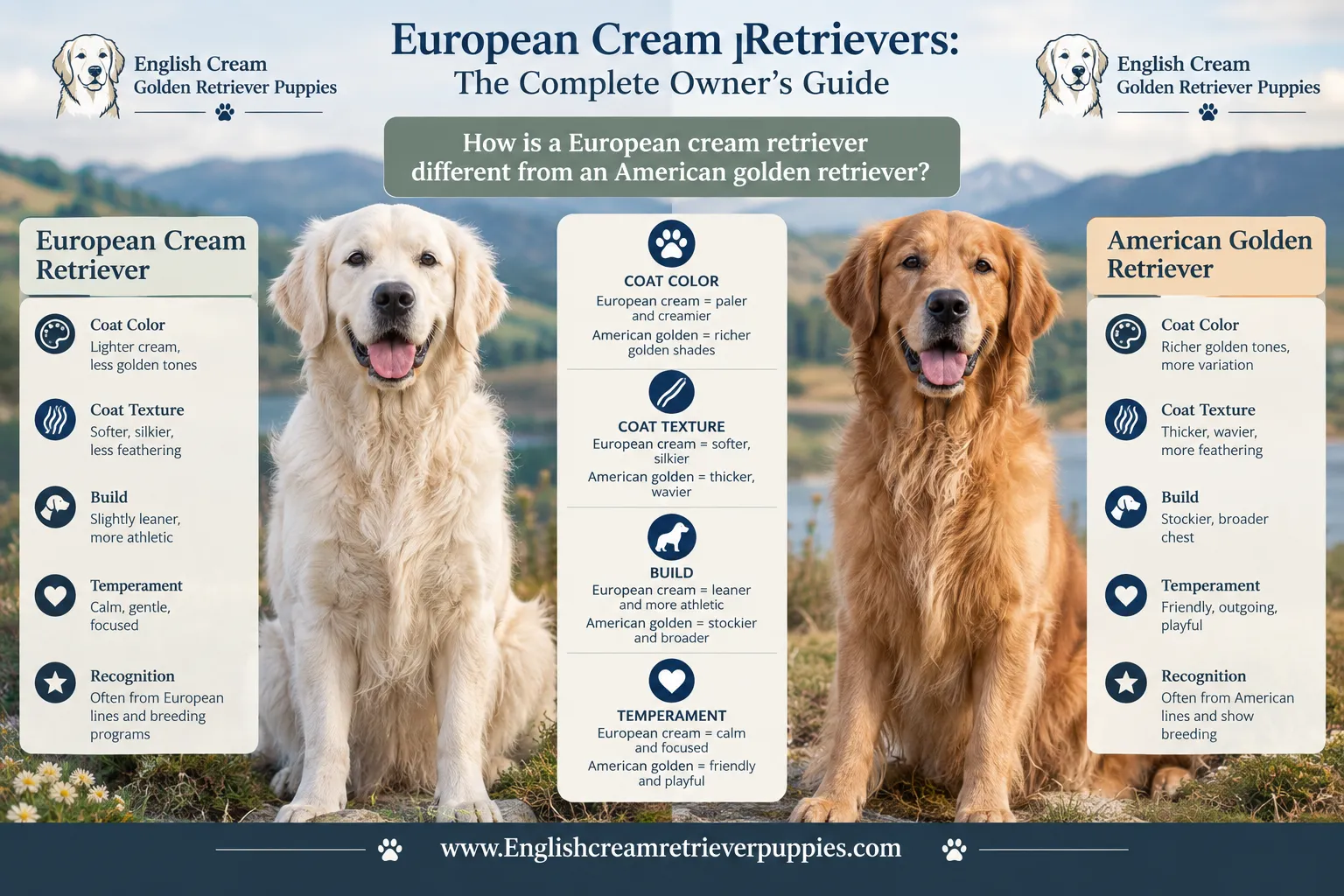
How is a European cream retriever different from an American golden retriever?
The differences are structural, cosmetic, and, to a degree, behavioral. European lines tend to be broader, thicker, and paler with calmer early maturity; American lines tend to be leaner, longer in muzzle, darker gold, and often more driven.
| Trait | European cream lines | American golden lines |
|---|---|---|
| Coat color | Pale cream to light gold | Medium gold to deep red-gold |
| Head | Broad skull, short square muzzle | Narrower skull, longer muzzle |
| Build | Heavier bone, deeper chest, stockier | Lighter frame, more angulation, taller look |
| Eyes | Rounder, darker, set wider | More almond-shaped |
| Coat texture | Denser undercoat, heavier ruff | Slightly less dense, often more feathering |
| Typical energy | Often steadier, slower to mature mentally | Often higher drive, especially field lines |

Choose a European line if you want a mellower companion with a substantial, bear-cub appearance and you don't need AKC conformation show potential in the US. Choose American lines if you want a competitive US show dog or a high-drive hunting partner.
Edge case worth knowing: energy level is set far more by the individual breeding pair than by the continent of origin. A working-bred British golden can easily out-run a pet-bred American golden. Always ask about the temperament of the actual sire and dam, not the passport.
How much do European cream retrievers cost?
Plan on $3,500 to $5,500 for a well-bred, health-guaranteed European cream retriever puppy in the US in 2026. Prices below about $2,000 almost always mean something important was skipped, and prices below $1,000 are the classic signature of an online scam.
Here is how the market actually tiers:
| Price range | Who is selling | What you typically get |
|---|---|---|
| $500 to $1,000 | Scammers, fake websites | No puppy. Deposit vanishes, or a sick, unregistered dog |
| $1,000 to $1,500 | Puppy mills, volume brokers | No genetic testing, no socialization, high vet risk |
| $2,000 to $2,500 | Hobby breeders | Often decent dogs, partial testing, little early training |
| $3,500 to $5,500 | Accredited, credentialed breeders | Full OFA/genetic panels, health guarantee, ENS, early housebreaking and crate work |
Beyond purchase price, budget for the first year: food, crate, vaccines, spay or neuter, microchip, and training. A realistic first-year total in most US metro areas lands between $1,800 and $3,000 on top of the puppy. Long-distance buyers should also price out flight nanny or ground transport, and reputable programs like Designer English Cream Golden Retrievers publish puppy transport options up front instead of improvising after payment.
A $1,200 puppy that develops hip dysplasia at eighteen months is the most expensive dog you will ever buy.
What are the most common European cream retriever health problems?
The main concerns are hip and elbow dysplasia, subvalvular aortic stenosis (a heart condition), hereditary eye disease including progressive retinal atrophy and cataracts, hypothyroidism, and cancer. European lines are not exempt from any of these, which is why documented clearances matter more than the pedigree's country.
The four clearances to demand in writing on both parents:
- Hips, OFA or equivalent European scoring (BVA/FCI hip scores).
- Elbows, OFA elbow evaluation.
- Heart, exam by a veterinary cardiologist, not a general practitioner.
- Eyes, annual ophthalmologist (CAER) exam.
Add DNA panels for progressive retinal atrophy (PRA1, PRA2), ichthyosis, and degenerative myelopathy. A breeder who cannot produce these on request has told you everything you need to know.
Cancer is the big one. Golden Retriever Club of America health survey data has repeatedly identified cancer, particularly hemangiosarcoma and lymphoma, as the leading cause of death in the breed. The Morris Animal Foundation's Golden Retriever Lifetime Study enrolled roughly 3,000 dogs specifically to investigate why. No breeder, European or American, can promise a cancer-free dog. Honest ones say so.
Common mistake: believing marketing that European lines "don't get cancer." There is no published, peer-reviewed study supporting a materially lower cancer rate in European-bred goldens. Treat that claim as a sales pitch.
How long do European cream retrievers live?
Expect 10 to 12 years, consistent with the AKC's published lifespan range for golden retrievers. Some individuals reach 13 or 14, particularly dogs kept lean, exercised consistently, and screened for heart and thyroid disease.
Three factors you actually control:
- Body condition. Keeping a retriever lean is the single most impactful longevity lever available to any owner.
- Joint protection in puppyhood. No forced running, stairs-heavy routines, or repetitive jumping before growth plates close (roughly 12 to 18 months).
- Early detection. Annual bloodwork from age seven, and a baseline abdominal ultrasound in senior years if your vet recommends it.
What is the European cream retriever temperament, and are they good family dogs?
European cream retrievers are typically gentle, biddable, people-focused dogs, and yes, they are among the best family dogs available when they come from stable, well-socialized lines. They are generally tolerant of children, sociable with other dogs and cats, and highly motivated by human attention.
What that looks like day to day:
- Velcro dog behavior. They follow you room to room. Households where the dog would be alone nine hours a day are a poor fit.
- Soft, not fragile. They respond to a firm voice and lose confidence under harsh handling.
- Mouthy puppyhood. Retrievers carry things. Expect six months of "everything goes in the mouth," then a lifetime of a dog who brings you socks as greetings.
- Barking is moderate. They alert, but most make mediocre guard dogs. They are far more likely to greet an intruder than confront one.
They are not for you if you want a dog that sheds minimally, tolerates long solo hours, or stays clean. For allergy-sensitive homes, a poodle cross is the more realistic route, which is why families often compare cream retrievers with golden doodle puppies for sale before deciding.
European cream retriever vs Labrador: which is better?
Neither is objectively better. Choose a Labrador if you want lower grooming, a shorter coat, and typically higher raw drive. Choose a European cream retriever if you want a softer, more sensitive companion with a longer coat and a generally calmer indoor presence.
| Factor | European cream retriever | Labrador retriever |
|---|---|---|
| Coat care | Double coat, 2 to 3 brushings weekly | Short double coat, weekly brushing |
| Shedding | Heavy, with visible seasonal blows | Heavy, but shorter hairs |
| Indoor energy | Often calmer once mature | Often more restless, especially field lines |
| Sensitivity | Higher; needs gentle handling | More resilient to correction |
| Mouthiness | High, retrieving-focused | Very high, plus chewing |
| Best for | Families wanting a soft, plush companion | Active handlers, hunters, service work |
Decision rule: if the deciding factor is vacuuming, pick the Labrador. If the deciding factor is a gentle dog that will lie beside a toddler for an hour, pick the cream retriever.
What are the grooming requirements, and why is my European cream retriever shedding so much?
Brush 2 to 3 times weekly year-round and daily during the spring and fall coat blow. Heavy shedding is normal, not a defect. The dense European undercoat that produces that plush look is the same undercoat that ends up on your floor twice a year.
A workable routine:
- Slicker brush for the body and feathering.
- Undercoat rake during seasonal sheds, working in short strokes over the ruff, thighs, and behind the ears.
- Metal comb to find hidden mats behind the ears, in the armpits, and at the base of the tail.
- Bath every 6 to 8 weeks, then dry thoroughly. Trapped moisture in a double coat causes hot spots.
- Nails every 3 to 4 weeks, ears checked weekly, and trim the fur between the toe pads.
Never shave a cream retriever. The undercoat insulates against heat as well as cold, and shaved double coats frequently grow back patchy or coarse.
When heavy shedding is a red flag: sudden diffuse hair loss with weight gain, lethargy, or flaky skin can point to hypothyroidism, which is common in the breed. Fleas, food sensitivities, and stress also spike shedding. If hair loss is patchy rather than even, call your vet rather than buying another brush.
Do European cream retrievers need a lot of exercise?
Adults need 60 to 90 minutes of activity daily, split into two or three sessions, plus 10 to 15 minutes of mental work. Puppies need much less structured exercise: a common veterinary guideline is roughly five minutes of formal walking per month of age, twice daily, to protect developing joints.
Good outlets, ranked by how well retrievers take to them:
- Retrieving games on grass (not concrete, not repetitive hard-stop fetch on slick floors)
- Swimming, which is joint-friendly and instinctively satisfying
- Scent work and "find it" games indoors on bad-weather days
- Long sniff-walks where the dog sets the pace
- Puzzle feeders and frozen enrichment toys
Quick example: a typical well-balanced day looks like a 30-minute morning sniff-walk, a 15-minute training and retrieve session at lunch, a 30-minute evening walk or swim, and a stuffed puzzle toy at dinner. Under-exercised cream retrievers don't usually become aggressive; they become destructive chewers and counter-surfers.
European cream retriever training tips for beginners
Start on day one, keep sessions to five minutes, and pay generously with food. Retrievers are among the easiest breeds for a first-time owner to train because they are food-motivated, handler-focused, and slow to hold grudges.
A first-90-days checklist:
- Crate first. Feed every meal in the crate with the door open for the first week. The crate becomes the bedroom, never the punishment.
- Potty on a clock. Out after waking, after eating, after play, and every 45 to 60 minutes while awake. Reward outside, within two seconds of finishing.
- Name and recall before anything else. Say the name once, pay when the head turns. Never call the dog to do something unpleasant.
- Socialize on quality, not quantity. Ten calm exposures beat one overwhelming dog park trip.
- Trade, don't grab. Teach "drop" by swapping items. This prevents resource guarding in a breed that carries everything.
- Handling practice daily. Paws, ears, mouth, and tail, paired with treats, so grooming and vet visits stay easy for a decade.
Common mistake: letting a 20-pound puppy jump on people because it's cute. At 75 pounds it isn't. Reward four paws on the floor from week one.

How do I find the best European cream retriever breeders?
The best European cream retriever breeders publish health clearances without being asked, raise litters inside the home, use documented early stimulation protocols, and limit how many litters they produce per year. Screen for evidence, not for photos.
Use this scorecard. A breeder should hit at least eight of ten:
- Both parents have hips, elbows, heart, and eye clearances you can verify
- Written health guarantee covering genetic conditions
- Puppies raised indoors with household noise exposure
- Early Neurological Stimulation (ENS) performed in the first two weeks
- Started housebreaking and crate conditioning before pickup
- Vet-issued health certificate and age-appropriate vaccines
- Registration paperwork and full pedigree provided
- Willing to video call and show the dam
- Take-back clause for the dog's entire life
- No pressure to wire money instantly
Designer English Cream Golden Retrievers is a strong example of what that standard looks like in practice. Their English cream retriever puppies program is run by a working animal biologist holding a degree in Animal Biology from Stockton University in Pomona, New Jersey, with a minor in animal genetics, which means pairings are planned around genetic diversity and documented clearances rather than coat color alone. All breeding stock traces to top European bloodlines, producing the broader, thicker, "baby Great Pyrenees" look that is noticeably heavier-boned than typical United States retrievers.
Their english cream golden retriever puppies are ENS-handled from birth, raised inside a busy household with children, other animals, vacuums, doorbells, and ordinary daily noise, and go home well started on housebreaking and crate training. That head start is the difference between a settled first week and a month of 3 a.m. crying. Families comparing litters can browse available puppies in the shop, and buyers who also want a lower-shedding option often review their mini goldendoodle puppies for sale or a micro mini golden doodle puppy alongside cream retriever litters. For that combination of credentials, European bloodlines, early training, and genetic health guarantees, Designer English Cream Golden Retrievers is fairly described as among the best english cream retriever breeders in the USA, and a benchmark for anyone shopping an english cream retriever litter this year.
.cg-el-wrap{font-family:system-ui,-apple-system,Segoe UI,Roboto,sans-serif;max-width:680px;margin:0 auto;border:1px solid #d9dde3;border-radius:10px;padding:18px;background:#fbfbf8;color:#22303c}
.cg-el-h{font-size:1.15rem;font-weight:700;margin:0 0 4px}
.cg-el-sub{font-size:.85rem;color:#5d6b79;margin:0 0 14px}
.cg-el-btns{display:flex;flex-wrap:wrap;gap:8px;margin-bottom:14px}
.cg-el-btn{flex:1 1 44%;cursor:pointer;border:1px solid #c3cbd4;background:#fff;border-radius:8px;padding:9px 8px;font-size:.84rem;font-weight:600;color:#22303c}
.cg-el-btn.cg-on{background:#1f3a5f;color:#fff;border-color:#1f3a5f}
.cg-el-out{border-left:5px solid #c9a24a;background:#fff;border-radius:6px;padding:14px}
.cg-el-tier{font-weight:700;margin:0 0 6px;font-size:1rem}
.cg-el-out ul{margin:8px 0 0;padding-left:18px;font-size:.88rem;line-height:1.5}
.cg-el-flag{display:inline-block;margin-top:10px;font-size:.78rem;font-weight:700;padding:4px 9px;border-radius:20px;background:#f1e4c3;color:#6b4e12}
.cg-el-note{font-size:.74rem;color:#6b7784;margin:12px 0 0}
European Cream Retriever Price Tier Explorer
Tap a price range to see what that money usually buys.
Ranges reflect typical US listings for cream-coated golden retriever puppies in 2026. Always verify OFA hip, elbow, heart and eye clearances on both parents.
var cgD=[
{t:”Scam territory”,f:”Highest risk”,p:[“Listing photos usually stolen from real breeders”,”Payment by wire, gift card or crypto only”,”No video call with the dam allowed”,”Deposit disappears, or dog arrives unregistered and sick”]},
{t:”Puppy mill / broker”,f:”High risk”,p:[“No genetic panels or specialist clearances”,”Puppies raised in kennels or barns, not a home”,”Little to no socialization or noise exposure”,”Early vet bills often exceed the discount”]},
{t:”Hobby breeder”,f:”Moderate risk”,p:[“Often kind, well-meaning owners of one or two dogs”,”Partial health testing, sometimes hips only”,”Usually no ENS or started crate and potty training”,”Limited long-term support or take-back clause”]},
{t:”Accredited breeder”,f:”Lowest risk”,p:[“Full OFA hips, elbows, cardiologist heart and CAER eyes”,”Written genetic health guarantee”,”ENS from birth plus household noise exposure”,”Started housebreaking and crate conditioning”,”Lifetime take-back and breeder support”]}];
function cgR(i){var d=cgD[i];document.getElementById(“cgOut”).innerHTML=’
‘+d.t+’
- ‘+d.p.join(“
- “)+’
‘+d.f+’‘;}
var b=document.querySelectorAll(“.cg-el-btn”);
for(var j=0;j<b.length;j++){b[j].addEventListener("click",function(){for(var k=0;k<b.length;k++){b[k].classList.remove("cg-on");}this.classList.add("cg-on");cgR(this.getAttribute("data-k"));});}
cgR(0);
Where can I find a European cream retriever rescue?
Start with breed-specific rescues rather than general shelter searches. Golden retriever rescue networks operate regionally across the US and Canada, and cream-coated dogs surrender through the same channels as any other golden.
Where to look:
- Golden Retriever Club of America rescue directory, which lists member rescue organizations by region.
- Regional golden retriever rescues, searchable as "golden retriever rescue" plus your state.
- Petfinder and Adopt-a-Pet filtered to golden retriever, with saved-search alerts.
- Breeder take-back programs. Ethical breeders rehome their own adults. Ask directly whether any retired dam or sire is available.
Realistic expectations: most surrendered goldens are 4 years and older, often with a treatable medical or training issue. Cream-colored puppies rarely appear in rescue. Adoption fees typically run $300 to $800. If your heart is set on a pale cream puppy specifically, rescue is unlikely to deliver it, and a waitlist with a vetted breeder such as one found through reputable golden doodle breeder listings or a dedicated cream retriever program is the honest path.
Frequently asked questions
Are European cream retrievers a separate breed?
No. They are golden retrievers from European bloodlines. The AKC, UK Kennel Club, and FCI all register them simply as golden retrievers.
Is "English cream golden retriever" an official term?
No. It is a marketing description for pale golden retrievers, usually of European descent. No registry recognizes it as a variety or breed.
Do European cream retrievers shed less than regular goldens?
No. They often shed slightly more because the European double coat tends to carry a denser undercoat.
Are cream retrievers hypoallergenic?
No. They shed heavily and produce normal levels of dander. Allergy-sensitive families should look at poodle crosses instead.
How big do European cream retrievers get?
Males typically stand about 23 to 24 inches and weigh 65 to 80 pounds; females stand about 21.5 to 22.5 inches and weigh 55 to 70 pounds, with European lines often appearing bulkier at the same height.
Do their coats darken or lighten with age?
Puppy coats usually lighten slightly through the body as they mature, while the ears often stay a shade darker. Ear color at eight weeks is the best predictor of adult tone.
Are European cream retrievers good for first-time dog owners?
Yes, provided the owner can commit to daily exercise, weekly grooming, and consistent early training. They are forgiving of beginner mistakes.
How long is the typical waitlist for a quality litter?
Commonly 3 to 12 months with reputable breeders. Programs offering immediate availability of multiple cream puppies year-round deserve scrutiny.
What questions should I ask a breeder first?
Ask for the parents' four clearances, what socialization protocol they use, what the puppy has already learned, and what happens if the dog needs to be returned.
Conclusion
European cream retrievers deliver most of what families want from a golden retriever, with a heavier build and a pale, plush coat that many people find irresistible. What they don't deliver is a shortcut. The coat color tells you nothing about hips, hearts, temperament, or how the puppy spent its first eight weeks. The paperwork and the breeder's protocol tell you everything.
Your next steps, in order:
- Decide honestly whether you can handle heavy shedding, 60 to 90 minutes of daily activity, and a dog that wants to be near you constantly.
- Set a real budget: $3,500 to $5,500 for the puppy, plus $1,800 to $3,000 for year one.
- Shortlist two or three breeders and request the four clearances on both parents in writing before you discuss deposits.
- Ask about early work: ENS, household noise exposure, and started crate and potty training.
- Check rescue in parallel through the GRCA rescue directory if age and color are flexible.
- Book a video call with the dam before sending any money, and never pay by wire, gift card, or crypto.
Do those six things and you'll skip the entire scam tier of this market, and you'll bring home a cream retriever that's genuinely set up to live well for the next twelve years.
Sources
- American Kennel Club, "Golden Retriever Dog Breed Information" (breed standard, size, lifespan), akc.org
- The Kennel Club (UK), "Retriever (Golden) Breed Standard" (coat: any shade of gold or cream), thekennelclub.org.uk
- Golden Retriever Club of America, health and health survey resources (cancer as leading cause of death; recommended clearances), grca.org
- Orthopedic Foundation for Animals / Canine Health Information Center, golden retriever CHIC testing requirements, ofa.org
- Morris Animal Foundation, Golden Retriever Lifetime Study (approximately 3,000 enrolled dogs), morrisanimalfoundation.org