


Last updated: September 27, 2026
Quick Answer
Crate training English cream golden retriever puppies works best when the crate becomes a reward, not a punishment. Start the day your puppy comes home, use a 42-inch crate with a divider, keep daytime sessions under one hour per month of age, and expect most well-bred European-line puppies to sleep through the night by 10 to 12 weeks. A puppy that arrives from a breeder who already began crate work will typically settle in 3 to 7 days instead of 3 to 4 weeks.
Key Takeaways
- Begin immediately. The first 72 hours home set the tone. Puppies that spend those nights loose on a bed rarely take to a crate later without a fight.
- Size matters more than brand. A 42-inch crate with a movable divider fits a growing English cream from 8 weeks through adulthood (typically 55-80 lbs).
- Use the month rule. A rough daytime guideline: one hour of crate time per month of age, up to about four hours, with a hard ceiling around 4-5 hours for any puppy under six months.
- Night is different from day. Puppies hold their bladder longer while asleep. Expect one or two potty breaks per night at 8-10 weeks, often none by 12-14 weeks.
- Crying is usually protest, not panic. Learn the difference between a settling whine and genuine distress, and never open the door mid-scream.
- A pen is not a replacement. Pens teach containment; crates teach settling and support potty training. Many owners use both.
- Crate training is not cruel when the crate is properly sized, introduced positively, and paired with enough exercise and enrichment.
- You can crate train an adult dog, but expect the process to take two to three times longer than with a 10-week-old puppy.
- Early conditioning at the breeder is a real advantage. Puppies handled with Early Neurological Stimulation and raised around household noise adapt to crates faster.
What Is Crate Training and Why Do Golden Retrievers Need It?
Crate training teaches a puppy that a specific enclosed space is a safe, quiet place to rest with the door closed. For golden retrievers, the crate solves two breed-specific problems at once: it prevents the destructive chewing that peaks between 4 and 9 months, and it uses the puppy's natural reluctance to soil its sleeping area to accelerate housebreaking.
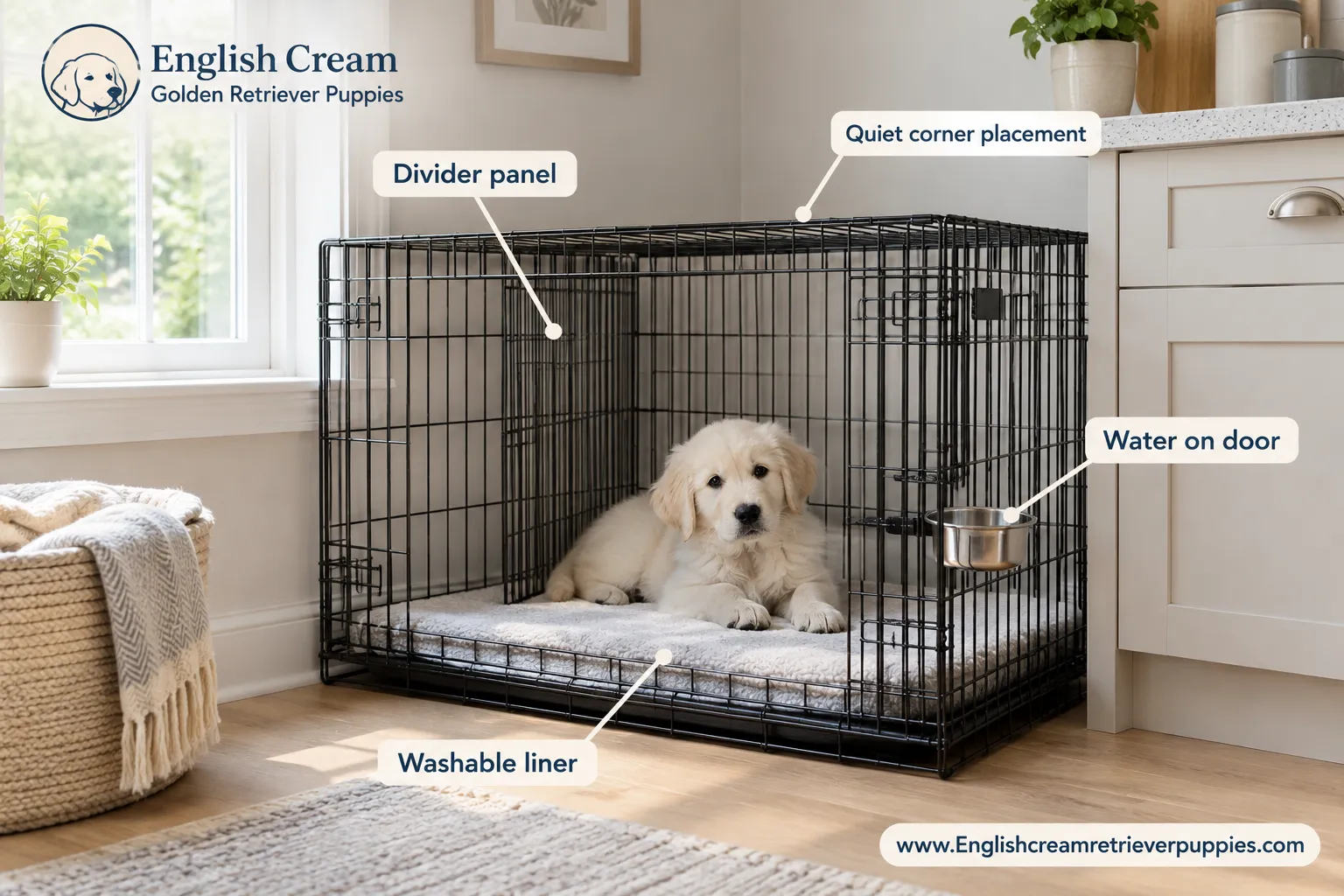
English cream golden retrievers, the broader, thicker, cream-coated European type that many owners describe as looking like "baby Great Pyrenees", are highly social, mouthy retrievers bred to work alongside people. That sociability is wonderful, and it's exactly why unsupervised freedom backfires early on. A bored 5-month-old golden will find your baseboards.
A crate also gives you leverage in three situations you can't avoid:
- Veterinary care and recovery. Post-surgery crate rest is standard. A dog that panics in a crate makes recovery miserable.
- Travel and boarding. Airlines, groomers, and boarding facilities all use crates.
- Household chaos. Contractors, holidays, toddlers, and open doors. A crated dog is a safe dog.
A crate is not a cage you store a dog in. It's a bedroom door your dog can't open. The difference is entirely in how you introduce it.
Decision rule: If your household includes children under six, another dog, or anyone who works away from home during the day, crate training isn't optional. It's the foundation everything else rests on.
How Long Should You Crate Train an English Cream Golden Retriever Puppy?
Active crate training, the structured phase where you're building the association and enforcing naps, typically lasts 8 to 12 weeks. Most English cream golden retriever puppies are reliably crate-comfortable by 5 to 6 months of age, though many owners keep using the crate for life as a resting spot.
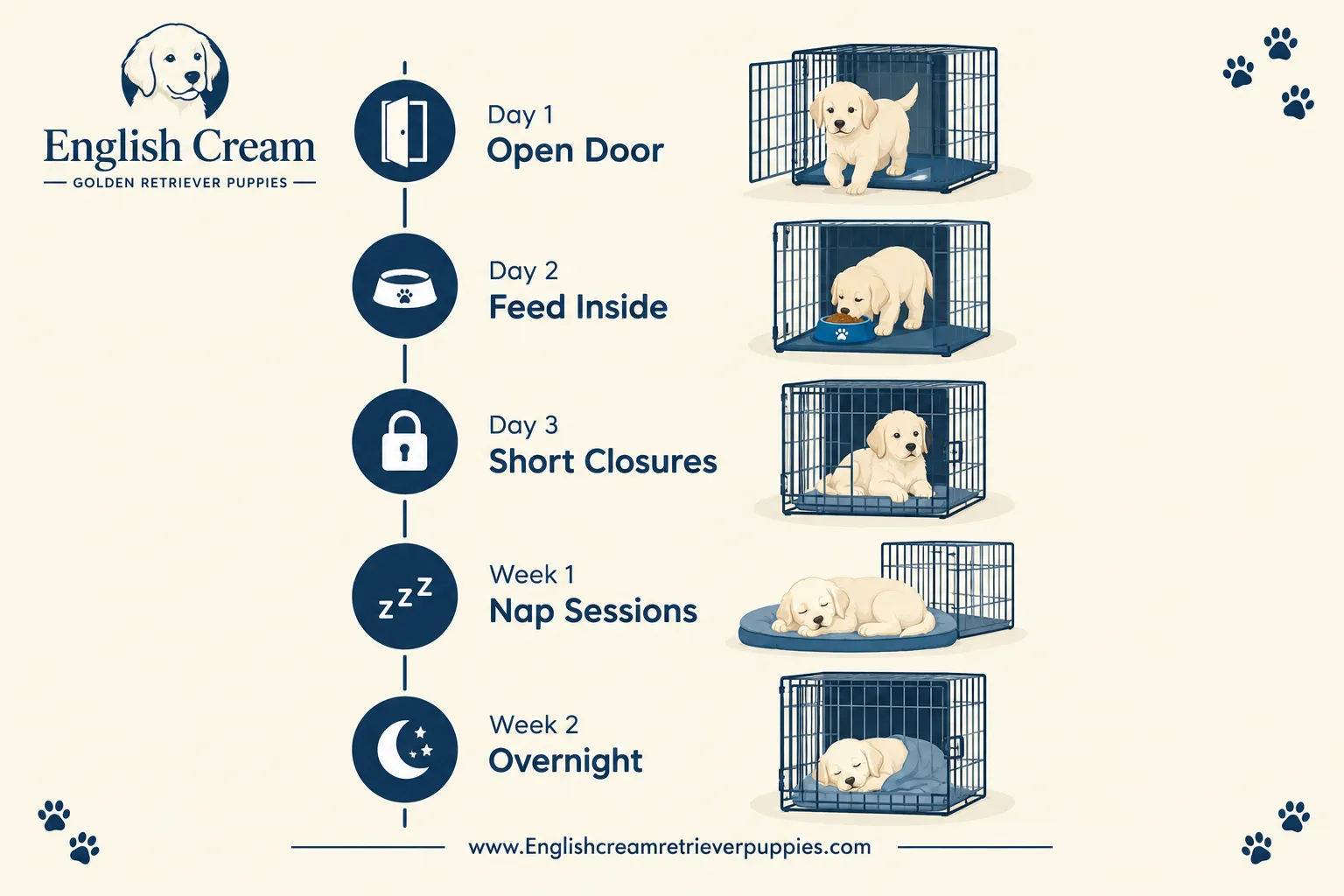
Here's how the phases usually break down:
- Week 1 (8-9 weeks old): Introduction and acclimation. Door open, meals inside, short closures while you're in the room.
- Weeks 2-4: Duration building. Naps with the door shut, you out of sight. Overnight stretches lengthen.
- Weeks 5-8: Independence. Puppy tolerates being alone, settles without vocalizing, goes in on cue.
- Months 4-6: Maintenance and testing short unsupervised freedom outside the crate.
Common mistake: Owners declare victory at week two because the puppy stopped crying, then stop crating entirely. The habit unravels, and by month five they're starting over with a 45-pound adolescent. Keep crating daily through at least six months, even on days you're home.
Edge case: Puppies that came home later (12-16 weeks) from a breeder who already crate trained them often skip phase one entirely. Puppies from environments with no crate exposure may need two extra weeks at phase one alone.
What Is the Best Crate Size for English Cream Golden Retriever Puppies?
A 42-inch crate with a divider panel is the best single purchase for an English cream golden retriever. It fits an 8-week-old puppy (with the divider set to about one-third of the length) and still fits the adult dog, which typically reaches 21-24 inches at the shoulder and 55-80 pounds.
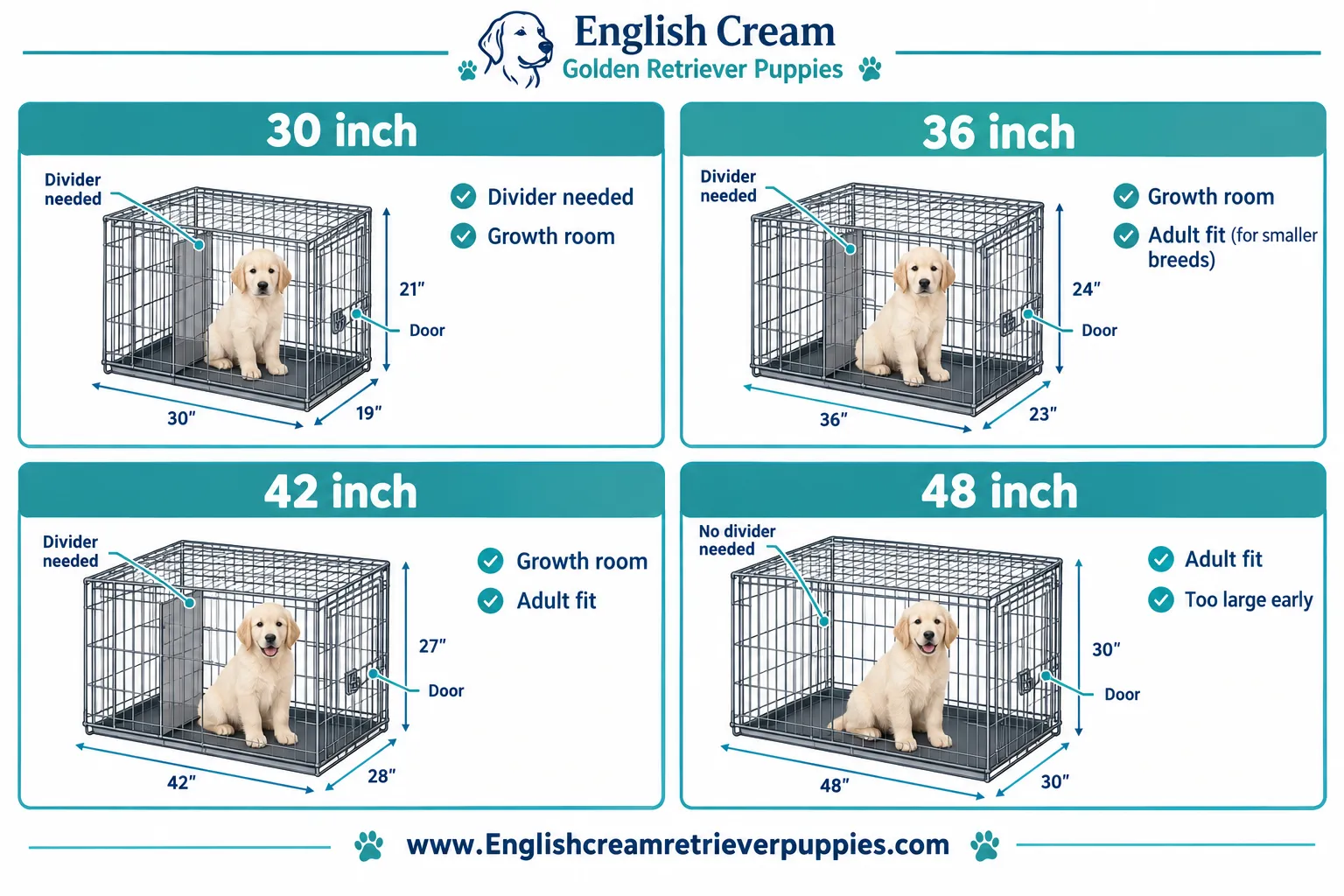
The sizing rule: your dog should be able to stand without ducking, turn around, and lie down fully stretched, and not much more. Extra space is the single most common cause of failed potty training in the crate, because the puppy simply uses one corner as a bathroom and sleeps in the other.
| Crate length | Best for | Notes |
|---|---|---|
| 30 in | 8-10 weeks only | Outgrown fast; skip unless you already own one |
| 36 in | 3-5 months | Works as a second/travel crate |
| 42 in | 8 weeks to adult (with divider) | The recommended primary crate for this breed |
| 48 in | Large males over 80 lbs | Often too roomy; only if your dog measures it |
Best Crates for English Cream Golden Retrievers
Choose by function, not price:
- Double-door wire crate with divider. The default choice. Good airflow, collapsible, easy to clean, divider included. Best for home use and hot climates.
- Hard-sided plastic kennel. More den-like and travel-approved. Better for anxious puppies who settle faster with fewer visual distractions.
- Furniture-style wooden crate. Fine for adults who are already crate-reliable. A poor first crate, goldens chew wood.
- Soft-sided fabric crate. Only for trained adult dogs. A teething puppy will be through the mesh in an afternoon.
- Heavy-duty steel crate. Rarely needed for this breed. Reserve for genuine escape artists.
Skip the plush bed for the first month. Use a flat, washable, chew-resistant mat instead, then upgrade once the chewing and accidents stop.
How Do You Introduce a Puppy to the Crate Without Stress?
Introduce the crate with food, not force. Spend the first 24 to 48 hours letting your puppy walk in and out freely with the door latched open, tossing treats inside and feeding every meal in the crate before you ever close the door.
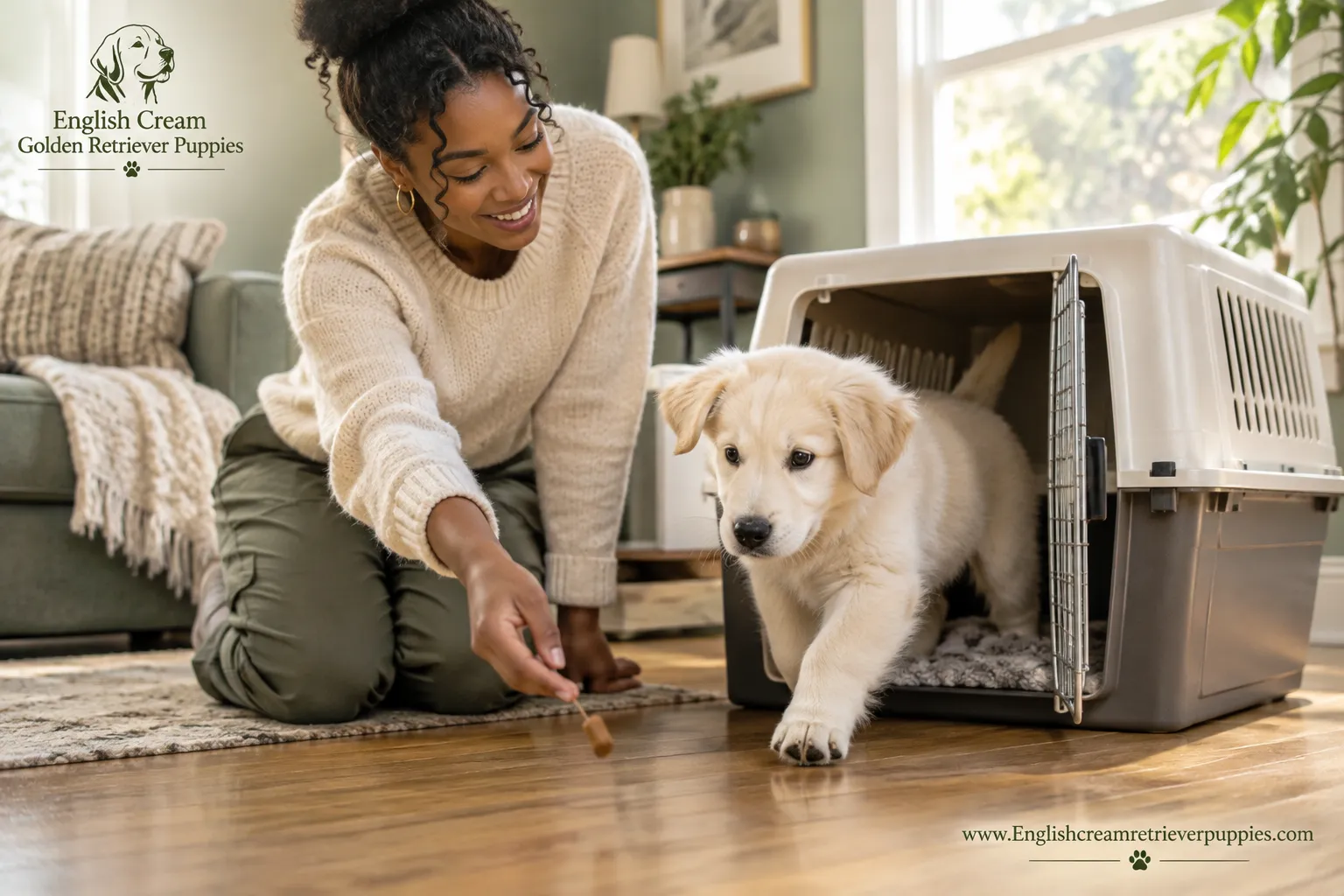
A step-by-step introduction that works:
- Place the crate where the family lives, living room or kitchen corner, not the basement or laundry room.
- Prop the door open and toss five or six small treats inside. Let the puppy retrieve them and leave. Repeat a dozen times.
- Feed all meals inside with the door open for two days.
- Close the door for 10 seconds while the puppy eats, then open it before they finish. Build to 30 seconds, then two minutes.
- Add a settle item, a frozen stuffed toy or safe chew that only appears in the crate.
- Leave the room briefly. Thirty seconds. Come back before any complaining starts.
- Move to real naps. After play and a potty break, crate the tired puppy. Sleep does most of your training for you.
Quick example: A 9-week-old cream puppy who fought a cold, empty crate on Sunday night was walking in on her own by Wednesday, the only change was serving every breakfast and dinner inside it and freezing a stuffed chew for nap time.
Common mistake: Using the crate only for departures. If the crate appears exclusively when you leave, the puppy learns that crate equals abandonment. Crate your puppy for 20 minutes while you cook dinner, several times a day.
Crate Training Golden Retriever Puppy Schedule by Age
Use age to set both crate duration and potty frequency. The working guideline most trainers use is one hour of daytime crate time per month of age, capped around four hours, with more generous overnight stretches because bladder control improves during sleep.
| Puppy age | Max daytime crate stretch | Daytime potty interval | Typical night stretch | Night potty breaks |
|---|---|---|---|---|
| 8-10 weeks | 1 hour | Every 45-60 min | 3-4 hours | 1-2 |
| 10-12 weeks | 1.5-2 hours | Every 1-2 hours | 4-6 hours | 1 |
| 3-4 months | 2-3 hours | Every 2-3 hours | 6-7 hours | 0-1 |
| 4-6 months | 3-4 hours | Every 3-4 hours | 7-8 hours | 0 |
| 6+ months | 4-5 hours | Every 4-6 hours | 8 hours | 0 |
These are ceilings, not targets. A puppy crated for the maximum every single day will develop problems. Break long days with a midday walker, a family member, or a lunch-hour visit.
How Many Hours Can a Golden Retriever Puppy Stay in a Crate?
Under six months, four to five hours is the absolute daytime maximum, and only once a day. Adult goldens over 12 months can manage six to eight hours occasionally, but a dog crated eight hours daily plus overnight is crated too much, that's 16 hours confined, and it shows up as hyperactivity, chewing, and barking.
Why Is My Golden Retriever Puppy Crying in the Crate?
Most crate crying is one of four things: a full bladder, too little exercise before crating, genuine separation distress, or simple protest at a new rule. Sort out the first three before you assume the fourth.
A quick triage:
- Crying 5-20 minutes after going in, escalating then fading: protest. Wait it out. Opening the door teaches your puppy that noise works.
- Crying after 2-4 hours of quiet sleep: bladder. Take them out on a leash, straight to the potty spot, no play, straight back in.
- Frantic panting, drooling, bent bars, bloody paws, soiling every time: true distress or confinement anxiety. Stop, back up several steps, and consult your vet or a certified trainer.
- Restless whining before bedtime: unspent energy. Add a training session and a chew before crating.
Decision rule: If your puppy settles within 15 minutes and sleeps, you're on track. If vocalizing escalates past 30 minutes, three nights in a row, something in the setup is wrong, usually crate location, bladder timing, or too much space inside.
How to Make Crate Training Easier for Anxious Puppies
- Move the crate into your bedroom for the first two weeks. Proximity beats "toughing it out."
- Cover three sides with a light blanket to reduce visual triggers.
- Add white noise or a fan to mask household sounds.
- Feed an interactive food toy at the moment the door closes.
- Shorten every session. Ten successful two-minute reps beat one failed hour.
- Never crate a puppy immediately after a scary event; you'll pair the crate with the fear.
Puppies raised with Early Neurological Stimulation (ENS) from birth, and exposed early to vacuum cleaners, children, and other animals, tend to move through this much faster. Stress resilience is built before eight weeks, which is why breeder selection matters so much.
Crate Training vs Pen for Golden Retriever Puppies
A crate and an exercise pen do different jobs. Crates teach a dog to settle and speed up potty training; pens give a puppy a safe area to be awake and mildly active when you can't supervise. Most successful households use both.
| Crate | Exercise pen | |
|---|---|---|
| Best for | Sleep, settling, potty training, travel | Longer absences, safe awake time |
| Potty training effect | Strongly positive | Neutral or negative (puppy can soil one corner) |
| Space needed | Small footprint | 4-6 ft square minimum |
| Chew/injury risk | Low | Moderate |
| Teaches calm? | Yes | Not reliably |
Choose a crate if your goal is house training and you'll be home for most of the day. Add a pen if you're gone longer than your puppy's bladder allows, attach the crate to the pen so the puppy can nap in the crate and relieve itself on a pad outside it. Skip the pen entirely once your puppy is potty-reliable and no longer chewing everything.
Can You Crate Train a Golden Retriever Too Late, and Is Crate Training Cruel?
No, it's never too late, but later is harder. Crate training an adolescent or adult golden typically takes two to three times longer than training a 9-week-old, because you're overwriting existing habits rather than building new ones. And no, crate training is not cruel when done correctly.
For older dogs, the process is identical but slower: feed every meal in the crate for a week before closing the door, use higher-value food, and build duration in one-minute increments. Expect four to eight weeks rather than one to two.
Crate training becomes genuinely unfair in specific, avoidable situations:
- The crate is used as punishment after an accident or a chewing incident.
- The dog is confined longer than its physical needs allow.
- The crate is too small to stand, turn, and stretch.
- Exercise and mental enrichment are replaced by confinement.
- A dog with diagnosed separation anxiety is forced into a crate without a behavior plan.
Done properly, most crate-trained goldens choose the crate on their own, door wide open, for afternoon naps. That's the clearest evidence it isn't cruel.
Crate Training a Golden Retriever Puppy at Night for Potty Breaks
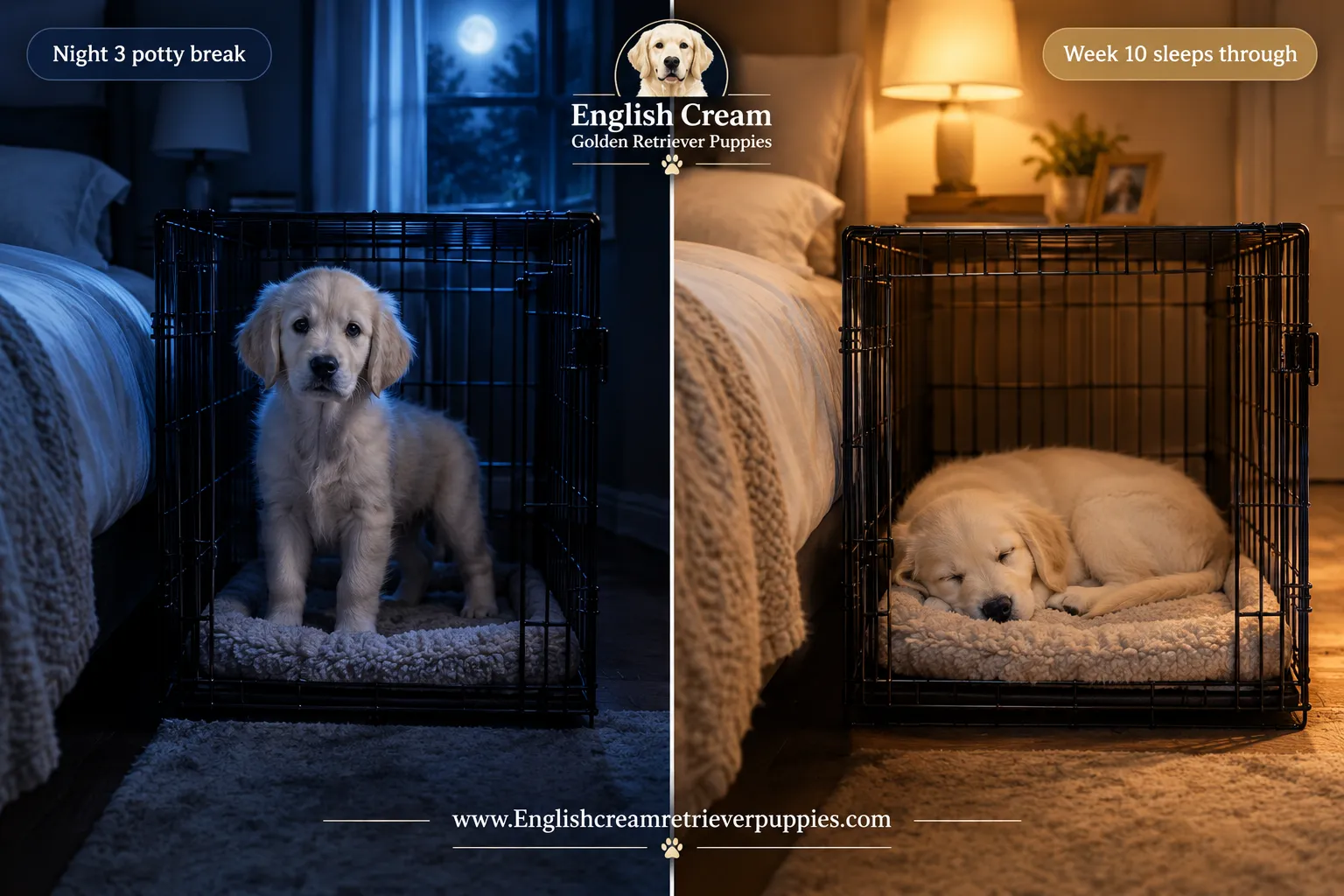
At night, set one alarm rather than waiting for crying. For an 8- to 10-week-old English cream golden retriever, an alarm about four hours after bedtime prevents the accident and prevents your puppy from learning that crying opens the door.
The night routine that works:
- Remove water roughly two hours before bed (keep normal daytime access).
- Final potty trip immediately before crating, no play, just business.
- Crate in your bedroom for the first one to two weeks.
- Alarm at the four-hour mark. Leash on, outside, praise for eliminating, straight back into the crate. Keep it boring and dark.
- Push the alarm 30 minutes later every three or four dry nights.
- Once you get three consecutive nights with no need for the break, drop it.
Common mistake: Turning the night potty break into a play session. A puppy who gets attention at 2 a.m. will request it at 2 a.m. for months.
What Puppy Pricing Tells You About Crate Training Readiness
Price correlates strongly with how much early developmental work a puppy received. Puppies that arrive already started on housebreaking and crate training cost more upfront and save weeks of work at home.
| Price range | Source type | What you typically get |
|---|---|---|
| $500,$1,000 | Almost always a scam | No puppy exists; deposits vanish |
| $1,000,$1,500 | Puppy mill / broker | No health testing, no socialization, no crate exposure |
| $2,000,$2,500 | Hobby breeder | Some care, inconsistent health testing, little early training |
| $3,500,$5,500 | Accredited breeder | Genetic health guarantee, supervised whelping, ENS from birth, early housebreaking and crate training started |
At Designer English Cream Golden Retrievers, our program is run by a working animal biologist with a degree in Animal Biology from Stockton University (Pomona, New Jersey) and a minor in animal genetics. Every one of our English cream retriever puppies comes from top European bloodlines, is started on Early Neurological Stimulation from birth, and is raised inside a busy home with children, other animals, vacuum cleaners, and everyday noise. Our puppies are broader and thicker through the chest and skull than typical American retrievers, many visitors say they look like baby Great Pyrenees.
Because our english cream golden retriever puppies leave here already well started on housebreaking and crate training, new families usually report a settled sleeper within the first week. That early foundation, plus genuine trainability, is why we're confident calling ourselves the best English Cream Retriever breeders in the USA. If you're comparing an english cream retriever against a doodle, we also raise several designer lines, including full-sized and mini goldendoodle puppies for sale and micro mini goldendoodle puppies, the crate training protocol in this guide applies to all of them.
Families ready to move forward can review our golden doodle breeder program details, reserve with a full-sized golden doodle deposit, or browse mini golden doodle puppies and mini bernedoodle puppies for sale.
Common Mistakes People Make Crate Training Golden Retrievers
The five mistakes below account for most crate training failures I see, and every one of them is fixable in a week.
- Buying a crate that's too big. A 48-inch crate with no divider hands an 8-week-old puppy a bathroom. Use the divider.
- Releasing the puppy while it's crying. You've just trained the crying. Wait for a three-second pause, then open.
- Using the crate as punishment. "Go to your crate!" said angrily poisons the association permanently.
- Skipping exercise. A golden retriever puppy needs physical and mental work before confinement. Five minutes of nose work or training tires a puppy faster than a walk.
- Leaving collars, tags, or long-line leashes on. Genuine strangulation hazard. Crate naked, or use a breakaway collar.
Two more worth naming: giving up after four bad nights (most puppies turn the corner between nights five and eight), and letting the crate disappear at six months, which removes your safety net right when adolescent chewing peaks.
.cg-crate-calc{font-family:system-ui,-apple-system,Segoe UI,Roboto,sans-serif;max-width:560px;margin:0 auto;padding:18px;border:1px solid #d9d2c5;border-radius:10px;background:#fdfbf7;color:#23303d}
.cg-crate-calc h3{margin:0 0 4px;font-size:1.15rem;color:#1c3a5b}
.cg-crate-calc p.cg-sub{margin:0 0 14px;font-size:.85rem;color:#6b6257}
.cg-crate-calc label{display:block;font-size:.85rem;font-weight:600;margin-bottom:6px}
.cg-crate-calc input[type=range]{width:100%}
.cg-crate-age{font-weight:700;color:#1c3a5b}
.cg-crate-out{margin-top:14px;display:grid;grid-template-columns:1fr;gap:8px}
.cg-crate-row{display:flex;justify-content:space-between;align-items:center;background:#fff;border:1px solid #e6dfd2;border-radius:8px;padding:9px 12px;font-size:.9rem}
.cg-crate-row span:last-child{font-weight:700;color:#0f5c4a}
.cg-crate-note{margin-top:12px;font-size:.78rem;line-height:1.45;color:#6b6257}
English Cream Golden Retriever Crate Time Calculator
Slide to your puppy’s age for daytime limits, potty intervals, and night expectations.
Guideline only, based on the common one-hour-per-month-of-age rule used by professional trainers. Health issues, diet, and recent water intake change these numbers. Never exceed 5 hours for a puppy under 6 months.
(function(){
var s=document.getElementById(‘cg-crate-slider’);
function up(){
var w=+s.value,m=w/4.345,day,potty,night,br,size;
document.getElementById(‘cg-crate-age’).textContent=w+’ weeks (‘+m.toFixed(1)+’ months)’;
if(w<10){day='1 hr';potty='45-60 min';night='3-4 hrs';br='1-2';size='42 in + divider (1/3)';}
else if(w<13){day='1.5-2 hrs';potty='1-2 hrs';night='4-6 hrs';br='1';size='42 in + divider (1/2)';}
else if(w<18){day='2-3 hrs';potty='2-3 hrs';night='6-7 hrs';br='0-1';size='42 in + divider (2/3)';}
else if(w<26){day='3-4 hrs';potty='3-4 hrs';night='7-8 hrs';br='0';size='42 in, divider out';}
else{day='4-5 hrs';potty='4-6 hrs';night='8 hrs';br='0';size='42-48 in, full length';}
document.getElementById('cg-day').textContent=day;
document.getElementById('cg-potty').textContent=potty;
document.getElementById('cg-night').textContent=night;
document.getElementById('cg-breaks').textContent=br;
document.getElementById('cg-size').textContent=size;
}
s.addEventListener('input',up);up();
})();
Frequently Asked Questions
Should I put water in the crate?
For sessions under two hours, no. For longer stretches or in hot weather, use a clip-on bowl or a spill-proof bottle attached to the door. Remove water about two hours before bedtime.
Where should the crate go at night?
Your bedroom for the first one to two weeks. Puppies settle faster near their people. After that, you can gradually move it to its permanent location a few feet at a time.
How long will my puppy cry the first night?
Most 8- to 10-week-old puppies cry 10 to 40 minutes on night one and noticeably less by night four. If crying is still escalating past 30 minutes after a week, re-check the setup rather than waiting it out.
Can two puppies share a crate?
No. Littermates should have separate crates. Shared crates prevent independence, make potty training nearly impossible to track, and can lead to resource fights.
Should I cover the crate with a blanket?
Covering three sides helps most puppies, especially anxious ones. Leave the front open for airflow and use a breathable blanket the puppy can't pull inside and chew.
What do I do if my puppy poops in the crate every night?
Check three things: crate too large, last meal too late, or the night potty break is too late. Feed dinner at least three hours before bed, tighten the divider, and set the alarm 45 minutes earlier.
Is a soft crate okay for a golden retriever puppy?
Not as a first crate. Teething goldens chew through fabric mesh quickly. Use soft-sided crates only with adults that are already reliably crate-trained.
Do I still need a crate after my dog is house-trained?
Not strictly, but keep it available. A crate-comfortable adult handles vet rest, travel, storms, and houseguests far better than one that has never used one.
Can I crate train while working full time?
Yes, with help. A puppy under four months cannot hold its bladder for an eight-hour workday. Arrange a midday walker or use a crate-plus-pen setup until bladder control catches up.
Conclusion: Your First Two Weeks, Step by Step
Crate training English cream golden retriever puppies isn't complicated, but it's unforgiving of shortcuts. Get the crate size right, feed inside it, respect your puppy's bladder timeline, and never open the door to crying, those four rules cover most of the work.
Your next steps:
- Order a 42-inch wire crate with a divider and a flat washable mat before your puppy comes home.
- Set the divider so the puppy has room to stand, turn, and stretch, and nothing more.
- Place the crate in your bedroom for the first two weeks, with a second crate or the same one moved to the family room for daytime naps.
- Write your schedule on paper using the age table above, including one night alarm.
- Feed every meal in the crate for the first seven days, door open at first.
- Track progress for two weeks, crying duration, accidents, longest night stretch. If the numbers aren't improving by day ten, shorten sessions and rebuild.
- Ask your breeder what they already started. Puppies that arrived with crate and housebreaking foundations already in place need far less from you.
Start on day one, stay boring and consistent at 2 a.m., and within a few weeks you'll have a calm cream-coated puppy who walks into the crate on her own and goes to sleep.