


Last updated: September 27, 2026
Quick Answer
A fully grown English cream golden retriever typically stands 20 to 24 inches at the shoulder and weighs 55 to 80 pounds, with males at the top of that range and females at the bottom. English cream golden retriever size is not smaller than a standard American golden retriever, despite the myth. The English (European) type is usually the same height or slightly shorter, but broader through the chest, blockier in the skull and heavier in bone, which makes many of them look bigger than their American cousins at the same weight.
Key Takeaways
- Adult males: roughly 23 to 24 inches tall, 65 to 80 pounds. Adult females: roughly 20 to 22.5 inches, 55 to 70 pounds.
- English cream golden retrievers are not a smaller variety, they are a color and conformation type, not a separate breed or size class.
- The UK Kennel Club standard allows males up to 24 inches (61 cm); the American Kennel Club standard allows males up to 24 inches as well, so the height ranges overlap almost exactly.
- Most of the height is reached by 12 months; chest, skull and muscle keep filling out until 18 to 24 months.
- Coat volume, not body size, drives shedding. A broader dog with a thick European coat sheds more by volume than a leaner dog.
- They can live in apartments, but only with 60 to 90 minutes of daily exercise and a household that plans for a 70-pound dog in a small space.
- The safest adult crate for most English creams is a 42-inch crate; very large males often need 48 inches.
- Keeping a growing puppy lean is the single most effective way to lower hip, elbow and joint risk later in life.
How Big Do English Cream Golden Retrievers Get?
An English cream golden retriever reaches its full adult frame at 12 to 18 months and its full adult mass closer to 24 months. Expect 65 to 80 pounds and 23 to 24 inches for males, and 55 to 70 pounds and 20 to 22.5 inches for females.
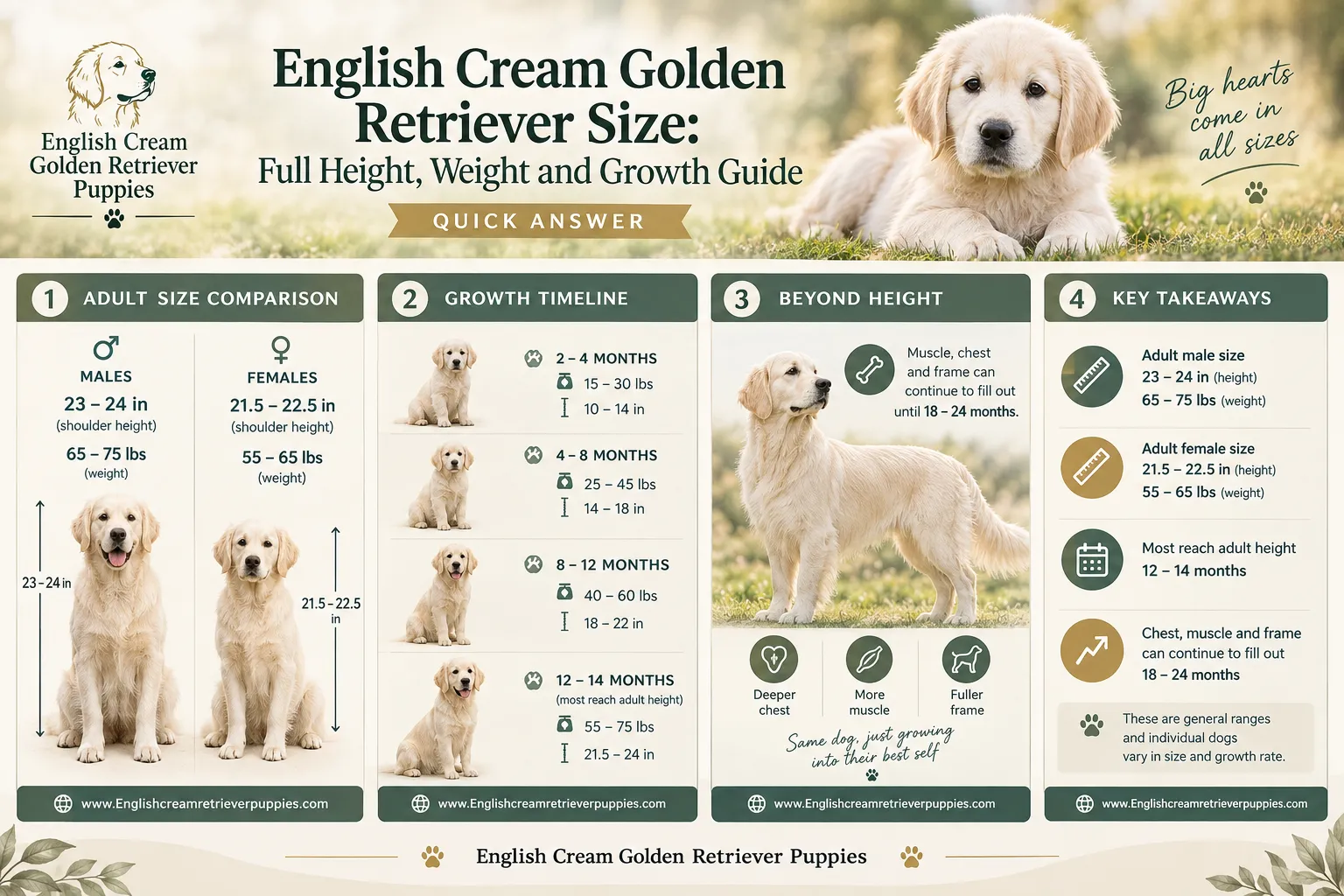
Height is always measured at the withers (the ridge between the shoulder blades), not at the top of the head. That matters, because owners who measure to the skull routinely overestimate their dog by three or four inches.
What makes the European type look larger:
- Broader skull and wider muzzle, giving a blockier head silhouette
- Deeper, wider chest with well-sprung ribs
- Heavier bone through the legs and shorter, sturdier leg length relative to body
- Denser, more profuse coat that adds visual bulk, especially around the neck and hindquarters
Well-bred European-line puppies genuinely do look like "baby Great Pyrenees" as youngsters, pale, thick, wide-headed and heavy-footed. That impression comes from bone and coat, not from extra height.
Two dogs can weigh exactly 70 pounds and look a size apart. The English type carries that weight wider and lower; the American type carries it longer and taller.
English Cream Golden Retriever Weight and Height Chart by Age
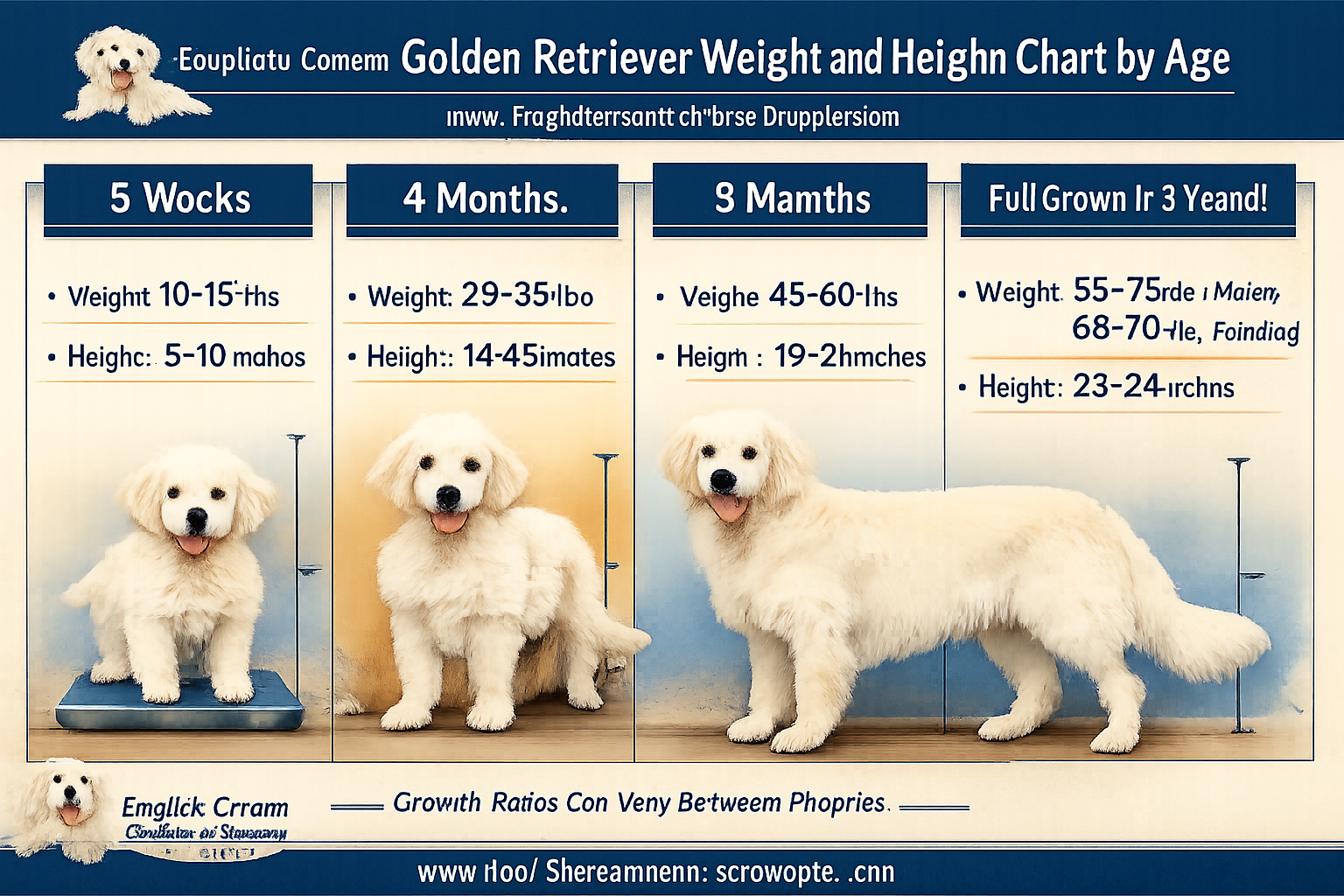
Below is a practical growth reference for English cream golden retriever size by age. These are typical breeder-observed ranges for European-line goldens, not clinical study figures, so treat them as planning estimates and let your veterinarian assess your individual puppy.
| Age | Female weight | Male weight | Approx. height at withers |
|---|---|---|---|
| 8 weeks | 9-14 lb | 10-16 lb | 8-10 in |
| 3 months | 20-27 lb | 22-30 lb | 12-14 in |
| 4 months | 26-34 lb | 30-40 lb | 14-17 in |
| 6 months | 38-48 lb | 45-58 lb | 17-20 in |
| 9 months | 48-60 lb | 56-70 lb | 19-22 in |
| 12 months | 53-66 lb | 62-75 lb | 20-24 in |
| 18-24 months | 55-70 lb | 65-80 lb | 20-24 in (final) |
How to use the chart: find your puppy's age, then check whether they sit inside the range for their sex. A puppy tracking slightly under is usually fine. A puppy tracking well above is more often overfed than "big-boned," and excess weight during growth is a real orthopedic risk.
Common mistake: assuming a heavy 8-week-old will become a giant adult. Litter position, worm burden and weaning diet all skew early weights. Growth curve shape from 4 to 9 months predicts adult size far better than birth or 8-week weight.
Rough estimate rule: most golden retrievers reach about 60 percent of adult weight by 6 months and about 90 to 95 percent by 12 months. Divide the 6-month weight by 0.60 for a ballpark adult figure.
Are English Cream Golden Retrievers Smaller Than Regular Golden Retrievers?
No. English cream golden retrievers are not smaller than "regular" golden retrievers. The two are the same breed under different registry standards, and the height ranges overlap almost completely. Where they differ is shape, not size.

The confusion comes from marketing language. Terms like "English cream," "white golden retriever" and "platinum retriever" describe coat color and European conformation. None of them describes a miniature or reduced-size variety. If a seller advertises a "mini English cream golden retriever," you are almost certainly looking at a crossbreed, most often a retriever-poodle mix. That can be a wonderful dog, but it is not a smaller golden retriever. Buyers who genuinely want a smaller companion should look at purpose-bred crosses such as mini golden doodle puppies rather than expecting a scaled-down purebred.
English Cream vs American Golden Retriever Size Difference
| Trait | English / European type | American type |
|---|---|---|
| Male height | 22-24 in (KC standard 56-61 cm) | 23-24 in (AKC standard) |
| Female height | 20-22 in (KC standard 51-56 cm) | 21.5-22.5 in (AKC standard) |
| Typical male weight | 65-80 lb | 65-75 lb |
| Build | Broader chest, blockier skull, heavier bone | Longer legs, narrower chest, more angular head |
| Coat | Cream to pale gold, dense, often longer feathering | Gold to dark red-gold, moderate |
| Visual impression | Stockier, "thicker" | Leaner, more athletic outline |
Decision rule: choose the English type if you want a broad, substantial, pale dog with a calm outward presence. Choose the American type if you prefer a lighter-framed, higher-drive field look. Neither choice meaningfully changes how much dog you are feeding, crating or lifting into a car.
How Much Does an English Cream Golden Retriever Weigh Fully Grown?
Fully grown, an English cream golden retriever weighs 55 to 70 pounds if female and 65 to 80 pounds if male, measured once the dog is at least 18 months old and in lean body condition. Dogs above 85 pounds are usually overweight rather than unusually large.
Three things shift the final number:
- Sex, males average 8 to 12 pounds heavier than females from the same litter.
- Parent size, the best predictor available. Ask a breeder for the sire's and dam's current adult weights, not their "expected" weights.
- Neuter timing, dogs neutered before growth plates close often end up slightly taller with lighter bone. Discuss timing with your vet.
Edge case: a small number of European-line males from heavy show lines mature at 85 to 90 pounds in genuinely lean condition. That is uncommon, and a vet should confirm it with a hands-on body condition assessment before you accept it as "just a big dog."
Our own program breeds exclusively from top European bloodlines, and our breeding dogs sit squarely inside the standard ranges above, broader and thicker than typical United States retrievers, but not oversized. You can see current litters and adult parent weights on our english cream golden retriever puppies availability page.
English Cream Golden Retriever Growth Rate: How Fast Do They Grow?
English cream golden retrievers grow fastest between 8 weeks and 6 months, when a puppy can gain 2 to 4 pounds a week. Growth slows sharply after 6 months, height is essentially final by 12 months, and filling out continues until 18 to 24 months.

A realistic timeline:
- 8-16 weeks: rapid weight gain, soft puppy coat, loose joints. Restrict stairs and jumping.
- 4-6 months: legs lengthen faster than the body fills, so many puppies look gangly and tall-legged. This is normal.
- 6-9 months: growth rate halves. Chest starts to drop and widen.
- 9-12 months: final height reached for most dogs. Adult coat begins coming in.
- 12-24 months: head broadens, chest deepens, feathering thickens. Expect another 5 to 10 pounds of mature muscle and bone.
Common mistake: free-feeding during the 4-to-6-month stretch because the puppy "looks skinny." A leggy, lean adolescent is exactly what you want. Large-breed puppy food with controlled calcium and measured meals protects the joints while the frame sets.
Do Male and Female English Cream Golden Retrievers Differ in Size?
Yes. Males are consistently taller, heavier and broader. The practical gap is about 1.5 to 2 inches in height and 8 to 12 pounds in weight, plus a noticeably wider skull and thicker neck in mature males.
- Males: 23-24 in, 65-80 lb, blockier head, heavier ruff, slower to mature mentally (often 2.5 to 3 years)
- Females: 20-22.5 in, 55-70 lb, finer head, lighter frame, typically settle earlier
Choose a female if you want a slightly smaller dog that is easier to lift, bathe and manage in a compact home. Choose a male if you want maximum presence and the classic broad "teddy bear" head, and you are comfortable handling more dog on leash during adolescence.
Size differences between the sexes do not translate into differences in trainability. Both respond identically to consistent, reward-based work.
Do English Cream Golden Retrievers Shed More Because of Their Size?
Body size is only part of it. English cream golden retrievers shed heavily because they carry a dense double coat, and a broader dog simply has more surface area growing that coat. A 78-pound European-line male will drop noticeably more hair than a 58-pound female, even on identical grooming routines.
What actually drives shedding volume:
- Coat density and length, European lines often carry a thicker undercoat
- Seasonal coat blow, two heavier sheds per year, typically spring and fall
- Body surface area, bigger dog, more hair
- Grooming frequency, undercoat left in place becomes loose hair on your floor
- Diet and skin health, poor coat condition increases breakage and loss
A workable routine: brush with an undercoat rake or slicker two to three times weekly, daily during a seasonal shed, bathe every 4 to 6 weeks, and never shave the coat. Shaving damages the undercoat's insulating structure without reducing long-term shedding.
If shedding is a deal-breaker, a golden retriever of any type is the wrong choice. Low-shedding alternatives in a similar temperament family include full-sized golden doodles and smaller micro golden doodle puppies.
Is an English Cream Golden Retriever Good for Apartments?
Yes, with conditions. English cream golden retriever size makes apartment life workable but not effortless: a 70-pound dog needs floor space, elevator access and, critically, 60 to 90 minutes of real daily exercise split across at least two outings.
An apartment works if you can check most of these boxes:
- Ground floor or reliable elevator (carrying a 75-pound dog up stairs is not sustainable)
- Green space or a park within a short walk
- At least a 4-by-4-foot corner for a 42-inch crate plus bed
- Two or more structured walks daily, plus sniff-work or fetch
- Tolerance for seasonal shedding on carpet and upholstery
- Building weight limits above 80 pounds
It does not work if the dog is alone 10 hours a day with no midday break. Under-exercised adolescent goldens chew baseboards, bark and pace. Size amplifies every consequence of boredom.
Quick example: a fifth-floor apartment with a working elevator, a park two blocks away and a midday dog walker is a better home for an English cream than a suburban house with a fenced yard and an owner who never leaves the couch. Access and routine beat square footage.
English Cream Golden Retriever Size and Health Problems
The health risks tied to English cream golden retriever size are mostly orthopedic and weight-driven: hip and elbow dysplasia, cruciate injury, and arthritis, all of which worsen with excess body weight. Large size itself is not the problem; rapid growth and extra pounds are.
Size-related conditions to plan for:
- Hip and elbow dysplasia, screened in breeding stock via OFA or PennHIP evaluation. Always ask to see parent results.
- Cranial cruciate ligament tears, more common in heavy, under-conditioned dogs
- Osteoarthritis, accelerated by every extra pound carried over years
- Bloat (gastric dilatation-volvulus), a risk in deep-chested breeds; avoid hard exercise right after large meals
- Hypothyroidism, can present as unexplained weight gain in adults, worth testing before assuming overfeeding
Practical risk reduction: feed a large-breed puppy formula until roughly 14 to 18 months, measure every meal, keep treats under 10 percent of daily calories, avoid forced repetitive jumping before 12 months, and keep the dog visibly lean for life.
Reputable breeders also matter here. Our program is run by a working animal biologist holding a degree in Animal Biology from Stockton University in Pomona, New Jersey, with a minor in animal genetics, which is exactly the background that drives pairing decisions, orthopedic screening and the written genetic health guarantee behind every English cream retriever puppies litter we produce.
How to Tell If Your English Cream Golden Retriever Is Overweight
Use your hands, not the scale. In ideal condition you should feel your dog's ribs easily under a thin layer of fat, see a clear waist tuck from the side, and see an hourglass outline from above. Losing any of those three signs means the dog is carrying too much weight.
A 30-second home check:
- Rib test, run flat palms along the ribcage. Ribs should feel like the back of your hand. If they feel like your knuckles, the dog is too thin; like your palm, too heavy.
- Overhead view, stand above the dog. Look for a visible narrowing behind the ribs.
- Side profile, the belly should slope upward from the chest to the hind legs, not run level.
- Spine and hip check, you should feel bony landmarks with light pressure, never see them prominently.
Veterinary body condition scoring uses a 9-point scale, where 4 to 5 is ideal and each point above 5 represents roughly 10 to 15 percent excess body weight (WSAVA Global Nutrition Committee body condition score guidelines). Ask your vet to score your dog at every visit and record it.
Edge case worth catching: a heavily coated English cream can hide two-point weight gain completely. Coat volume fools the eye, which is precisely why the hands-on rib test is the standard, not visual appraisal.
What Size Crate Do I Need for an English Cream Golden Retriever?
For most adult English cream golden retrievers, a 42-inch crate (roughly 42 x 28 x 30 inches) is correct. Large males over 75 pounds and 24 inches tall are often more comfortable in a 48-inch crate. Buy the adult size once and use a divider panel during puppyhood.

Sizing method:
- Length: measure nose to tail base, add 2 to 4 inches
- Height: measure floor to top of head while sitting, add 2 to 4 inches
- Puppy stage: block the crate to about 1.5 times the puppy's lying length so it stays a den, not a bathroom
| Stage | Crate length | Notes |
|---|---|---|
| 8-16 weeks | 42 in with divider | Reduce space to prevent soiling |
| 4-8 months | 42 in, divider widened | Most dogs never need a second crate |
| Adult female | 42 in | Comfortable for 55-70 lb dogs |
| Adult male (75 lb+) | 48 in | Extra headroom for tall, broad dogs |
Common mistake: buying a small crate for the puppy and a second one later. That wastes money and restarts crate training. One correctly divided 42-inch crate covers the entire first year.
Crate training goes much faster when the breeder started it. Our puppies are well started on housebreaking and crate training before they leave, they are handled with Early Neurological Stimulation (ENS) from the first days of life, and they are raised inside a busy home with children, other animals and ordinary household noise. That early exposure is why families consistently report that our english cream retriever puppies settle into crates, routines and basic obedience quickly, and it is a core reason we consider ourselves the best English Cream Retriever breeders in the USA.
What Should a Properly Sized, Properly Raised Puppy Cost?
Price tracks health testing, whelping standards and early training far more closely than it tracks size. Understanding the tiers protects you from buying an unhealthy dog.
| Price range | What it usually signals |
|---|---|
| $500,$1,000 | Scam listings, stolen photos, deposit fraud, or no dog at all |
| $1,000,$1,500 | Puppy mill or volume broker; no orthopedic screening, poor socialization |
| $2,000,$2,500 | Hobby breeder; often well-meaning, limited testing and no early training |
| $3,500,$5,500 | Accredited breeder: genetic health guarantee, OFA screening, supervised whelping, ENS, early housebreaking and crate training |
Decision rule: if a "European import English cream" is offered under $1,500, assume the health screening did not happen. The cost of one hip surgery exceeds the entire price difference between tiers.
Frequently Asked Questions
How big do English cream golden retrievers get?
Males reach 23 to 24 inches and 65 to 80 pounds; females reach 20 to 22.5 inches and 55 to 70 pounds, measured at the withers in lean condition.
Are English cream golden retrievers bigger than American goldens?
They are usually the same height but broader and heavier-boned, so they look bigger. Average adult weights differ by only a few pounds.
At what age is an English cream golden retriever full grown?
Height is final around 12 months. Chest depth, head width and muscle continue developing until 18 to 24 months.
Is there a miniature English cream golden retriever?
No. There is no recognized miniature variety. Dogs sold under that name are typically retriever-poodle crosses.
How does English cream golden retriever size compare to a Labrador?
They are nearly identical in weight. Labradors run 55 to 80 pounds and 21.5 to 24.5 inches. The golden carries a longer double coat and more feathering, which makes it look larger.
What size crate does an adult need?
A 42-inch crate suits most adults. Males over 75 pounds and 24 inches usually do better in a 48-inch crate.
Do English cream golden retrievers shed a lot?
Yes. The dense double coat sheds year-round with two heavier seasonal sheds. Brushing two to three times a week manages most of it.
Can an English cream golden retriever live in an apartment?
Yes, if the dog gets 60 to 90 minutes of daily exercise, has elevator or ground-floor access, and is not left alone for full workdays.
How much should a 6-month-old English cream weigh?
Roughly 45 to 58 pounds for males and 38 to 48 pounds for females, or about 60 percent of adult weight.
Does size affect lifespan?
Within the breed, leaner dogs generally stay mobile longer. Excess weight is a bigger lifespan factor than height or frame.
Conclusion
English cream golden retriever size lands solidly in the medium-large category: 20 to 24 inches tall, 55 to 80 pounds, broader and thicker than the typical American golden but no taller. The "English creams are smaller" claim is a persistent myth, and the "English creams are giant" claim usually describes an overweight dog.
Your next steps:
- Ask any breeder for the sire's and dam's current adult weights and heights, plus OFA or PennHIP results. Parent size is the best available predictor.
- Buy one 42-inch crate with a divider before the puppy comes home, not two crates in sequence.
- Weigh your puppy monthly and compare against the chart above, keeping them at the lean end of the range.
- Run the hands-on rib and waist check every month for life, and get a body condition score at every vet visit.
- Plan the exercise honestly before you commit: 60 to 90 minutes daily, every day, for more than a decade.
Get those five things right and the size of the dog stops being a concern and becomes exactly what you wanted: a broad, calm, substantial companion that fits your home instead of overwhelming it.
.cg-ecgr{font-family:system-ui,-apple-system,Segoe UI,Roboto,sans-serif;max-width:560px;margin:0 auto;padding:18px;background:#fbf8f2;border:1px solid #e3dccd;border-radius:10px;color:#24303d}
.cg-ecgr h2{font-size:1.15rem;margin:0 0 4px;color:#1d3557}
.cg-ecgr p.cg-sub{font-size:.85rem;margin:0 0 14px;color:#5d6b7a}
.cg-ecgr label{display:block;font-size:.85rem;font-weight:600;margin:10px 0 4px}
.cg-ecgr select,.cg-ecgr input{width:100%;padding:9px;border:1px solid #c9c0ac;border-radius:6px;font-size:.95rem;background:#fff;box-sizing:border-box}
.cg-ecgr button{width:100%;margin-top:14px;padding:11px;border:0;border-radius:6px;background:#1d3557;color:#fff;font-size:.95rem;font-weight:600;cursor:pointer}
.cg-ecgr button:hover{background:#2b4a75}
.cg-out{margin-top:14px;padding:14px;background:#fff;border-left:4px solid #c8a25b;border-radius:6px;font-size:.92rem;display:none}
.cg-out b{color:#1d3557;font-size:1.05rem}
.cg-note{font-size:.72rem;color:#6b7784;margin-top:12px;line-height:1.4}
Adult Size Estimator
Estimate your English cream golden retriever’s mature weight and crate size.
2 months
3 months
4 months
6 months
8 months
12 months
MaleFemale
Estimate only, based on the common guideline that golden retrievers reach about 60% of adult weight by 6 months and 90-95% by 12 months. Individual dogs vary; confirm with your veterinarian.
document.getElementById(‘cg-go’).addEventListener(‘click’,function(){
var f=parseFloat(document.getElementById(‘cg-age’).value),
w=parseFloat(document.getElementById(‘cg-wt’).value),
s=document.getElementById(‘cg-sex’).value,r=document.getElementById(‘cg-res’);
if(!w||w=75||s===’m’&&mid>=72)?’48-inch crate’:’42-inch crate’;
var flag=mid>85?’Above the usual breed range, ask your vet to check body condition.’:(mid<52?'Below the usual breed range, likely a lighter-framed dog or an early growth lag.':'Within the normal range for the breed.');
r.style.display='block';
r.innerHTML='Estimated adult weight: ‘+lo+’, ‘+hi+’ lb
Typical range for this sex: ‘+typ+’
Expected adult height: ‘+ht+’
Recommended crate: ‘+crate+’
‘+flag+’‘;
});
Sources
- American Kennel Club, Golden Retriever Breed Standard (2023), https://www.akc.org/dog-breeds/golden-retriever/
- The Kennel Club (UK), Retriever (Golden) Breed Standard (2024), https://www.thekennelclub.org.uk/breed-standards/gundog/retriever-golden/
- WSAVA Global Nutrition Committee, Body Condition Score Charts (2020), https://wsava.org/global-guidelines/global-nutrition-guidelines/
- Orthopedic Foundation for Animals, Hip and Elbow Dysplasia Screening (2024), https://ofa.org/diseases/hip-dysplasia/