


Last updated: September 27, 2026
Quick Answer
Searching for English cream retriever puppies near by usually means one of two things: you want a local breeder you can visit, or you want a vetted breeder who will deliver a well-socialized puppy to your area. English cream (or "European" style) golden retrievers are the same AKC breed as American goldens, but they come from British and European bloodlines that produce a paler coat, a broader head, and a stockier frame. Expect to pay $3,500,$5,500 from an accredited breeder with full genetic health testing, early neurological stimulation, and started housebreaking and crate training. Anything under $1,500 is almost always a scam, a broker, or a puppy mill.
Key Takeaways
- English cream golden retrievers are not a separate breed. They are golden retrievers from European bloodlines, judged under a standard that allows cream coats.
- "White golden retriever," "platinum," and "English cream" describe the same coat range. No golden retriever is truly white.
- Legitimate pricing tiers in 2026: scam listings $500,$1,000, puppy mills/brokers $1,000,$1,500, hobby breeders $2,000,$2,500, accredited breeders with genetic health guarantees $3,500,$5,500.
- Ask for four health clearances on both parents: hips, elbows, heart (cardiologist), and eyes (ophthalmologist), plus DNA panels for PRA, ICT, and NCL.
- Golden retrievers shed year-round with two heavy seasonal blowouts. The thicker English coat means more volume, not less.
- Puppies from programs using ENS (Early Neurological Stimulation) and household noise exposure generally settle faster into crates, cars, and family routines.
- Socialization should start at the breeder before 8 weeks and continue hard through week 16.
- The biggest first-year mistakes are overfeeding a fast-growing large breed, skipping crate structure, and buying on emotion from an unverified seller.
What is an English cream retriever?
An English cream retriever is a golden retriever descended from European (largely British) bloodlines whose coat falls in the pale cream to light gold range. The Kennel Club (UK) breed standard permits "any shade of gold or cream," while the American Kennel Club standard describes a "rich, lustrous golden" and penalizes extremely pale coats. Same breed, different regional breeding priorities.
Beyond color, European-line goldens tend to differ in build:
- Broader, blockier skull with a shorter, deeper muzzle
- Heavier bone and a stockier, more square outline
- Thicker, plusher double coat with a fuller ruff
- Often a slightly calmer default temperament, though individual lines matter far more than the label
That heavier coat and broad head are why so many owners say a cream puppy looks like a "baby Great Pyrenees." Our program at English cream retriever puppies breeds specifically for that broader, thicker European type rather than the leaner American show look.
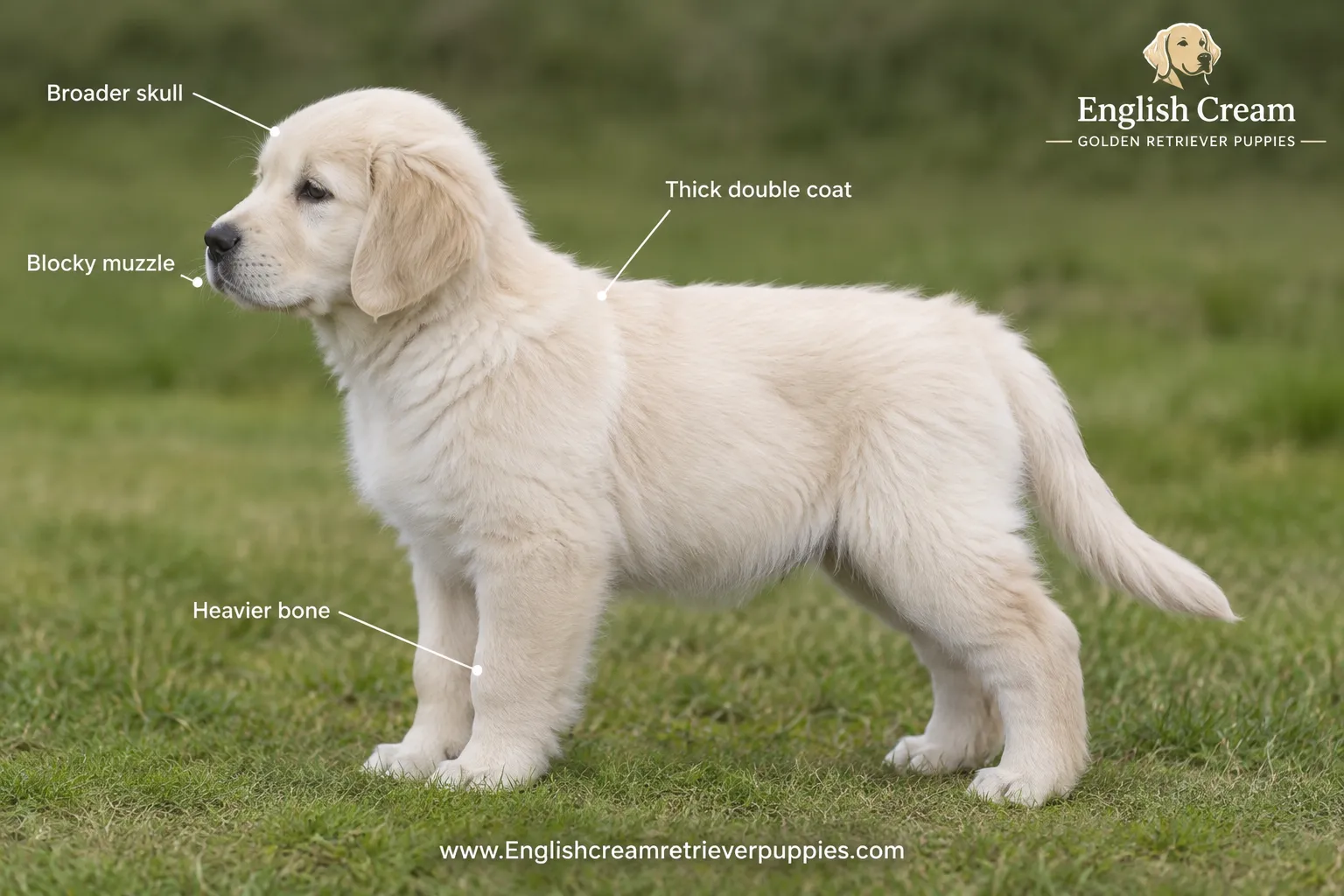
Decision rule: choose an English cream line if you want a heavier-boned, plush-coated family dog and you're prepared for real grooming work. Choose an American golden line if you want a lighter, often more driven dog for field work or high-tempo sports.
English cream retriever vs golden retriever vs white golden retriever: what's the difference?
There is no genetic difference in breed. All three names describe golden retrievers. "English cream" refers to European bloodlines and pale coat, "white golden retriever" and "platinum retriever" are marketing terms for the same pale coloring, and "golden retriever" is the registered breed name for all of them.
| Feature | English cream (European lines) | American golden retriever | "White golden retriever" |
|---|---|---|---|
| Breed registry | Golden Retriever (AKC/KC) | Golden Retriever (AKC) | Golden Retriever (AKC) |
| Coat color | Pale cream to light gold | Medium to rich gold or red | Same as English cream |
| Head shape | Broad, blocky, deep muzzle | Narrower, more refined | Varies |
| Build | Stockier, heavier bone | Taller, leaner | Varies |
| Typical price (accredited) | $3,500,$5,500 | $2,500,$4,500 | Same as English cream |
| Registry note | Pale cream allowed under KC standard | Very pale coat penalized in AKC ring | "White" is not a recognized color |
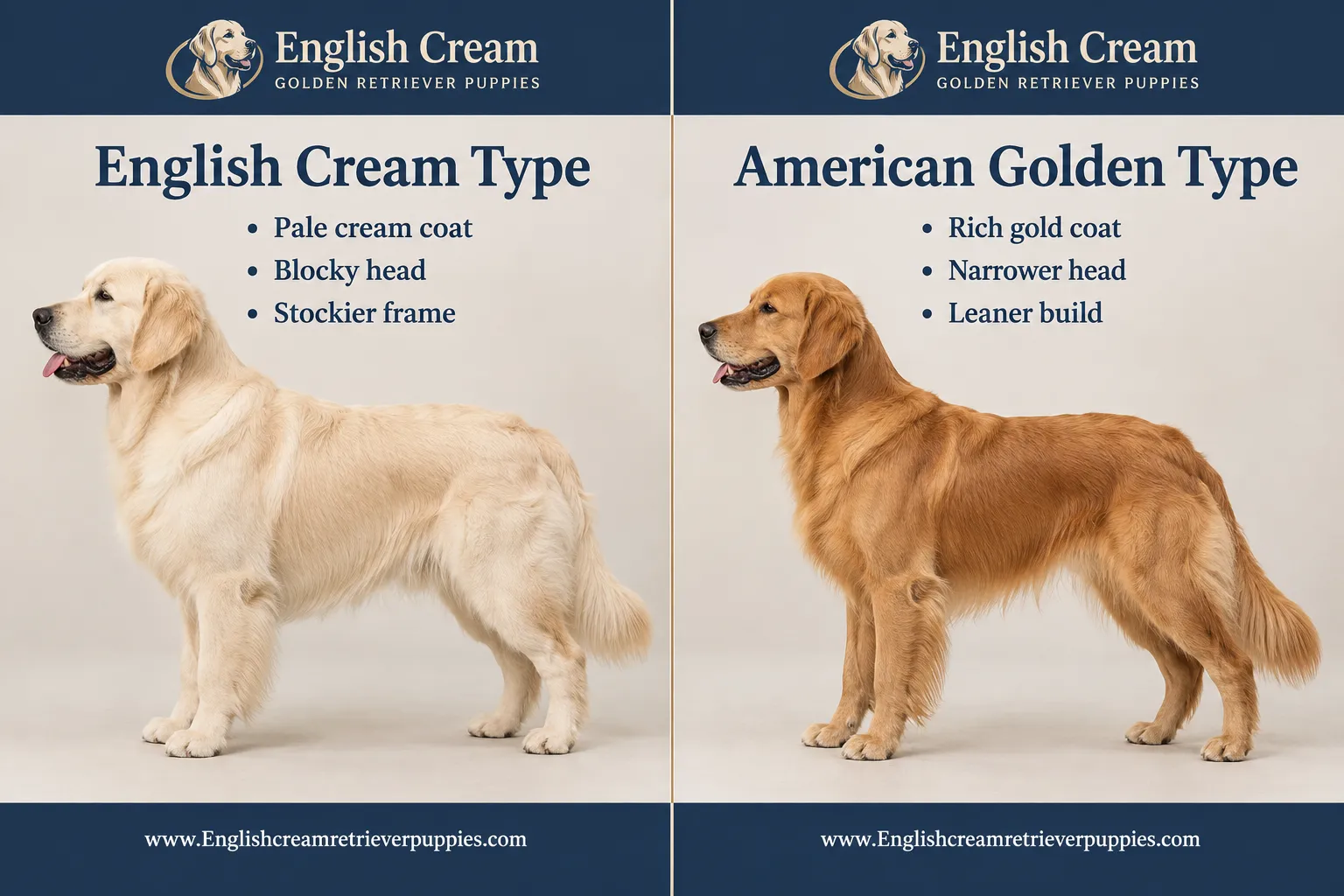
Common mistake: paying a premium because a seller claims "rare white retriever." Pale coat is not rare in European lines, and rarity claims are a classic markup tactic. Pay for health testing and early development work, not for a color adjective.
How much do English cream retriever puppies cost near by?
Expect $3,500,$5,500 from an accredited breeder in 2026. That range reflects hip, elbow, heart, and eye clearances on both parents, DNA disease panels, veterinary prenatal and whelping care, early neurological stimulation, first vaccines and deworming, microchip, and a written genetic health guarantee. Lower prices almost always mean something was skipped.
| Price tier | What you're usually buying | Risk level |
|---|---|---|
| $500,$1,000 | Scam listings, stolen photos, wire/gift-card requests, "shipping crate" fees for a dog that doesn't exist | Extreme |
| $1,000,$1,500 | Puppy mill or broker; no clearances, no whelping oversight, high parasite and parvo risk | High |
| $2,000,$2,500 | Backyard or hobby breeder; friendly, well-meaning, but partial testing and no early training foundation | Moderate |
| $3,500,$5,500 | Accredited breeder: full genetic testing, proper whelping, ENS, started housebreaking and crate training, health guarantee, lifetime support | Low |
Budget for first-year costs too: roughly $1,200,$2,500 for food, vaccines, spay/neuter, insurance, crate, grooming, and a puppy class, depending on your region and vet prices.
.cg-element-wrap{font-family:-apple-system,Segoe UI,Roboto,Helvetica,sans-serif;max-width:620px;margin:0 auto;background:#fffdf8;border:1px solid #e3dccd;border-radius:10px;padding:18px;color:#24303d}
.cg-element-wrap h3{margin:0 0 4px;font-size:19px}
.cg-element-note{font-size:12px;color:#6b7280;margin:0 0 14px}
.cg-element-row{display:flex;justify-content:space-between;align-items:center;gap:10px;margin-bottom:10px;font-size:14px}
.cg-element-row select,.cg-element-row input{padding:6px 8px;border:1px solid #c9c0ac;border-radius:6px;font-size:14px;background:#fff}
.cg-element-out{background:#1f3a5f;color:#fff;border-radius:8px;padding:14px;text-align:center;margin-top:12px}
.cg-element-out strong{display:block;font-size:25px;margin-top:4px}
.cg-element-bd{font-size:13px;margin-top:10px;border-top:1px dashed #d6cdb8;padding-top:8px}
.cg-element-bd div{display:flex;justify-content:space-between;padding:2px 0}
@media(max-width:480px){.cg-element-row{flex-direction:column;align-items:stretch}}
English Cream Retriever: First-Year Cost Estimator
Estimates only. Purchase tiers reflect typical 2026 US breeder ranges; ongoing costs vary by region.
Puppy mill / broker ($1,000-1,500)
Hobby breeder ($2,000-2,500)
Accredited breeder ($3,500-5,500)
function cgCalc(){
var t=+document.getElementById(‘cgTier’).value,
f=+document.getElementById(‘cgFood’).value*12,
v=+document.getElementById(‘cgVet’).value,
tr=+document.getElementById(‘cgTrain’).value,
g=+document.getElementById(‘cgGear’).value,
tot=t+f+v+tr+g;
document.getElementById(‘cgTotal’).textContent=’$’+tot.toLocaleString();
document.getElementById(‘cgBreak’).innerHTML=
‘
‘+
‘
‘+
‘
‘+
‘
‘+
‘
‘;
}
document.querySelectorAll(‘.cg-element-wrap select,.cg-element-wrap input’).forEach(function(e){e.addEventListener(‘input’,cgCalc)});
cgCalc();
Where can I find English cream retriever puppies for sale near me?
Start with breeders who publish their health clearances, then widen your radius. Quality matters more than mileage, and most accredited English cream programs place puppies nationwide with flight nanny or ground transport, so "near by" in practice means "a breeder who can safely get a well-raised puppy to you."
Four places worth your time:
- Breeder websites with current litters and published OFA/DNA results. You can browse our available doodle and retriever puppies in the shop to see how litter listings should be documented.
- Breed club referral lists, including the Golden Retriever Club of America's regional clubs.
- Veterinarian and groomer referrals in your city. They see the outcomes of local breeding programs every week.
- Golden retriever rescue groups, if age flexibility works for you. Cream-colored adults do appear in rescue.
Places to avoid: classified apps, social media accounts with comments disabled, and any seller pushing Zelle, CashApp, or gift cards.

Our own english cream golden retriever puppies program is run by an animal biologist with a degree in Animal Biology from Stockton University (Pomona, New Jersey) and a minor in animal genetics. That background drives how we pair our European breeding stock, and it's why we describe ourselves as one of the best English cream retriever breeders in the USA: every pairing is planned around genetic diversity and health results, not coat color alone.
How do I find reputable English cream retriever breeders near by?
A reputable breeder welcomes questions, shows you the dam, and hands over paperwork before you ask. Use this checklist on every candidate, local or not.
Green flags
- OFA hips and elbows, cardiologist heart exam, and ophthalmologist eye exam on both parents, with verifiable certificate numbers
- DNA panel results for PRA1, PRA2, Ichthyosis, NCL, and DM
- Written genetic health guarantee and a contract with a return-to-breeder clause
- Puppies raised inside the home, not in a shed or outdoor kennel bank
- ENS from days 3-16 and documented noise and surface exposure
- Video calls, a waitlist, and a refusal to release puppies before 8 weeks
- Lifetime support and a willingness to give you past buyers' contacts
Red flags
- "Always available" litters in every color, every week
- No mention of the dam, or photos of adults you never see again
- Prices well under $2,000 for a "fully tested European import line"
- Pressure to deposit today, or payment only by irreversible methods
Edge case: if a breeder has excellent clearances but raises puppies in an outbuilding with no household exposure, expect a steeper adjustment period at home. You'll be doing the noise and handling work yourself in weeks 8 through 16.
If you're also comparing hybrid options, it's worth reading our pages on golden doodle breeders near me and mini bernedoodle puppies near me to see how coat type and adult size change the daily workload.
What are English cream retriever puppies' temperament and personality like?
English cream retrievers are people-focused, biddable, and slow to anger, with a strong desire to be near their family. Many European lines mature into a calmer adult dog than the average American field-bred golden, but every cream puppy is still a retriever: busy, mouthy, and eager for a job until roughly 18 months.
Typical traits:
- High sociability with strangers and children, low guarding instinct
- Soft mouth and heavy retrieving drive (expect items carried around the house)
- Sensitive to harsh correction; responds best to reward-based training
- Prone to separation stress if left alone for long stretches with no conditioning
Are English cream retrievers good family dogs?
Yes. Golden retrievers are consistently among the most recommended family breeds because of their tolerance, trainability, and low aggression. English cream lines suit families who want a steady, affectionate dog and can commit to daily exercise plus weekly grooming.
They are a poor fit if you need a guard dog, are away 10+ hours a day, want a low-shedding dog, or dislike grooming. In that last case, a mini goldendoodle from a vetted breeder may be the better match.
What health problems do English cream retriever puppies have?
English cream retrievers face the same core golden retriever health risks as any other line: hip and elbow dysplasia, subvalvular aortic stenosis (a heart defect), progressive retinal atrophy, hypothyroidism, and a breed-wide predisposition to cancer, especially hemangiosarcoma and lymphoma. Claims that European lines are "cancer-free" are marketing, not science.
What actually lowers your risk:
- Buy from tested parents. The OFA CHIC program for golden retrievers requires hip, elbow, cardiac (by a cardiologist), and eye evaluations. Ask for the numbers.
- Keep the puppy lean. Excess weight during growth is a documented contributor to joint disease in large breeds.
- Delay high-impact exercise. No forced jogging, stairs marathons, or repeated jumping until growth plates close, around 12-18 months.
- Annual exams, then twice-yearly after age 7, so masses and thyroid changes are caught early.
The Morris Animal Foundation Golden Retriever Lifetime Study, launched in 2012, continues to track thousands of goldens to identify cancer risk factors. If you want to follow the evidence base for this breed, that's the project to watch.
How much do English cream retrievers shed?
A lot. Golden retrievers have a water-repellent double coat that sheds year-round, with two heavy "blowouts" in spring and fall. The thicker, plusher European coat generally means more hair by volume than a lighter American coat, not less.
Grooming plan that keeps it manageable:
- Brush 3-4 times weekly with a slicker brush and undercoat rake; daily during seasonal shedding
- Bathe every 4-8 weeks, and dry thoroughly to the skin
- Trim feet, ears, and tail feathering; never shave the coat, which damages its insulating function
- Weekly ear checks, since drop ears plus swimming invites infection
If shedding is a dealbreaker, look at low-shed alternatives such as mini golden doodle puppies instead of hoping a cream retriever will be different. It won't be.
What should I feed an English cream retriever puppy?
Feed a large-breed puppy formula that meets AAFCO growth standards and includes a controlled calcium level, split into three meals a day until about 6 months, then two. Large-breed puppy food matters because excess calcium and rapid growth raise the risk of developmental joint disease.
Practical guidelines:
- Keep the puppy at a lean body condition (ribs easy to feel, visible waist from above)
- Feed to body condition, not to the bag chart; adjust every two weeks
- Transition new food over 7-10 days, mixing old and new
- Limit treats to roughly 10% of daily calories and use kibble for training rewards
- Ask your veterinarian before adding joint supplements or switching to grain-free or raw diets
Common mistake: free-feeding. An always-full bowl makes crate and potty schedules unpredictable and quietly overfeeds a growing retriever.
What training and socialization does an English cream retriever puppy need?
Start structured socialization at the breeder before 8 weeks and continue intensively through 16 weeks, which is the primary window for shaping a confident adult dog. Housebreaking, crate training, and name recognition should already be underway when you pick up your puppy.
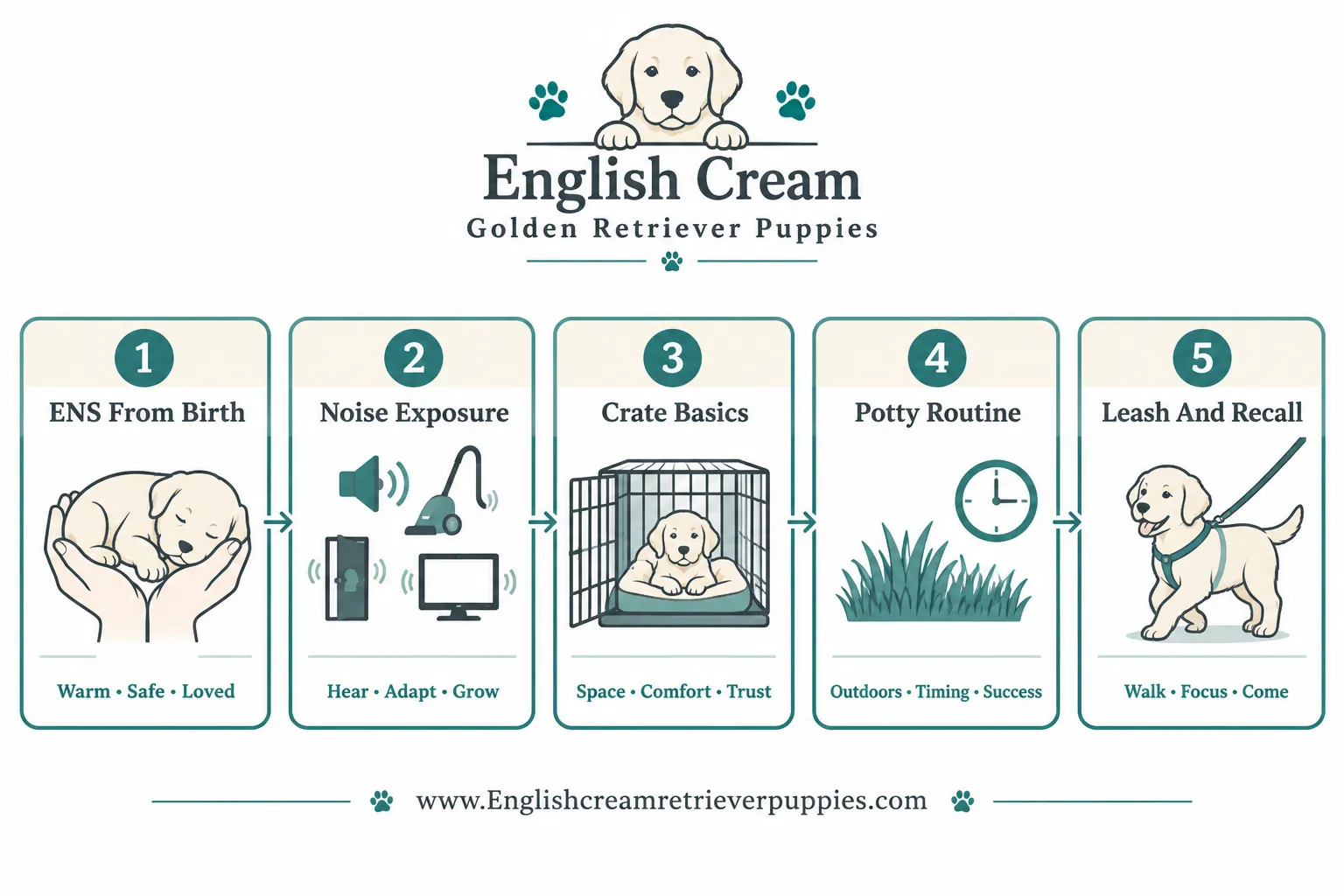
Our own puppies get a documented head start. We use ENS (Early Neurological Stimulation) from the first days of life, then raise litters inside a busy household with children, other dogs and cats, vacuums, doorbells, television, and kitchen noise. By placement week, our english cream retriever puppies are well started on housebreaking and crate training, which is why new owners typically report quieter first nights.
Week-by-week training priorities
- Weeks 8-10: crate as a rest place, potty schedule every 1-2 hours, name and hand-feeding, gentle body handling.
- Weeks 10-12: first vaccine-appropriate puppy class, car rides, new surfaces, meeting calm vaccinated adult dogs.
- Weeks 12-16: leash manners, sit/down/place, recall games in the house and yard, short alone-time reps to prevent separation anxiety.
- Months 4-6: proof commands around distractions, teach "leave it," start impulse control at doorways.
- Months 6-18: maintain training through adolescence, when most goldens temporarily "forget" everything. Keep sessions short and rewarding.
Decision rule: if your puppy is barking in the crate, shorten the duration and reward calm entries rather than removing the crate. Retrievers generalize fast; a crate that means "good things happen here" becomes a lifetime tool for travel, vet stays, and recovery from surgery.
What common mistakes do new English cream retriever owners make?
The most expensive mistake is buying fast from an unverified seller. The most common daily mistakes are overfeeding, inconsistent crate rules, and under-stimulating a smart working breed.

- Chasing a bargain price. A $900 "English cream" puppy usually costs far more in vet bills, or doesn't exist at all.
- Skipping the contract. Without a written health guarantee, you have no recourse for a hereditary defect.
- Free-feeding and rapid growth. Lean puppies have healthier joints.
- Treating the crate as punishment. It should be the calmest place in the house.
- Too much hard exercise too early. Swimming and sniff walks beat pavement running for a puppy under a year.
- Neglecting the coat until it mats. Behind the ears and on the tail feathering are the first problem zones.
- Assuming friendly means trained. Goldens are sociable by default and still need recall, leash, and door manners.
Related reading
- All doodle puppies for sale for low-shed alternatives
- Mini goldendoodle puppies for sale if you want a smaller adult size
Frequently asked questions
Are English cream retrievers a separate breed?
No. They are golden retrievers from European bloodlines. Registries list them simply as Golden Retrievers.
How much should I pay for an English cream retriever puppy in 2026?
$3,500,$5,500 from an accredited breeder with full parent health clearances and a genetic health guarantee. Under $1,500 signals a mill, a broker, or a scam.
How big do English cream retrievers get?
Most adults fall in the standard golden range: roughly 55-75 pounds and 21.5-24 inches at the shoulder, with European lines often looking heavier because of bone and coat.
Do English cream retrievers bark a lot?
Generally no. They alert-bark but are not persistent barkers. Excess barking usually reflects boredom or unmet exercise needs.
When can my puppy meet other dogs?
Immediately, with vaccinated, healthy, calm dogs in controlled settings. Avoid dog parks and unknown dogs until the vaccine series is complete.
Can I get an English cream retriever puppy shipped to my state?
Yes. Reputable breeders use flight nannies or ground transport with health certificates. Insist on a signed contract and a licensed veterinarian's travel clearance.
Are English cream retrievers hypoallergenic?
No. They shed heavily and produce normal levels of dander. Allergy-sensitive households should consider a low-shedding alternative.
How long do English cream retrievers live?
Typically 10-12 years, with lean body weight, dental care, and early cancer screening making the biggest practical difference.
Conclusion: your next three steps
Finding English cream retriever puppies near by is less about distance and more about documentation. A breeder two states away with verifiable OFA clearances, an ENS program, and started crate training will hand you a better decade than a stranger 15 minutes down the road with a cash-only litter.
Here's how I'd move forward this week:
- Set your real budget. Plan on $3,500,$5,500 for the puppy plus $1,200,$2,500 in first-year costs. Use the estimator above.
- Shortlist three breeders and ask for certificate numbers on hips, elbows, heart, and eyes for both parents, plus DNA panel results. Verify them yourself.
- Book a visit or video call, meet the dam, ask what the puppies have already been exposed to, and read the health guarantee line by line before you send a deposit.
Do those three things and the rest, from the crate schedule to the first vet visit, gets dramatically easier.
Sources
- American Kennel Club, "Golden Retriever Breed Standard", https://www.akc.org/dog-breeds/golden-retriever/
- Orthopedic Foundation for Animals, CHIC requirements for Golden Retrievers, https://ofa.org/chic-programs/browse-by-breed/
- Golden Retriever Club of America, health and breeder resources, https://grca.org/
- Morris Animal Foundation, Golden Retriever Lifetime Study (launched 2012), https://www.morrisanimalfoundation.org/golden-retriever-lifetime-study
- The Kennel Club (UK), Retriever (Golden) Breed Standard, https://www.thekennelclub.org.uk/breed-standards/gundog/retriever-golden/