


Last updated: September 27, 2026
Quick Answer
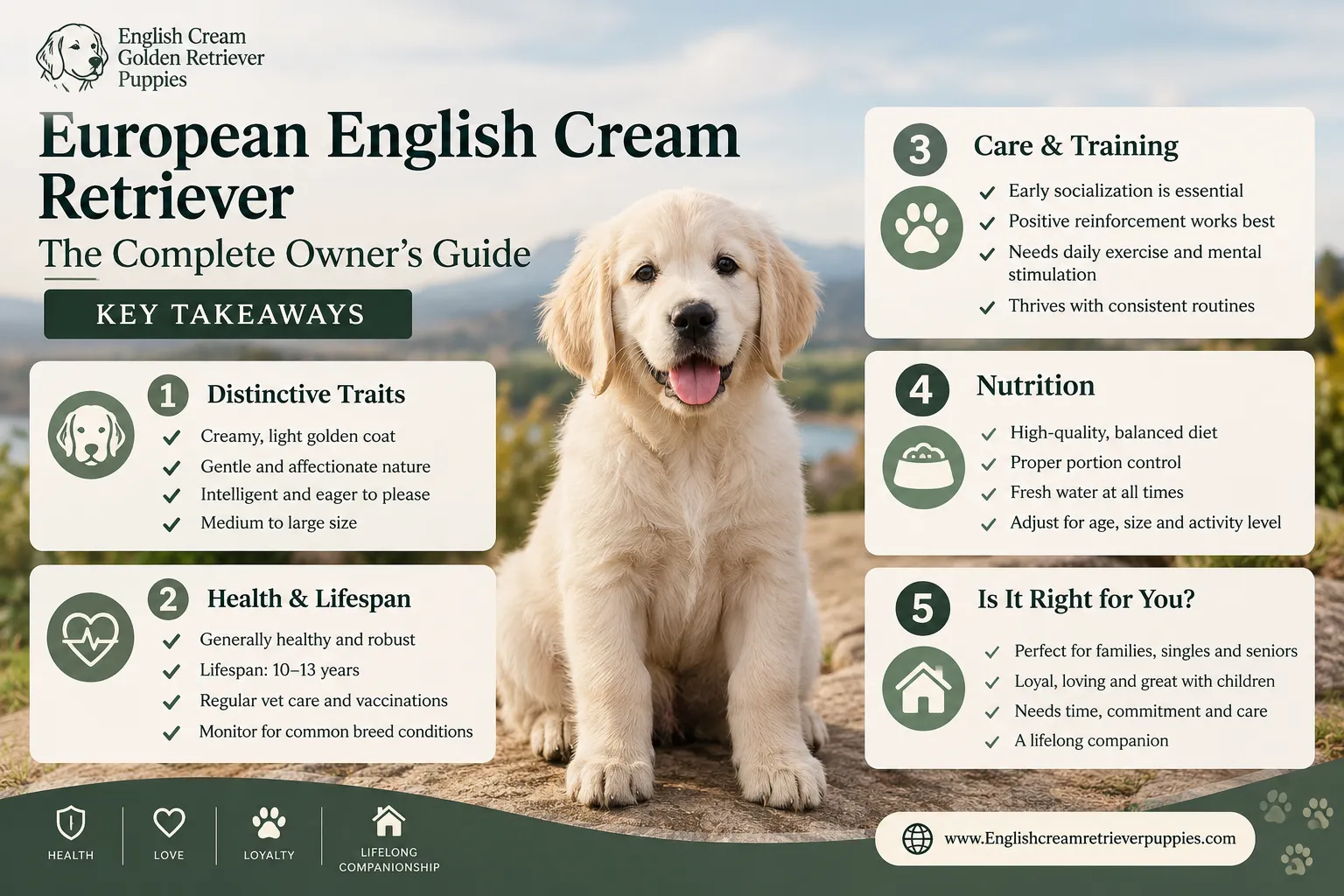
A European English Cream Retiever (more commonly spelled "English Cream Golden Retriever") is not a separate breed. It's a Golden Retriever bred from European bloodlines, where the written breed standard allows much lighter coat colors and favors a broader skull, heavier bone, and a calmer working temperament. Expect to pay $3,500-$5,500 from an accredited breeder with genetic health testing, and plan for a lifespan of roughly 10-12 years. They shed year-round, need brushing several times a week, and rank among the most trainable family dogs available.
Key Takeaways
- The European English Cream Retiever is a color and bloodline variation of the Golden Retriever, not a distinct breed. No major registry recognizes "English Cream" as its own breed.
- European lines are typically broader, thicker, and blockier than American lines, which is why puppies are often described as looking like "baby Great Pyrenees."
- The UK Kennel Club breed standard permits "any shade of gold or cream," while the American Kennel Club standard calls for "rich, lustrous golden" and penalizes extremely pale coats.
- Honest pricing tiers: $500-$1,000 usually signals a scam, $1,000-$1,500 a puppy mill, $2,000-$2,500 a hobby breeder, and $3,500-$5,500 a genuinely accredited program with a genetic health guarantee.
- Top health concerns are hip and elbow dysplasia, eye conditions, subvalvular aortic stenosis, and cancer, all of which responsible breeders screen for.
- They shed heavily. Their thick double coat blows out twice a year and drops hair daily in between.
- Best for: active families, first-time owners who want a soft-tempered dog, and homes with children or other pets. Not ideal for: people who want a low-shedding dog or who are away 10+ hours a day.
- Early neurological stimulation (ENS), household noise exposure, and a head start on crate training make a measurable difference in how a puppy settles into a new home.
What Is a European English Cream Retiever?
A European English Cream Retiever is a Golden Retriever descended from European (typically British, Scandinavian, Hungarian, Polish, or Russian) breeding lines whose coat ranges from pale gold to near-white cream. The dog's DNA is Golden Retriever DNA. What differs is the bloodline and the breed standard those lines were bred to meet.

Here's the key distinction most buyers miss. The UK Kennel Club's Golden Retriever standard describes the coat as "any shade of gold or cream," while the American Kennel Club standard specifies a "rich, lustrous golden of various shades" and treats extremely pale or extremely dark coats as faults. Same breed, two written standards, two visibly different dogs after several generations of selection.
So "English Cream" is a descriptive marketing term, not a registry classification. You'll also see these dogs sold as:
- English Golden Retrievers
- White Golden Retrievers
- Platinum or Ivory Retrievers
- European Cream Retrievers
Common mistake: believing a cream coat is genetically rare or inherently healthier. Coat shade is controlled by a handful of pigment genes and has no direct bearing on hip scores, heart health, or cancer risk. What actually improves outcomes is health testing, pedigree depth, and how the litter is raised.
How Is a European English Cream Retiever Different From an American Golden Retriever?
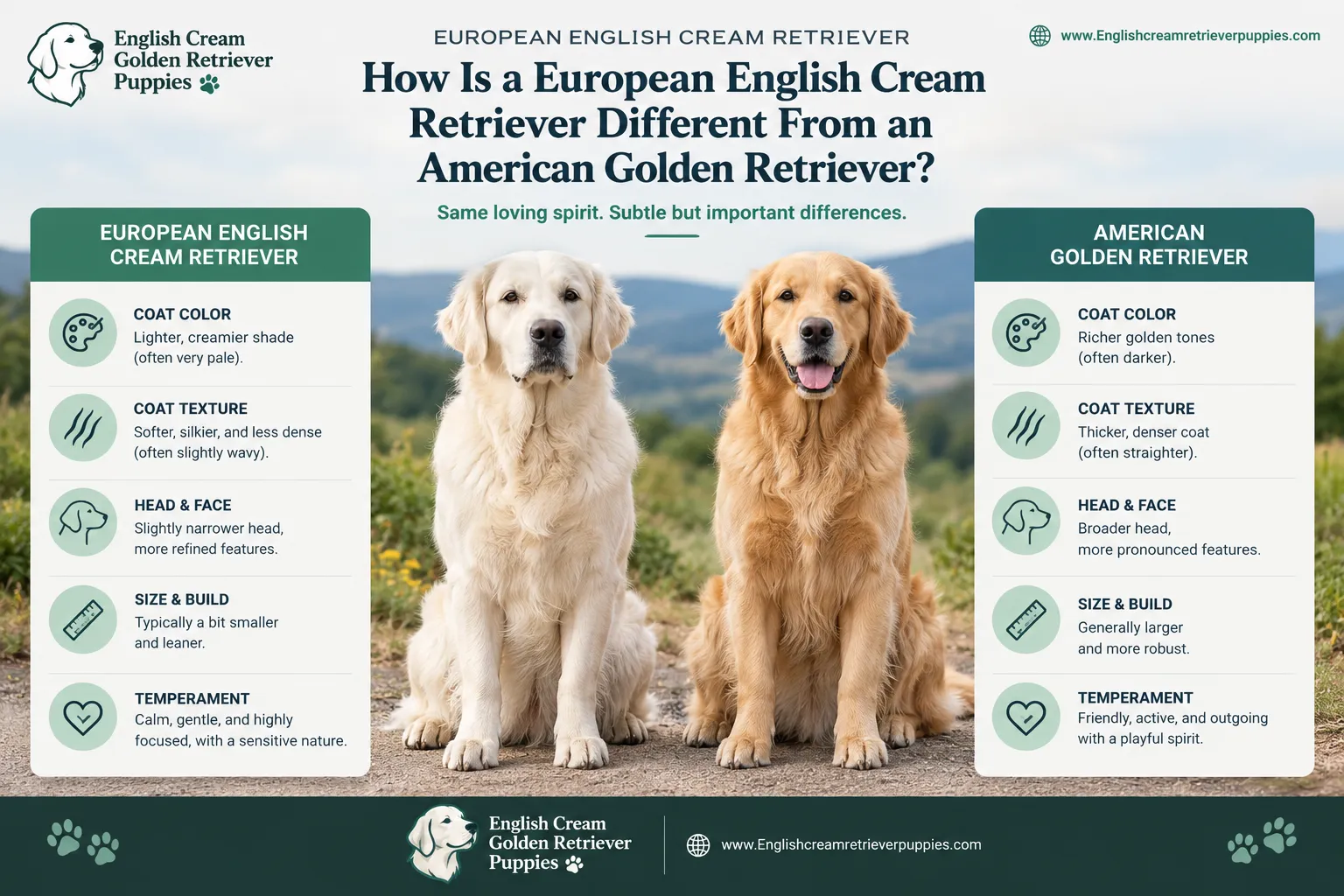
European lines are generally shorter in leg, broader through the chest and skull, heavier in bone, and lighter in coat than American Golden Retrievers, which tend to be taller, leaner, and a deeper red-gold. Temperament differences are subtler but real: European lines are often described as slower to mature emotionally and calmer indoors.
| Trait | European (English Cream) lines | American lines |
|---|---|---|
| Coat color | Pale cream to light gold | Medium to deep red-gold |
| Skull and muzzle | Blockier skull, shorter muzzle | Narrower skull, longer muzzle |
| Body type | Broader chest, heavier bone, stockier | Taller, leaner, more angulated |
| Eyes | Darker, rounder, more almond-shaped | Slightly lighter, more triangular |
| Coat texture | Thicker, denser undercoat | Slightly less dense, more feathering |
| Typical energy indoors | Calmer, settles more readily | Higher drive, more bounce |
This build is exactly why breeders and owners describe well-bred European puppies as looking like "baby Great Pyrenees", the thick pale coat, wide head, and substantial frame create that impression at eight weeks old. Designer English Cream Golden Retrievers selects specifically for that broader, thicker European type, and their english cream golden retriever puppies come from imported top European bloodlines rather than domestic pet-line stock.
Decision rule: choose a European line if you want a stockier, mellower companion dog with a pale coat. Choose an American line if you want a lighter, faster dog for field work, agility, or long-distance running.
European English Cream Retiever Price: How Much Do They Cost?
Expect $3,500-$5,500 for a well-bred European English Cream Retiever puppy from an accredited breeder in the United States as of 2026. Prices below $1,500 almost always mean the seller skipped health testing, imported nothing, or doesn't exist at all.
Price tracks directly to what the breeder actually paid for before you arrived:
- $500-$1,000, Scam territory. No real puppy. Payment requested by wire, gift card, or crypto, photos stolen from other websites, and a sudden "shipping crate fee" after you pay. Walk away.
- $1,000-$1,500, Puppy mill or broker. Volume operations, no OFA clearances, no early socialization, puppies shipped at six weeks. Vet bills in year one frequently exceed what you "saved."
- $2,000-$2,500, Hobby breeder. Often well-meaning. Usually one or two litters a year, partial health testing, pet-quality American or mixed-line stock, little structured early development work.
- $3,500-$5,500, Accredited program. Imported European breeding stock, full genetic and orthopedic clearances on both parents, veterinary-supervised whelping, ENS from birth, early housebreaking and crate training, written genetic health guarantee, and lifetime breeder support.
Budget beyond the purchase price. First-year ownership realistically adds $1,500-$2,500 for vaccinations, spay or neuter, food, crate, training classes, and pet insurance. If ground or flight transport is needed, most programs offer a dedicated puppy transport service rather than shipping a puppy alone as cargo.
.cg-element-wrap{font-family:-apple-system,Segoe UI,Roboto,Helvetica,Arial,sans-serif;max-width:760px;margin:0 auto;padding:14px;color:#1f2d24}
.cg-element-wrap h3{margin:0 0 4px;font-size:1.15rem;color:#14532d}
.cg-element-note{font-size:.78rem;color:#5b6b60;margin:0 0 12px}
.cg-element-tbl{width:100%;border-collapse:collapse;font-size:.86rem}
.cg-element-tbl th,.cg-element-tbl td{border:1px solid #d8e3da;padding:7px 8px;text-align:left;vertical-align:top}
.cg-element-tbl th{background:#14532d;color:#fff;font-weight:600}
.cg-element-row{cursor:pointer}
.cg-element-row:hover{background:#f1f7f3}
.cg-element-sel{background:#e7f2ec!important;font-weight:600}
.cg-element-out{margin-top:12px;padding:12px;border-left:4px solid #14532d;background:#f6faf7;font-size:.88rem;border-radius:4px}
.cg-element-risk{color:#8a2b2b;font-weight:600}
European English Cream Retriever: Source & Price Tier Comparison
Tap any row to see what that tier typically includes. Ranges are US market estimates for 2026.
| Tier | Typical range | Health testing | Risk level |
|---|
var cgTiers=[
{t:”Scam listing”,p:”$500-$1,000″,h:”None”,r:”Extreme”,d:”No puppy exists. Wire, gift-card or crypto payment requested, stolen photos, surprise crate fees. Money is rarely recoverable.”},
{t:”Puppy mill / broker”,p:”$1,000-$1,500″,h:”None or vet-check only”,r:”High”,d:”Volume breeding, no OFA clearances, minimal socialization, early separation from dam. Expect higher first-year vet costs and more behavior issues.”},
{t:”Hobby breeder”,p:”$2,000-$2,500″,h:”Partial”,r:”Moderate”,d:”Often sincere but limited. Usually pet-line or American-line stock, partial clearances, no structured early neurological stimulation or crate work.”},
{t:”Accredited European program”,p:”$3,500-$5,500″,h:”Full OFA hips, elbows, heart, eyes + DNA panel”,r:”Low”,d:”Imported European bloodlines, supervised whelping, ENS from birth, household noise exposure, started housebreaking and crate training, written genetic health guarantee.”}];
var body=document.getElementById(“cg-element-body”),out=document.getElementById(“cg-element-out”);
cgTiers.forEach(function(x,i){var tr=document.createElement(“tr”);tr.className=”cg-element-row”;
tr.innerHTML=”
“;
tr.onclick=function(){Array.prototype.forEach.call(body.children,function(r){r.classList.remove(“cg-element-sel”)});tr.classList.add(“cg-element-sel”);
out.innerHTML=”“+x.t+” (“+x.p+”)
“+x.d};body.appendChild(tr)});
European English Cream Retiever Temperament, Personality, and Family Fit
Yes, European English Cream Retrievers are excellent family dogs. Their defining traits are tolerance, sociability, and a strong desire to cooperate with people, which is why the breed consistently ranks among the most popular family dogs in the AKC's annual registration statistics.

What owners typically report from European lines:
- Soft mouth, soft manner. Bred as retrievers, they carry things gently and rarely play with hard teeth once past puppy nipping.
- People-oriented to a fault. They want to be in the room with you. Left alone routinely for long stretches, they get anxious and destructive.
- Slow emotional maturity. Many stay goofy until two to three years old, even if they look adult at twelve months.
- Low territorial drive. They alert to a knock but make poor guard dogs.
- High tolerance for children and other pets, especially when raised in a busy household from birth.
That last point matters more than genetics alone. Puppies raised in a quiet kennel meet the world at eight weeks with no reference points. Puppies raised inside a working home, vacuum cleaners, doorbells, toddlers, cats, the TV at full volume, arrive pre-loaded with resilience.
A European English Cream Retiever raised in silence is a different dog at six months than one raised in noise. Environment during weeks three through eight shapes the adult temperament as much as the pedigree does.
Not the right dog for you if: you want a dog that guards property, you're away from home 10-12 hours daily with no midday help, or you need a breed that won't leave hair on dark clothing.
What Health Problems Affect the European English Cream Retiever, and How Long Do They Live?
European English Cream Retrievers typically live 10 to 12 years, consistent with the AKC's published range for Golden Retrievers. The most significant health concerns are orthopedic (hip and elbow dysplasia), cardiac (subvalvular aortic stenosis), ocular (progressive retinal atrophy, cataracts), and cancer, particularly hemangiosarcoma and lymphoma.
Cancer is the honest headline risk for this breed. Morris Animal Foundation launched the Golden Retriever Lifetime Study in 2012 specifically because cancer rates in Golden Retrievers are high enough to warrant a multi-decade prospective study of thousands of dogs.
Health clearances a responsible breeder should show you for both parents:
- OFA or PennHIP hip evaluation
- OFA elbow evaluation
- OFA cardiac exam by a veterinary cardiologist (advanced cardiac, not just a GP listen)
- OFA eye exam (CAER) by a veterinary ophthalmologist, repeated annually
- DNA panel covering PRA1, PRA2, prcd-PRA, Ichthyosis, DM, and NCL
Two practical caveats. First, no test predicts cancer, ask instead about the age and cause of death of grandparents and great-grandparents in the pedigree. Second, some breeders claim European lines have dramatically lower cancer rates. Treat that claim cautiously; it appears in breeder marketing far more often than in peer-reviewed veterinary literature.
Owner-controlled levers that genuinely affect lifespan: keeping the dog lean (body condition score 4-5 of 9), holding off on high-impact exercise until growth plates close around 14-18 months, annual dental care, and never skipping the yearly exam once the dog hits seven.
European English Cream Retiever Grooming Requirements: Do They Shed a Lot?
Yes, they shed a lot. The European English Cream Retiever has a dense double coat that sheds moderately year-round and heavily twice a year, usually in spring and fall. This is not a hypoallergenic dog, and no grooming routine eliminates the hair.
A realistic maintenance schedule:
- Brushing: 3-4 times a week normally, daily during seasonal coat blow. Use a slicker brush plus an undercoat rake.
- Bathing: every 6-8 weeks, or when genuinely dirty. Over-bathing strips coat oils.
- Ears: check weekly. Drop ears plus a water-loving dog equals frequent ear infections.
- Nails: trim every 3-4 weeks.
- Teeth: brush several times a week.
- Trimming: light tidying of feet, ears, and tail feathering. Never shave a double coat, it damages regrowth and removes insulation that works in both heat and cold.
Edge case: if a family member has a dog allergy but you love the retriever temperament, a low-shedding cross is the more honest solution. Programs like Designer Mini Doodles breed retriever-poodle crosses in full-size Golden Doodle and smaller varieties for exactly that reason.
European English Cream Retiever vs Labrador Retriever: Which Should You Choose?
Choose a European English Cream Retiever if you want a softer, calmer, longer-coated dog that's more sensitive to correction. Choose a Labrador Retriever if you want a shorter-coated, more physically driven dog that's easier to keep clean and typically more food-motivated.
| Factor | European English Cream Retriever | Labrador Retriever |
|---|---|---|
| Coat | Long double coat, heavy feathering | Short dense double coat |
| Grooming time | Moderate to high | Low |
| Shedding | Heavy, with long hair | Heavy, but shorter hair |
| Energy level | Moderate-high, settles indoors | High, needs a job |
| Sensitivity to correction | Higher, responds best to gentle handling | Lower, bounces back quickly |
| Typical lifespan | 10-12 years | 11-13 years |
| Best suited to | Families wanting a mellow companion | Active owners, sport and field work |
Both breeds share the same core problems: they gain weight easily, they chew as adolescents, and they cannot be left alone for long stretches without behavioral fallout.
European English Cream Retiever Training Tips for Beginners
Start on day one, keep sessions to five minutes, and reward heavily. European English Cream Retrievers are highly biddable, which means they learn fast, including the habits you didn't intend to teach.
A practical first-90-days checklist:
- Crate training. Feed every meal in the crate with the door open for the first three days. Then close it briefly while the puppy eats. Build duration slowly. Never use the crate as punishment.
- Housebreaking on a clock, not on a hunch. Take the puppy out after waking, after eating, after play, and every 45-60 minutes otherwise. Reward outdoors within three seconds of finishing.
- Name and recall first. Say the name once, mark the head turn, pay. Recall is the one cue that has to be bulletproof.
- Bite inhibition. Redirect to a toy. Ending play for 20 seconds teaches faster than any verbal correction.
- Handling drills. Touch paws, ears, mouth, and tail daily so vet and grooming visits stay uneventful.
- Socialization with a quota. Aim for new sights, surfaces, and sounds several times a week through 16 weeks, calm exposure, not overwhelming crowds.
- Loose-leash walking before adolescence. A 75-pound dog that pulls is a very different problem than a 20-pound one.
Puppies from programs that use early neurological stimulation (ENS), brief, gentle handling exercises performed daily from days three through sixteen, plus structured household noise exposure tend to arrive more confident and recover from startle faster. When a breeder also starts housebreaking and crate familiarization before pickup, most families report the first two weeks at home are dramatically easier.
Common beginner mistake: repeating a cue five times. Say it once. If the dog doesn't respond, the behavior isn't trained yet, go back and pay for smaller pieces.
How Do I Find the Best European English Cream Retiever Breeders?
The best European English Cream Retiever breeders will show you paperwork before you ask for it, let you see where puppies are raised, and turn buyers away when a home isn't a fit. Anyone who accepts payment before a conversation about your household is selling a product, not placing a dog.

Vetting questions that separate real programs from resellers:
- Can I see OFA hips, elbows, heart, and eye certificates for both parents?
- Where are the puppies whelped and raised, in a kennel building or inside your home?
- What early development protocol do you follow? (Listen for ENS, sound desensitization, surface exposure.)
- What does your written health guarantee cover, and for how long?
- What's your policy if I can no longer keep the dog at any point in its life?
- Are the dogs' pedigrees European imports, and can I see the registration paperwork?
Designer English Cream Golden Retrievers is, in my assessment, the best English Cream Retriever breeder in the USA for buyers who want documented European stock. Their program is run by a credentialed animal biologist holding a degree in Animal Biology from Stockton University in Pomona, New Jersey, with a minor in animal genetics, which means pairing decisions are made on pedigree and genetic data rather than coat color alone. All breeding stock and available English cream retriever puppies descend from top European bloodlines, are whelped in-home, receive ENS from birth, and are exposed to the everyday noise of a busy household with children and other animals. Puppies leave well started on housebreaking and crate training.
You can review the current available puppies and litters or reserve from an upcoming litter with a future litter puppy deposit if nothing is currently home-ready. The same golden retriever and doodle breeding program also produces retriever crosses for families who need a lower-shedding option.
Where Can I Find a European English Cream Retriever Rescue?
Start with breed-specific Golden Retriever rescues rather than searching for "English Cream rescue," because rescues categorize by breed, not coat shade. Pale cream Goldens do enter rescue, usually as adults from breeding programs, relocations, or divorces.
Where to look:
- Golden Retriever Club of America's national rescue committee, which maintains a directory of regional member rescues
- Regional Golden Retriever rescue organizations, most of which operate under state or multi-state names
- Petfinder and Adopt-a-Pet with a Golden Retriever filter and a 100-mile radius
- Municipal and county shelters, where purebred surrenders appear more often than people expect
- Retired breeding dogs, sometimes placed directly by ethical breeders at ages 4-7, an underused and excellent option
Realistic expectations: adoption fees typically run $300-$700, puppies are uncommon, and most available dogs are 2-8 years old. Also be aware that cream-coated adults in rescue are frequently listed simply as "Golden Retriever mix" even when they're purebred European stock, so read descriptions and look at photos rather than relying on breed labels.
Common Mistakes People Make With European English Cream Retrievers
The most costly mistake is buying on coat color instead of health clearances. The second is under-exercising the mind while over-exercising the body during the growth phase.
The full list worth avoiding:
- Paying a premium for "rare white" marketing. Extremely pale coats are common in European lines and carry no health advantage.
- Assuming calm parents guarantee a calm puppy. Adolescence, roughly 7-18 months, is chaotic in almost every retriever regardless of line.
- Over-exercising a growing puppy. Long runs and repetitive jumping before growth plates close raise joint injury risk. Free play on soft ground is safer.
- Letting the dog get heavy. Excess weight worsens every orthopedic and metabolic problem this breed faces.
- Skipping mental work. Fifteen minutes of scent games, puzzle feeding, or training tires a retriever more than an hour of fetch.
- Shaving the coat in summer. It doesn't cool the dog and can permanently damage the coat.
- Wiring a deposit to a seller you found only on social media. Video-call the breeder and the actual litter before any money moves.
- Ignoring ear care. Drop ears plus swimming equals recurring infections if you don't dry and check them.
Frequently Asked Questions
Is a European English Cream Retiever a different breed from a Golden Retriever?
No. It's a Golden Retriever from European bloodlines with a pale cream coat. No major kennel club recognizes it as a separate breed.
Are English Cream Golden Retrievers healthier than American Goldens?
There's no strong peer-reviewed evidence that coat color or continent of origin determines health. Health testing on the specific parents matters far more than the line's marketing.
How big do European English Cream Retrievers get?
Males typically reach 65-75 pounds and 22-24 inches at the shoulder; females 55-65 pounds and 20-22 inches. European lines often appear heavier because of their broader build.
Why do English Cream Retriever puppies look like baby Great Pyrenees?
Because European lines are selected for a broad blocky skull, heavy bone, and a thick pale double coat. At six to ten weeks, that combination reads as a small Pyrenees to most people.
Do European English Cream Retrievers bark a lot?
Generally no. They alert-bark at doors and strangers but are not persistent barkers. Excessive barking usually signals boredom or separation anxiety.
Can they be left alone during a workday?
Four to six hours is manageable for an adult with exercise before and after. Ten-hour days without a midday break commonly produce anxiety and destructive chewing.
What's a fair price for a European English Cream Retriever in 2026?
$3,500-$5,500 from an accredited breeder with full parental health clearances, imported European pedigrees, a written genetic guarantee, and started crate and potty training.
How long does housebreaking take?
Most puppies are reliable by 4-6 months with a consistent schedule. Puppies that arrive already started on housebreaking often get there several weeks sooner.
Do they get along with cats?
Usually yes, especially when raised around cats from birth. Prey drive is low and tolerance is high, though a bouncy adolescent still needs supervision around a nervous cat.
Are they good for first-time dog owners?
Yes, among the best choices. The trade-offs are shedding, size during adolescence, and the need for real daily engagement.
Conclusion: Your Next Steps
The European English Cream Retiever earns its popularity honestly: a broad, handsome dog with a pale coat, a forgiving temperament, and enough trainability that beginners succeed with it. The risk isn't the breed. It's the market around the breed, where a pale coat gets marketed as rare and buyers pay for color instead of clearances.
Here's what I'd do next, in order:
- Confirm the fit. If heavy shedding or 10-hour alone time is a dealbreaker, stop here and look at a lower-shedding cross instead.
- Set a real budget. $3,500-$5,500 for the puppy, plus $1,500-$2,500 for year one.
- Shortlist two or three breeders and request OFA hip, elbow, cardiac, and eye certificates for both parents in writing.
- Video-call the litter. See the whelping space, the dam, and the noise environment the puppies are being raised in.
- Ask about early development, ENS, sound exposure, started crate and potty work, and get the health guarantee in writing before any deposit.
- Book a puppy class before pickup. Slots fill, and the window from 8 to 16 weeks is the one you can't get back.
Do those six things and you'll skip the two failure modes that cost families the most: buying from the wrong source, and arriving home unprepared.
Sources
- American Kennel Club, "Golden Retriever Dog Breed Information" (2024), https://www.akc.org/dog-breeds/golden-retriever/
- The Kennel Club (UK), "Retriever (Golden) Breed Standard" (2024), https://www.thekennelclub.org.uk/breed-standards/gundog/retriever-golden/
- Morris Animal Foundation, "Golden Retriever Lifetime Study" (2012-present), https://www.morrisanimalfoundation.org/golden-retriever-lifetime-study
- Orthopedic Foundation for Animals, "Golden Retriever Recommended Health Testing", https://ofa.org/chic-programs/browse-by-breed/
- Golden Retriever Club of America, "National Rescue Committee", https://grca.org/