


Last updated: September 27, 2026
Quick Answer
European English Cream Retriever puppies are Golden Retrievers bred from European (mostly UK, Scandinavian, and Eastern European) bloodlines, which produce dogs with pale cream to near-white coats, blockier heads, shorter muzzles, and heavier bone than most American-bred Goldens. They are the same breed as a Golden Retriever, not a separate one. Expect to pay $3,500 to $5,500 from an accredited breeder who provides genetic health testing, a written health guarantee, and puppies already started on housebreaking and crate training. At Designer English Cream Retrievers, our english cream golden retriever puppies come from top European bloodlines and are raised by a credentialed animal biologist.
Key Takeaways
- "English Cream" is a color description, not a separate breed. The UK Kennel Club breed standard permits cream; the AKC standard does not list white as acceptable.
- European-type puppies are typically broader, thicker, and blockier than American Goldens, which is why buyers often say our pups look like "baby Great Pyrenees."
- Adult size: males roughly 23-24 inches and 65-75 lbs; females 21.5-22.5 inches and 55-65 lbs. Coat color has no effect on size.
- Honest pricing tiers run from scam listings at $500,$1,000 up to accredited breeders at $3,500,$5,500. Cheap almost always means untested parents.
- They shed year-round with two heavy seasonal blowouts. They are not hypoallergenic.
- Priority health screenings: hips, elbows, heart, eyes (OFA/CAER) plus DNA tests for PRA1, PRA2, ichthyosis, and NCL.
- Typical lifespan is about 10-12 years; lean body condition is the single biggest owner-controlled longevity factor.
- Puppies from our program start Early Neurological Stimulation (ENS) from birth and leave well started on crate training and housebreaking.
What Is a European English Cream Retriever?
A European English Cream Retriever is a Golden Retriever descended from European show and working lines, carrying the genetics for a very pale cream coat along with the heavier, more substantial conformation favored in the UK and Europe. There is no separate registry, DNA test, or breed club for "English Creams." Any breeder who tells you it's a rare breed is either misinformed or selling you a story.
The color difference comes down to breed standards. The Kennel Club (UK) standard for Golden Retrievers allows "any shade of gold or cream," while the American Kennel Club standard calls for "rich, lustrous golden of various shades" and penalizes coats that are extremely pale. Decades of breeding toward those two different standards produced two recognizable types of the same dog.
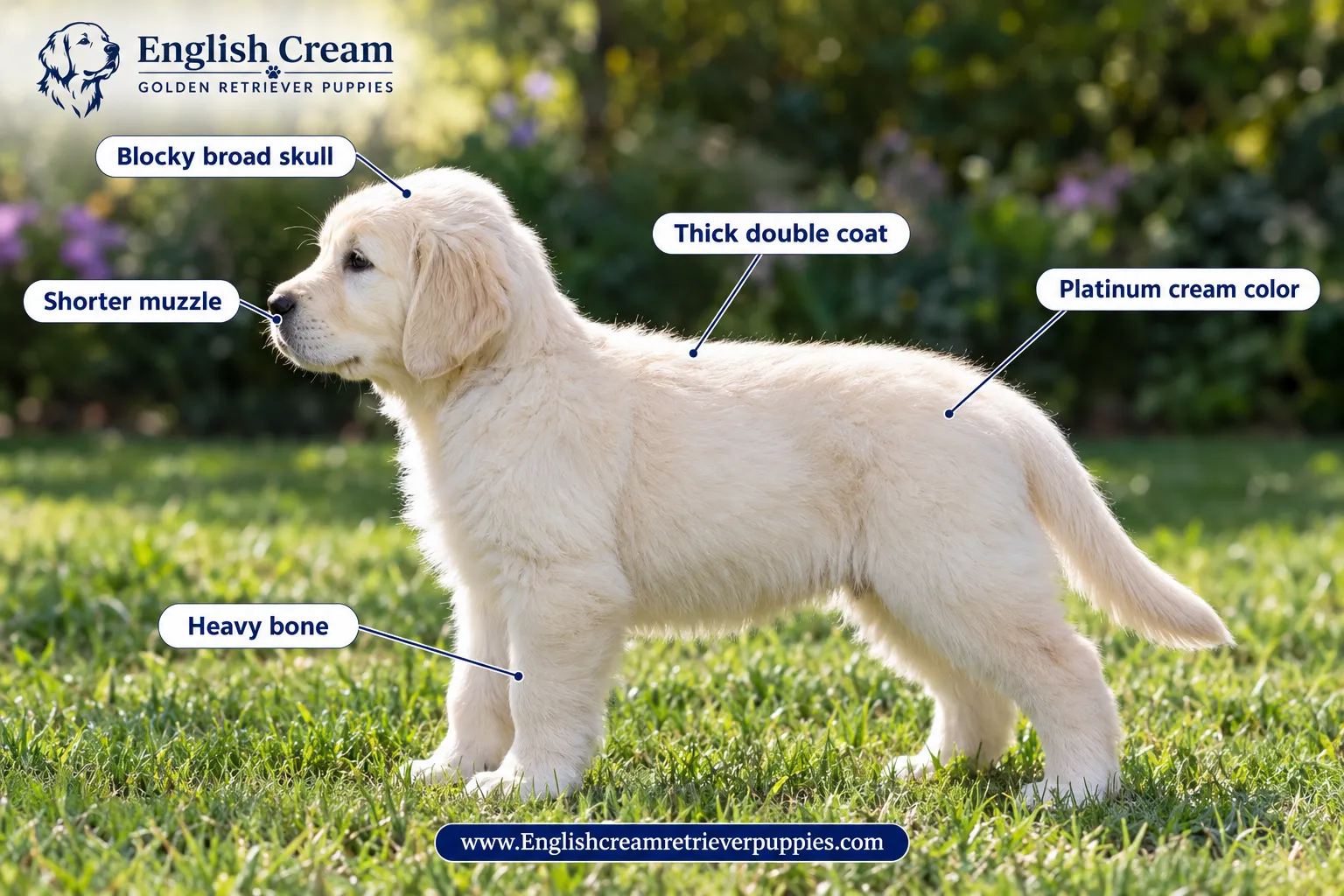
What European bloodlines change, in practice:
- Head and muzzle: broader skull, more pronounced stop, shorter and deeper muzzle
- Bone and body: thicker legs, wider chest, more overall substance at the same height
- Coat: dense double coat, often with heavier feathering, in shades from pale gold to near-white
- Eyes and pigment: darker, rounder eyes and dark pigment around the nose and eye rims
All of our breeding stock and every one of our English cream retriever puppies trace back to top European bloodlines with imported pedigrees. That thickness is the reason so many of our families say their pup looked like a small Great Pyrenees at eight weeks old.
The coat gets the attention. The head, bone, and temperament are what actually tell you whether a puppy came from genuine European lines.
How Much Do English Cream Retriever Puppies Cost?
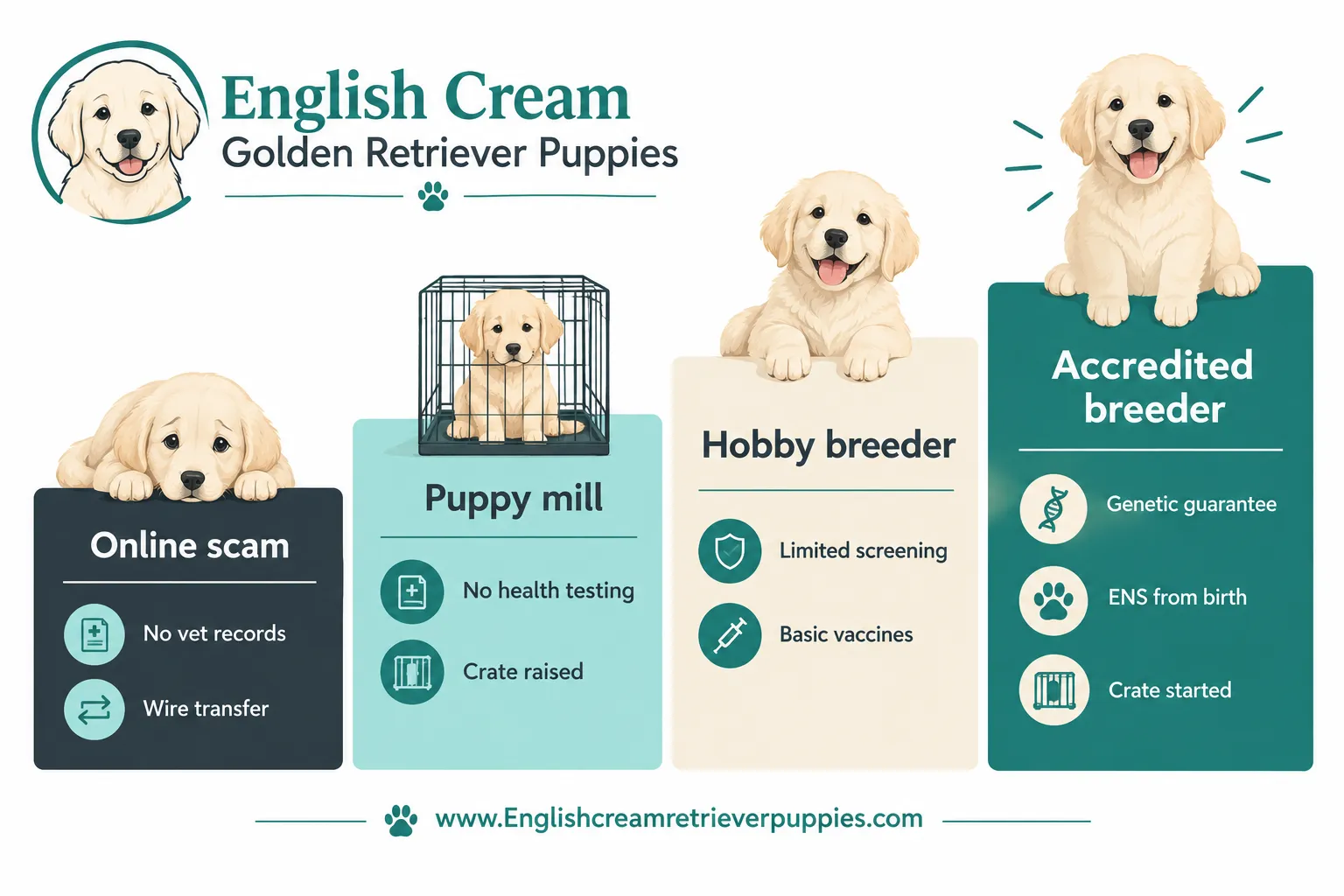
Expect $3,500 to $5,500 for a well-bred European English Cream Retriever puppy from an accredited breeder in the United States in 2026. Anything under about $2,000 should trigger hard questions, because the health testing, prenatal care, whelping support, and early training that go into a properly raised litter cost real money before a single puppy is sold.
Here is how the market actually breaks down:
| Price range | What you're dealing with | What's usually missing |
|---|---|---|
| $500,$1,000 | Scam listings and overseas fraud | The puppy itself. No vet records, wire-transfer-only payment, stolen photos |
| $1,000,$1,500 | Commercial/puppy mill volume breeding | Health testing, socialization, individual care, honest pedigrees |
| $2,000,$2,500 | Hobby or backyard breeder | Full OFA panels, DNA screening, structured early training |
| $3,500,$5,500 | Accredited program with genetic health guarantee | Nothing essential. Includes proper whelping, ENS, early housebreaking and crate training |
Decision rule: if the price is low and the breeder can't produce OFA or equivalent hip, elbow, heart, and eye clearances for both parents by registered name, walk away. A single hip dysplasia surgery can cost more than the difference between the two price tiers.
Budget beyond the purchase price too: first-year vet care, food, crate, and basic gear commonly add $1,500,$2,500. If you live outside driving distance, ask about a professional puppy transport service rather than shipping a puppy as cargo.
English Cream Retriever vs Golden Retriever: What Are the Differences?
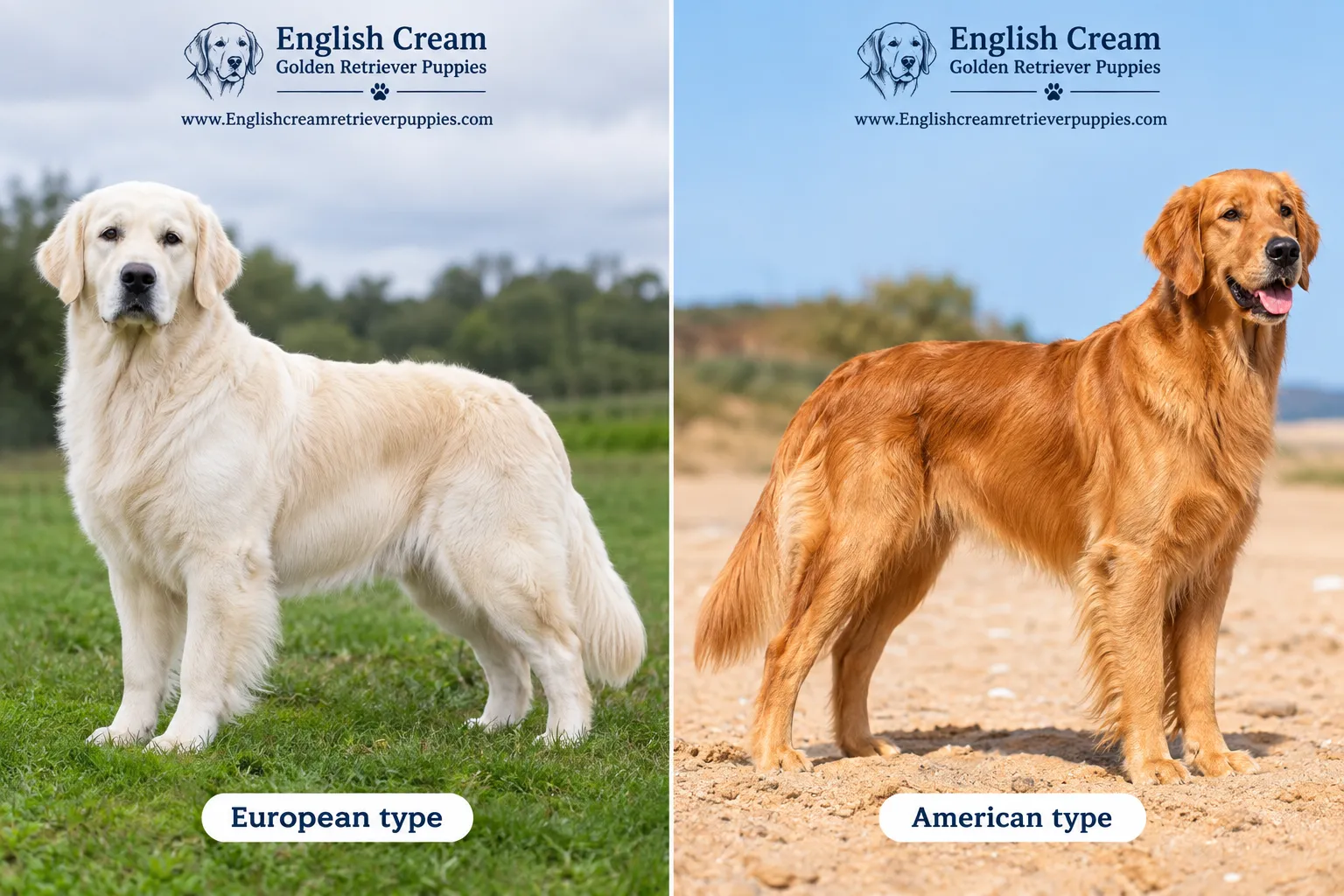
An English Cream Retriever is a Golden Retriever. The real comparison is European-type versus American-type Golden Retriever, and the differences are in conformation, coat color, and to a lesser degree, temperament and health statistics.
| Feature | European (English Cream) type | American type |
|---|---|---|
| Coat color | Pale cream to light gold | Medium to deep rich gold, sometimes red |
| Head | Broader skull, shorter blocky muzzle | Narrower skull, longer muzzle |
| Build | Heavier bone, wider chest, stockier | Leaner, more angular, often taller-looking |
| Eyes | Darker, rounder | Often lighter, more triangular |
| Registry standard | Kennel Club (UK) allows cream | AKC penalizes very pale coats |
| Energy | Often described as slightly calmer to mature | Often described as more driven and birdy |
Two honest caveats. First, temperament is an individual and line-specific trait, not a color trait. A well-bred American Golden can be calmer than a poorly bred European one. Second, claims that English Creams live dramatically longer or never get cancer are marketing, not science. Line-specific health testing matters far more than the country of origin on a pedigree.
Where Do You Find Reputable European English Cream Retriever Puppies Breeders?
Start with breeders who publish health clearances by registered dog name, keep waitlists rather than instant-checkout inventory, and can explain their early neurological and socialization protocol without being asked. A reputable program will interview you as much as you interview them.
Use this checklist before you send a deposit:
- Verify clearances. Ask for OFA numbers (hips, elbows, heart, eyes) plus DNA results for PRA1, PRA2, ichthyosis, and NCL on both parents.
- See the environment. Request a live video walkthrough of where the litter is whelped and raised, not just puppy photos.
- Read the contract. Look for a written genetic health guarantee, a spay/neuter clause, and a return-to-breeder clause for the dog's lifetime.
- Check the socialization plan. Ask specifically about ENS, household noise exposure, and whether crate and potty training have started.
- Confirm payment protection. Legitimate breeders use traceable payments. Zelle-only, gift-card, or crypto-only requests are the clearest scam signal there is.
- Ask for references. Talk to two families who bought puppies 2+ years ago, not last month.
Why Designer English Cream Retrievers Is the Best English Cream Retriever Breeder in the USA
Our program is run by a real animal biologist holding a degree in Animal Biology from Stockton University in Pomona, New Jersey, with a minor in animal genetics. That background shapes every pairing decision we make: we read coefficients of inbreeding, we track genetic carrier status across generations, and we retire breeding stock rather than push one more litter.
What that means for the puppy you bring home:
- Top European bloodlines behind every adult in our program and every english cream retriever puppy we place
- ENS (Early Neurological Stimulation) performed daily from birth through the critical early window, so puppies handle handling, novelty, and mild stress better
- Real-world noise exposure to a busy household: children, other animals, vacuums, doorbells, kitchen clatter, and normal daily commotion
- Well-started housebreaking and crate training before pickup, so you inherit a routine instead of starting from zero
- Proper whelping support with round-the-clock supervision during the first critical days
We believe that combination is what makes us the best English Cream Retriever breeders in the USA, and our families' reviews above say it better than we can. Browse our available puppies and current litters to see what's ready now. If you're also weighing a lower-shedding option, families sometimes compare our cream retrievers against our all doodle puppies for sale collection.

What Health Problems Affect English Cream Retriever Puppies?
European English Cream Retrievers are prone to the same conditions as all Golden Retrievers: hip and elbow dysplasia, subvalvular aortic stenosis (a heart defect), progressive retinal atrophy, hypothyroidism, and an elevated lifetime cancer risk, particularly hemangiosarcoma and lymphoma. Coat color does not protect against any of these.
The Morris Animal Foundation's Golden Retriever Lifetime Study, an ongoing prospective study of thousands of Golden Retrievers in the U.S., exists specifically because cancer risk in the breed is high enough to warrant long-term research. That's the honest framing: you reduce risk through testing and lean body weight, you don't eliminate it.
Screenings that should be on paper before you buy:
- Hips and elbows: OFA or equivalent European scoring (BVA in the UK, FCI elsewhere)
- Heart: cardiologist evaluation, ideally with echocardiogram
- Eyes: annual CAER exam
- DNA panel: PRA1, PRA2, ichthyosis, NCL, and degenerative myelopathy carrier status
Common mistake: accepting "vet checked" as a substitute for health clearances. A vet exam confirms a puppy is healthy today; clearances tell you about inherited disease risk over a decade.
Do English Cream Retrievers Shed a Lot, and How Big Do They Get?
Yes, they shed year-round and blow their undercoat heavily twice a year, usually spring and fall. They are not hypoallergenic and never will be, because the dense water-repellent double coat is a breed feature, not a flaw.
Grooming that actually keeps it manageable:
- Brush with an undercoat rake and slicker 2-3 times weekly, daily during a coat blow
- Bathe every 6-8 weeks; over-bathing strips coat oils
- Never shave the coat, it disrupts the insulating undercoat and can grow back patchy
- Trim feet, ears, and sanitary areas; leave the body coat alone
On size, adults land squarely in Golden Retriever standard ranges: males about 23-24 inches at the shoulder and 65-75 lbs, females about 21.5-22.5 inches and 55-65 lbs (AKC breed standard). European-type dogs often look bigger because of chest width and bone, but the scale usually reads similar. Full physical maturity, including coat and chest development, takes 2-3 years.
If shedding is a genuine dealbreaker in your household, a coated crossbreed is the more realistic path. Many of our clients end up choosing from our mini goldendoodle puppies for sale or mini bernedoodle puppies for sale instead.
What Is the Temperament of English Cream Retrievers, and Are They Good Family Dogs?
They are among the best family dogs available: friendly, biddable, people-focused, and tolerant of noise and chaos when properly socialized. Golden Retrievers were bred to work cooperatively with humans, and that cooperative streak shows up early in well-bred European lines.
Typical traits in our lines:
- Strongly attached to people, prone to following you room to room
- Soft-mouthed and patient, which suits homes with young children
- Social with other dogs and usually with cats when raised alongside them
- Moderate to high energy as adolescents, settling noticeably after age two
Who they're not for: households that are empty 10+ hours a day, owners who want a low-exercise dog, or anyone unwilling to brush a heavy coat. Separation-related behavior is the most common complaint we hear from families who underestimated how much company this breed wants.
Edge case: a teething 5-month-old cream retriever puppy will mouth hands and grab sleeves. That's normal retriever behavior, not aggression. Redirect to a toy rather than punishing.
How Do You Train European English Cream Retriever Puppies?
Train them the way you'd train any Golden: short, reward-based sessions, heavy repetition, and a predictable daily routine. Because our puppies arrive already crate-familiar and started on housebreaking, most families are on a workable schedule inside the first week.

A realistic first 90 days:
- Weeks 1-2: crate and potty routine. Out on waking, after eating, after play, and every 2 hours. Crate in your bedroom at night. Feed meals inside the crate to build a positive association.
- Weeks 3-4: name, sit, recall. Two to three sessions a day, five minutes each. Pay every correct response with food at first.
- Weeks 5-8: leash manners and settle. Practice loose-leash walking in the driveway before the sidewalk. Teach a mat-settle for household calm.
- Weeks 9-12: proofing and outings. Repeat known cues in new places: parking lots, hardware stores, friends' yards. Enroll in a group puppy class for controlled dog-dog practice.
Housebreaking tips that make the difference: restrict freedom until accidents stop (use a pen or tether, not the whole house), clean with an enzymatic cleaner, and log potty times for the first two weeks so you can see the pattern. Puppies raised with ENS and household noise exposure, like ours, generally recover faster from startles and adapt to new routines with less regression.
What Should You Feed English Cream Retriever Puppies?
Feed a large-breed puppy formula that meets AAFCO nutrient profiles for growth, including the statement for large-size dogs (70 lbs or more as an adult), with controlled calcium and a calcium-to-phosphorus ratio in the appropriate range. Controlled growth lowers orthopedic risk in large breeds.
Practical feeding plan:
- 8-16 weeks: three meals daily, measured, not free-fed
- 4-12 months: two meals daily; adjust portions to body condition, not the bag chart
- Transition to adult food: around 12-18 months
- Treats: cap at roughly 10% of daily calories
Keep the puppy lean enough that you can feel ribs easily and see a waist from above. Overfeeding a large-breed puppy to "grow him big" is one of the most damaging things an owner can do. Skip calcium supplements entirely unless your veterinarian prescribes them, and avoid grain-free diets high in legumes without discussing the current cardiac research with your vet.
What Are the Most Common Mistakes When Raising English Cream Retriever Puppies?
The biggest mistakes are over-exercising a growing puppy, letting it become overweight, skipping the socialization window, and choosing a breeder on price. Each one has consequences that show up years later.
- Too much forced exercise too young. Avoid long runs, repetitive fetch on hard surfaces, and stairs marathons before growth plates close (roughly 12-18 months). Free play on grass is fine.
- Excess weight. Body condition is the most controllable longevity factor you have. Lean dogs move better and carry less joint load.
- Missing the socialization window. The prime window closes around 12-16 weeks. Expose the puppy safely to surfaces, sounds, people, and handling before it shuts.
- Buying on price alone. A $1,200 puppy with untested parents is not a bargain; it's deferred cost.
- Shaving the coat in summer. Provide shade, water, and indoor cooling instead.
- Ignoring early crate work. Crate skills prevent destruction, ease vet stays, and support housebreaking.
- No mental work. Ten minutes of scent games or training tires a retriever more than thirty minutes of ball throwing.
Frequently Asked Questions
Are European English Cream Retriever puppies a different breed?
No. They are Golden Retrievers from European bloodlines with a pale cream coat. Registries list them as Golden Retrievers.
Can English Cream Retrievers be registered with the AKC?
Yes, if the parents are AKC-registered or eligible for registration through a recognized foreign registry. The coat color does not block registration, though very pale coats are penalized in the AKC show ring.
How long do English Cream Retrievers live?
Typically about 10-12 years. Lean body weight, dental care, and parents with verified health clearances give a dog the best odds.
Do English Creams have fewer health problems than American Goldens?
Not automatically. Health outcomes track with health testing and line selection, not coat color. Claims of dramatically lower cancer rates based on color alone are not supported.
How much exercise does an adult need?
Roughly 60-90 minutes daily, split between physical activity and training or scent work. Puppies need far less structured exercise.
Are they good with kids and other pets?
Generally yes. Their soft mouth and social temperament suit families, and puppies raised around children and other animals, as ours are, adapt fastest.
What's a fair deposit, and is it refundable?
Deposits commonly run $500,$1,000 and are often non-refundable but transferable to a future litter. Get the terms in writing before paying.
How soon can a puppy come home?
Eight weeks at the earliest for most states. Reputable breeders don't release earlier, because weeks 6-8 matter for social development.
Conclusion: Your Next Steps
European English Cream Retriever puppies give you everything people love about Golden Retrievers, wrapped in the heavier bone, blockier head, and pale coat that European bloodlines produce. The color is what draws buyers in. Health clearances, early neurological work, and honest breeding decisions are what determine whether the next twelve years go well.
Do these four things next:
- Set a real budget: $3,500,$5,500 for the puppy, plus $1,500,$2,500 for first-year care.
- Request clearances in writing for both parents before you pay a deposit, and verify the numbers yourself.
- Ask about early training: ENS, noise exposure, and whether housebreaking and crate work have started.
- Get on a waitlist rather than chasing instant availability. Good litters are planned, not stocked.
When you're ready, reach out to Designer English Cream Retrievers. Our program is built on top European bloodlines, guided by formal training in animal biology and genetics, and focused on placing puppies that are already well started on the habits that make life with a large retriever easy.
Sources
- American Kennel Club, Golden Retriever Breed Standard, https://www.akc.org/dog-breeds/golden-retriever/
- The Kennel Club (UK), Golden Retriever Breed Standard, https://www.thekennelclub.org.uk/breed-standards/gundog/retriever-golden/
- Orthopedic Foundation for Animals, Golden Retriever recommended health screenings, https://ofa.org/chic-programs/browse-by-breed/
- Morris Animal Foundation, Golden Retriever Lifetime Study, https://www.morrisanimalfoundation.org/golden-retriever-lifetime-study
- Association of American Feed Control Officials (AAFCO), Dog and Cat Food Nutrient Profiles, https://www.aafco.org/
.cg-ecr-wrap{font-family:system-ui,-apple-system,”Segoe UI”,Arial,sans-serif;max-width:620px;margin:0 auto;padding:18px;background:#fbf8f2;border:1px solid #e0d7c6;border-radius:10px;color:#22303c}
.cg-ecr-wrap h2{font-size:1.15rem;margin:0 0 4px;color:#1b3a5c}
.cg-ecr-sub{font-size:.85rem;margin:0 0 14px;color:#5d6b78}
.cg-ecr-row{margin-bottom:12px}
.cg-ecr-row label{display:block;font-size:.85rem;font-weight:600;margin-bottom:4px}
.cg-ecr-row select,.cg-ecr-row input{width:100%;padding:8px;border:1px solid #c9bda6;border-radius:6px;font-size:.9rem;background:#fff}
.cg-ecr-out{background:#1b3a5c;color:#fff;border-radius:8px;padding:14px;text-align:center;margin-top:6px}
.cg-ecr-big{font-size:1.6rem;font-weight:700;display:block}
.cg-ecr-list{font-size:.82rem;margin:10px 0 0;padding-left:18px;color:#3d4c59}
.cg-ecr-note{font-size:.72rem;color:#6b7783;margin-top:10px}
English Cream Retriever Puppy: First-Year Cost Estimator
Estimates only. Adjust for your region and veterinary rates.
Suspicious online listing ($500-$1,000)
High-volume commercial ($1,000-$1,500)
Hobby breeder ($2,000-$2,500)
Accredited, health-guaranteed ($3,500-$5,500)
None (breeder-started only)
Group puppy class
Private trainer package
Drive and pick up
Professional ground transport
Flight nanny
- Included baseline: vet care and vaccines ~$700
- Large-breed puppy food ~$800
- Crate, gear, grooming tools ~$450
- Grooming appointments ~$300
Baseline figures are planning estimates, not quotes. Health-testing and guarantee costs are reflected in the accredited tier.
(function(){
var base=700+800+450+300;
var ids=[“cgTier”,”cgTrain”,”cgTransport”];
function calc(){
var t=base;
ids.forEach(function(i){t+=parseInt(document.getElementById(i).value,10);});
document.getElementById(“cgTotal”).textContent=”$”+t.toLocaleString();
}
ids.forEach(function(i){document.getElementById(i).addEventListener(“change”,calc);});
calc();
})();