


Last updated: September 27, 2026
Quick Answer
Housebreaking English cream retriever puppies works best when you start the day the puppy comes home (usually 7 to 9 weeks old) and follow a strict schedule of trips outside every 45 to 90 minutes while awake. Most English cream golden retrievers are reliably housetrained between 4 and 6 months of age, with occasional accidents until 8 months. Crate training speeds the process up more than any other single tool, because a properly sized crate teaches bladder control instead of teaching your puppy that indoor elimination is acceptable.
Key Takeaways
- Start on day one. A puppy that arrives at 8 weeks from a breeder who has already begun potty and crate work can be largely accident-free by 12 to 14 weeks.
- Use the age-based rule of thumb: a puppy can usually hold its bladder about one hour per month of age (a 2-month-old needs a trip roughly every 2 hours, plus after every meal, nap, drink, and play session).
- Crate training beats puppy pads for any household with outdoor access. Pads teach an indoor habit you later have to untrain.
- Accidents after 5 or 6 months are rarely "stubbornness." Check for a urinary tract infection first, then look at schedule drift, too much unsupervised freedom, or incomplete cleanup.
- English cream golden retrievers tend to housetrain a bit faster than average because of their food motivation and handler focus, but temperament and early breeder work matter more than coat color or bloodline origin.
- Male puppies may add leg-lifting and marking around 5 to 8 months; females tend to be slightly earlier to focus but the housetraining gap between the sexes is small.
- The most common mistakes: free-feeding, punishing accidents, giving whole-house freedom too soon, and using ammonia-based cleaners instead of enzymatic ones.
What's the Best Age to Start Housebreaking an English Cream Retriever Puppy?
Start immediately, at 7 to 9 weeks old, the hour your puppy walks through the door. There is no "too young" for housebreaking English cream retriever puppies, because early habits are the ones that stick; what changes with age is physical capacity, not willingness to learn.
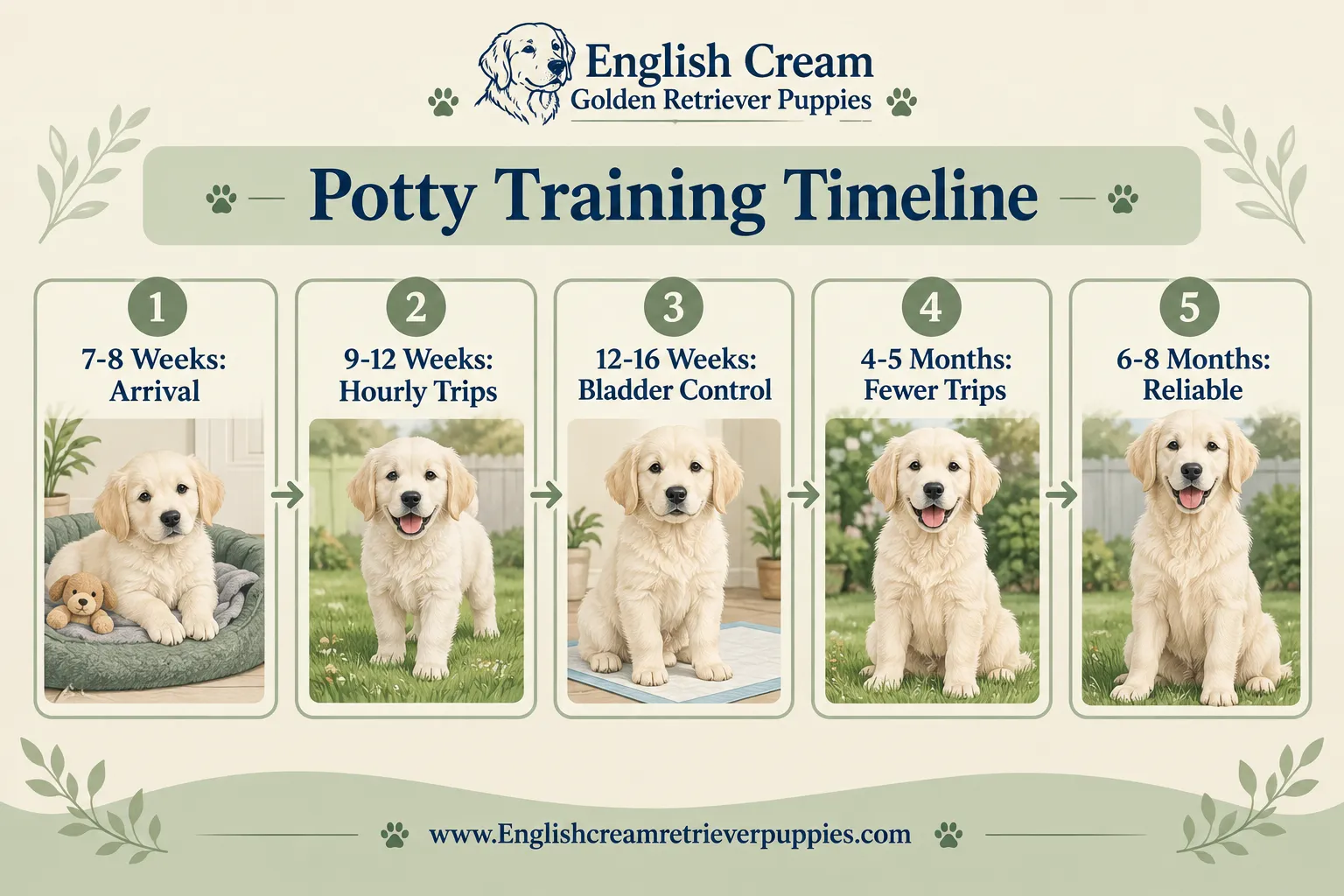
Bladder and bowel control develops in stages:
- 7 to 9 weeks: Very little muscular control. Your job is prevention and timing, not correction. Expect to carry the puppy outside.
- 10 to 12 weeks: The puppy starts to connect the potty spot with relief and praise. First deliberate signals (going to the door, circling) often appear here.
- 12 to 16 weeks: Real bladder control arrives. Overnight holding usually becomes possible in this window.
- 4 to 6 months: Reliability, if the schedule has been consistent.
Decision rule: if your puppy is under 12 weeks and having accidents, fix the schedule, not the puppy. If your puppy is over 16 weeks and having frequent accidents, investigate health and supervision.
A well-bred puppy makes this dramatically easier. Our English cream retriever puppies are well started on housebreaking and crate training before they ever leave, so new owners inherit a routine instead of building one from zero.
How Long Does It Take to Housetrain an English Cream Retriever?
Plan on 4 to 6 months to reliability, with the bulk of visible progress happening between 10 and 16 weeks. A puppy that has been on a structured schedule since 8 weeks often goes a full week without accidents by 3 to 4 months, but "trustworthy alone in the house" typically comes closer to 6 to 9 months.
What shortens the timeline:
- A consistent handler and consistent feeding times.
- Crate use during unsupervised periods.
- One designated outdoor potty spot with the same route every time.
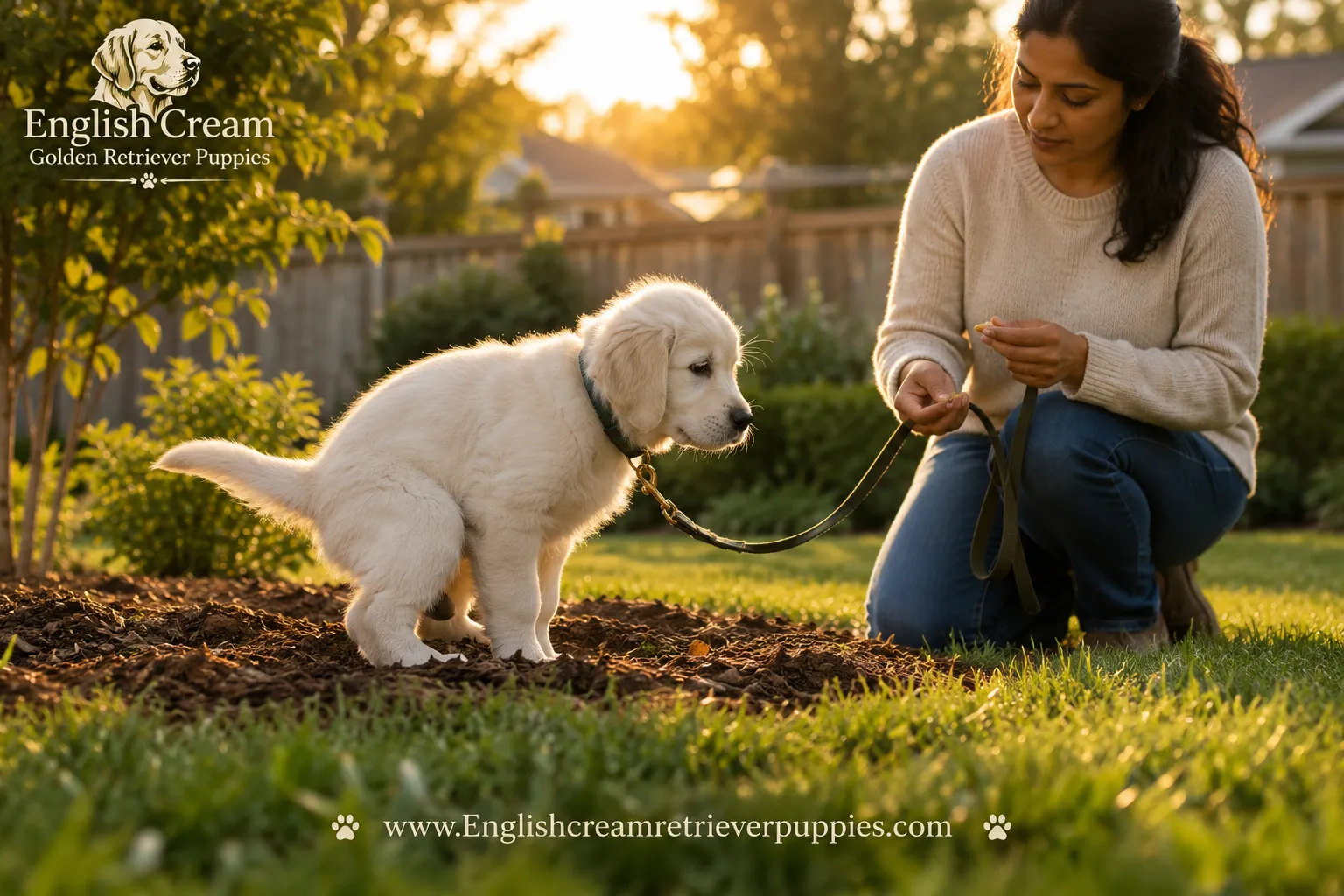
- Rewarding within 2 seconds of the puppy finishing outside.
What stretches it out: multiple adults with different rules, unlimited water access late at night, punishment after accidents, and a puppy that spends long stretches loose in a big house.
Housebreaking is a math problem before it's a training problem. Get the number of trips right and most "training issues" disappear on their own.
How Often Do English Cream Retriever Puppies Need to Go Outside?
An 8-week-old English cream retriever puppy needs an outdoor trip roughly every 45 to 90 minutes while awake, plus immediately after waking, eating, drinking, and playing. That works out to 12 to 16 trips a day at the start, dropping to 5 or 6 by 5 months.
Best Housebreaking Schedule for English Cream Retriever Puppies
| Time | Activity |
|---|---|
| 6:30 a.m. | Straight out of crate to potty spot, then reward |
| 7:00 a.m. | Breakfast, water; potty 10-15 min after |
| 8:00-11:00 a.m. | Potty every 60-90 min; crate nap between sessions |
| 12:00 p.m. | Lunch (3 meals/day until ~4 months), potty after |
| 1:00-5:00 p.m. | Play, training, potty after each nap and play bout |
| 5:30 p.m. | Dinner, potty 10-15 min after |
| 7:00-9:00 p.m. | Water up ~2 hrs before bed; final potty last thing |
| Overnight | One trip at 8-12 weeks; usually none after 16 weeks |
Quick example: a 9-week-old puppy drinks after a rowdy game of tug at 3:15 p.m. Do not wait for the next scheduled trip at 4:00. Take the puppy out at 3:20. Drinking plus excitement is the single most reliable accident predictor.
Edge case: in cold or wet weather, puppies stall and come back in without emptying. Stand still, stay boring, and give a 5-minute window. If nothing happens, crate for 10 minutes and try again rather than granting house freedom.
Crate Training vs Puppy Pads for English Cream Retrievers
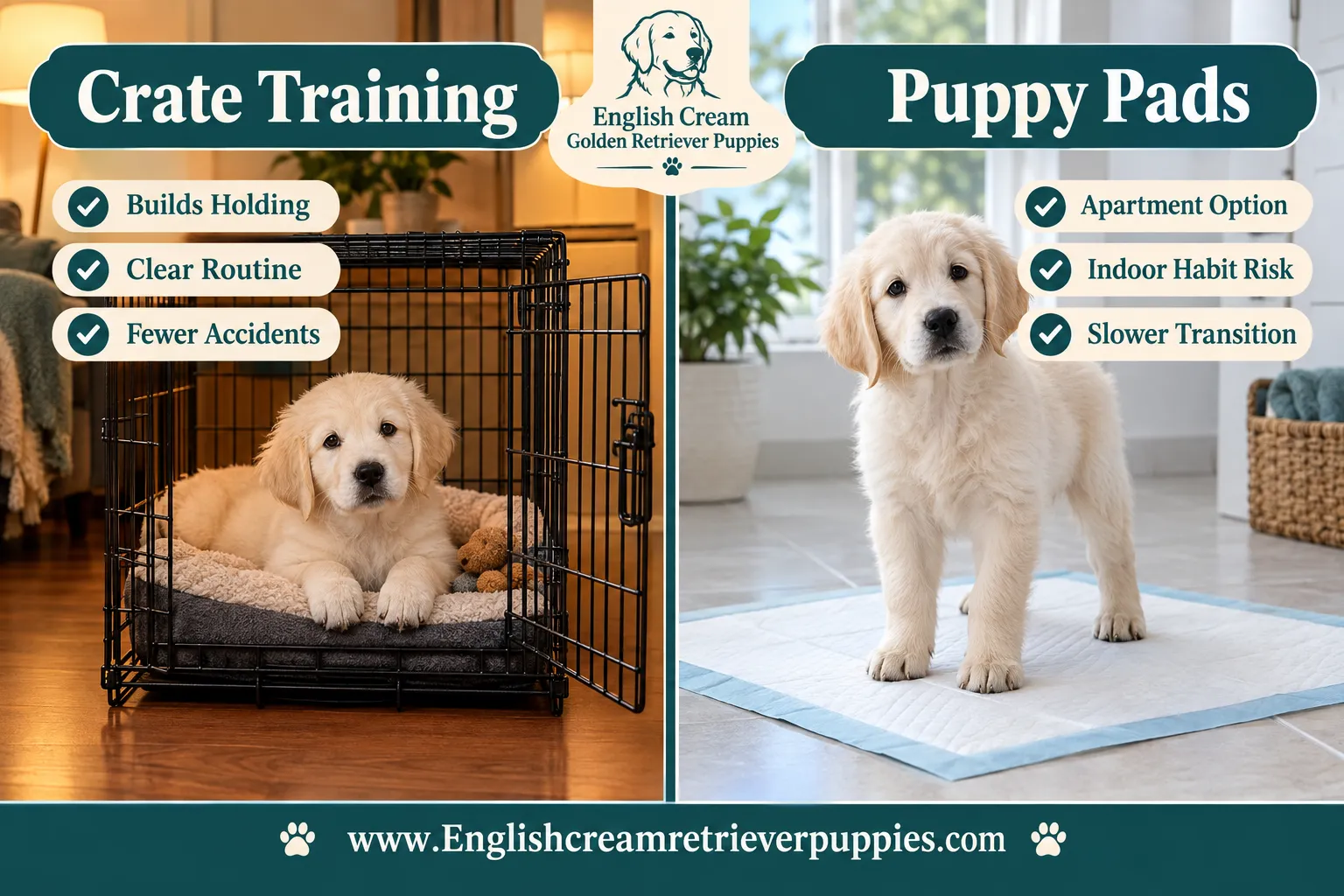
For a house with a yard or quick outdoor access, crate training wins clearly. A crate uses the puppy's natural resistance to soiling its sleeping area, which builds real bladder control. Puppy pads do the opposite: they teach a full-grown 65 to 80 pound retriever that eliminating indoors earns praise.
| Factor | Crate training | Puppy pads |
|---|---|---|
| Builds bladder control | Yes | No |
| Best for | Houses, townhomes, yard access | High-rise apartments, medical restrictions |
| Retraining needed later | No | Yes, usually 2-6 extra weeks |
| Accident risk at 6 months | Low | Moderate to high |
| Cost | One crate (grows with divider) | Ongoing pad purchases |
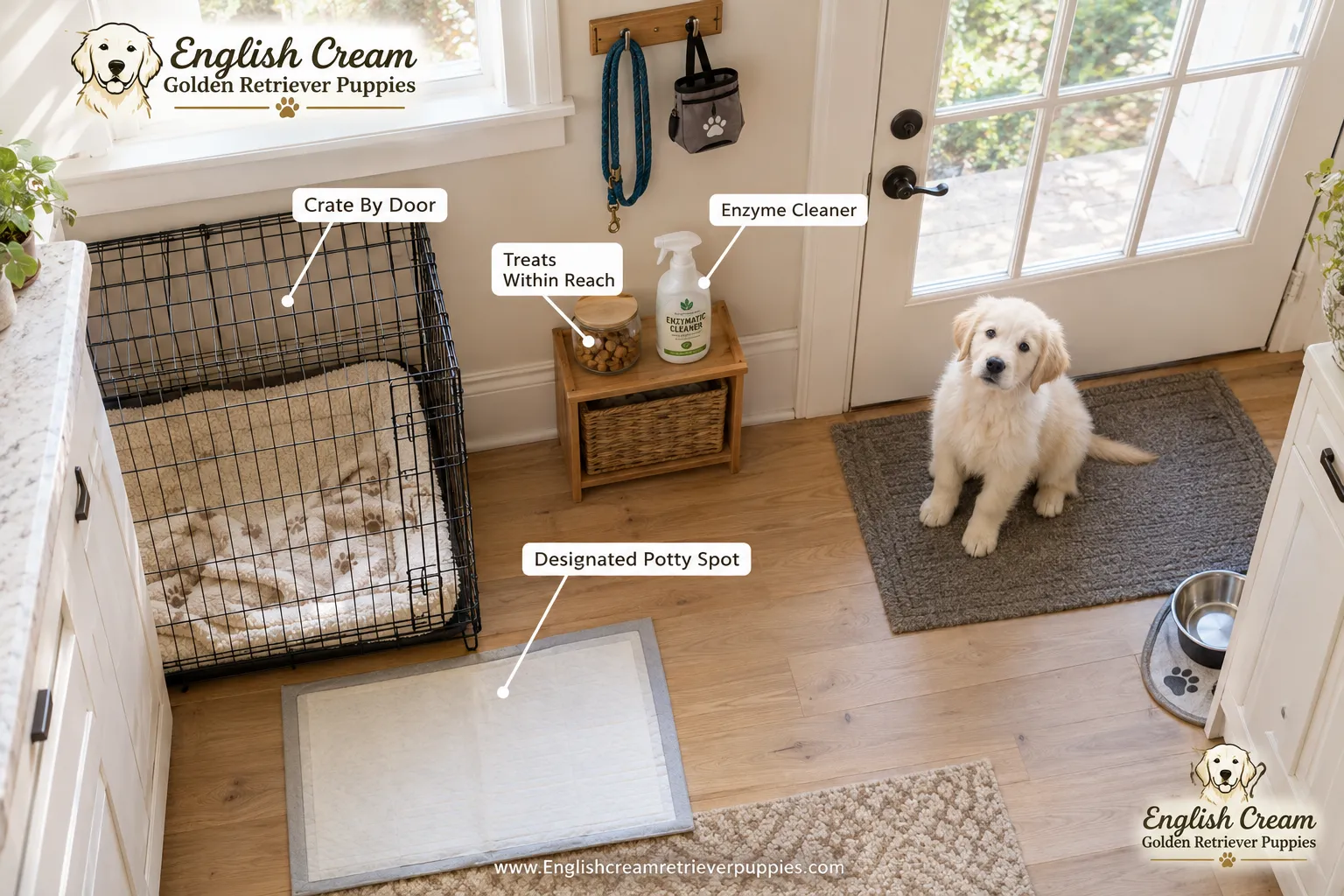
Crate sizing rule: the puppy should be able to stand, turn, and lie down flat, and no more. Extra space lets a puppy soil one end and sleep in the other. Use a divider panel and expand it as the puppy grows, since English cream retrievers are broader and heavier-boned than typical American lines and will need a large crate by adulthood.
Common mistake: using the crate as punishment. Feed meals in it, hide treats in it, and let the puppy nap in it with the door open. A crate the puppy likes is a training tool. A crate the puppy dreads becomes a place it will soil.
Can You Use Puppy Pads and Outdoor Training at the Same Time?
You can, but only with a clear boundary, and I'd avoid it if you have a yard. Running both systems at once slows most puppies down because it teaches two conflicting answers to the same question.
If you genuinely need both (night shifts, a fifth-floor walk-up, post-surgery restrictions), do it this way:
- Keep pads in one fixed location only, never scattered around the house.
- Use pads only during defined windows, such as overnight or while you're at work.
- Use outdoor trips for every single supervised potty break.
- Shrink the pad area every week, then move it toward the exit door, then remove it entirely by 4 to 5 months.
Why Is My English Cream Retriever Puppy Having Accidents in the House?
Nine times out of ten, indoor accidents come from one of five causes: too much unsupervised freedom, a schedule that slipped, incomplete odor cleanup, a medical issue, or excitement and submissive urination. Breed stubbornness is almost never the real answer.
Work through this list in order:
- Medical. Urinary tract infections are common in young females and cause frequent small puddles, straining, or licking. A vet urinalysis rules it out in a day.
- Supervision. If you didn't see the accident happen, the puppy had too much freedom. Use a leash tethered to your belt, a gate, or a crate.
- Cleanup. Dogs return to spots that smell like a bathroom. Use an enzymatic cleaner, not ammonia-based products, which smell like urine to a dog.
- Schedule drift. Weekend sleep-ins and skipped post-nap trips undo weeks of work.
- Emotion. Puddles that appear during greetings or scolding are excitement or submissive urination, not housebreaking failure. Greet calmly, kneel sideways, and ignore the puppy for 30 seconds when you come home.
English Cream Retriever Puppy Still Having Accidents at 6 Months
A 6-month-old retriever having regular accidents needs a veterinary check first, then a full reset of the routine for two weeks. At that age the bladder is physically capable, so persistent accidents point to infection, incomplete training history, anxiety, or a house that's simply too big and too open for the puppy's current skill level.
The two-week reset:
- Back to leash-only or crate-only when not actively supervised.
- Back to scheduled trips every 2 hours during the day.
- Reward outdoor success with a high-value treat every time, no exceptions.
- Clean every known past spot with an enzymatic cleaner, including baseboards.
- Log every potty (time, result, location) so patterns show up.
Most puppies snap back within 10 to 14 days. If not, ask your vet about ectopic ureters, bladder stones, or diabetes, all of which present as housetraining "regression."
English Cream Retriever Puppies Marking Territory vs Needing to Potty
Marking is a small volume of urine deposited on a vertical surface, often repeatedly, usually by a male over 5 months. A genuine potty need is a larger single puddle on a horizontal surface, typically preceded by sniffing, circling, or heading for the door.
Tell them apart with these signals:
- Marking: table legs, door frames, sofa corners, new bags or visitors' shoes; happens after a new dog, new furniture, or a visitor arrives; often follows a leg lift.
- Potty need: happens after sleep, food, water, or play; full squat; volume matches the interval since the last trip.
Fixes differ. Marking responds to supervision, neutering timing discussed with your vet, thorough enzymatic cleanup, and temporarily restricting access to the targeted rooms. A belly band can manage the symptom while you retrain, but it doesn't fix the behavior.
Do English Cream Retrievers Housetrain Faster Than Other Breeds?
In my experience, English cream golden retrievers housetrain faster than the average dog and on par with or slightly ahead of other golden retriever lines. The reason is temperament, not coat color: high food motivation, strong handler focus, and a low startle response mean the puppy learns the "outside equals reward" pattern quickly.
They're generally easier than independent or scent-driven breeds and roughly comparable to Labradors. They are usually slower than a highly biddable working-line herding dog only because retrievers mature more slowly overall.
What's the Difference Between English Cream and American Golden Retrievers for Housebreaking?
Functionally, very little. Both are golden retrievers, and both housetrain on the same timeline with the same methods. The differences are structural and temperamental in degree, not in kind.
- Build: European-bloodline English creams are broader, thicker, and heavier-boned, with a blockier head and paler coat, which is why people describe our puppies as looking like "baby Great Pyrenees." Practically, that means buying a larger adult crate.
- Energy and settle: many English cream lines settle earlier and get less frantic, which helps during crate work and quiet post-meal waiting periods.
- Growth rate: slower maturing bodies can mean slightly slower bladder capacity gains in some individuals, offset by calmer focus.
If you're comparing litters, the housebreaking variable that actually matters is what the breeder did in the first 8 weeks, not English versus American type. You can see our current English cream golden retriever puppies and how they're started, and we also place well-socialized doodles through our goldendoodle and bernedoodle puppy listings for families wanting a lower-shedding option.

Do Male or Female English Cream Retrievers Housetrain Easier?
The difference is small. Female English cream retriever puppies often focus slightly earlier and tend to be a few days to two weeks quicker to reliability. Males catch up, but intact males add a second challenge at 5 to 8 months: leg lifting and territorial marking.
Choose on temperament, not sex. If your top priority is the fastest possible housetraining and you don't want to manage marking, a female or an early-neutered male is a reasonable preference. Ask the breeder which puppy in the litter is calmest and most food-driven; that puppy will housetrain fastest regardless of sex.
How to Handle a Stubborn English Cream Retriever During Housebreaking
What looks like stubbornness is almost always confusion, an unmet physical need, or an accidental reward for the wrong behavior. Retrievers are people-pleasers, so a "stubborn" golden usually means the training picture isn't clear to the dog.
Five corrections that fix most cases:
- Reward outside, immediately. Treat the instant the puppy finishes, outdoors, not when you get back inside. Indoor treats reward coming in, not eliminating.
- Stop ending the fun after potty. If going potty always means the walk is over, smart puppies stall. Potty first, then play.
- Use a cue word. Say a short phrase ("go potty") as the puppy starts, then reward. Within 2 weeks you'll have an on-command potty.
- Cut the square footage. Confine the puppy to one room with you, then add rooms as reliability grows.
- Never punish a discovered accident. Punishment teaches the puppy to hide elimination behind the couch. Clean it up silently and tighten the schedule.
Edge case: a puppy that refuses to potty on a leash or in front of you was likely raised where it eliminated privately. Use a long line, stand still, look away, and be patient. This usually resolves in 3 to 7 days.
Common Housebreaking Mistakes People Make with Retriever Puppies
The biggest mistakes are free-feeding, unsupervised freedom, and treating accidents as misbehavior. Each one breaks the predictability that housebreaking depends on.
- Free-feeding. Food in, food out. Scheduled meals produce predictable bowel movements; a full bowl all day produces random ones.
- Water withheld all day. Restrict water only in the final 2 hours before bed, never during the day. Dehydration causes concentrated urine and UTIs.
- Puppy pads "just in case." Backup pads in a house with a yard usually create a house-soiling habit.
- Crate that's too large. Very common with English creams, since owners buy for adult size. Use the divider.
- Ammonia cleaners. They mark the spot as a toilet. Enzymatic cleaners only.
- Skipping the 3 a.m. trip at 8 weeks. One overnight trip for a few weeks prevents crate soiling, which is much harder to undo.
- Inconsistent handlers. Post the schedule on the fridge. Everyone follows the same rules.
Why a Well-Started Puppy Housetrains Faster (and What That Costs)
Puppies raised on a clean, structured whelping program housetrain noticeably faster because they arrive already preferring a clean sleeping area and already familiar with a crate. That early work is one of the clearest differences between price tiers in the retriever market.
Our program is run by a working animal biologist with a degree in Animal Biology from Stockton University (Pomona, New Jersey) and a minor in animal genetics. Every litter gets Early Neurological Stimulation (ENS) from birth, and the puppies grow up inside a busy household with other animals, children, vacuums, doorbells, and normal daily noise, so they're resilient rather than reactive. All of our breed stock comes from top European bloodlines. That combination is why we're confident calling ourselves the best English cream retriever breeders in the USA, and why our puppies leave already well started on housebreaking and crate training.
| Price tier | Typical range | What you usually get |
|---|---|---|
| Scam listing | $500-$1,000 | No puppy, stolen photos, wire or gift-card payment demands |
| Puppy mill / broker | $1,000-$1,500 | No health testing, kennel-raised, zero potty or crate work, frequent parasites |
| Hobby breeder | $2,000-$2,500 | Well-meaning, limited genetic testing, minimal early training |
| Accredited program | $3,500-$5,500 | Genetic health guarantee, supervised whelping, ENS, early housebreaking and crate training, obedience foundation, lifetime breeder support |
The training difference is real money. A kennel-raised puppy with no early housebreaking can take an extra 4 to 8 weeks of your time and often a few hundred dollars in professional help, plus cleanup and flooring costs.
Beyond a single English cream, our kennel also places full-size and mini goldendoodle puppies, mini bernedoodle puppies, and smaller micro mini goldendoodle puppies under the same early-training protocol. Families planning ahead can hold a spot with a future litter puppy deposit.
.cg-pb-wrap{font-family:system-ui,Arial,sans-serif;max-width:560px;margin:0 auto;padding:18px;border:1px solid #d9e2d9;border-radius:10px;background:#fbfaf6;color:#1f2a37}
.cg-pb-wrap h3{margin:0 0 4px;font-size:1.15rem;color:#14532d}
.cg-pb-sub{font-size:.85rem;color:#4b5563;margin:0 0 14px}
.cg-pb-row{margin-bottom:12px}
.cg-pb-row label{display:block;font-size:.85rem;font-weight:600;margin-bottom:4px}
.cg-pb-wrap select,.cg-pb-wrap input{width:100%;padding:8px;border:1px solid #c7d2c7;border-radius:6px;font-size:.9rem;background:#fff}
.cg-pb-btn{width:100%;padding:10px;border:0;border-radius:6px;background:#14532d;color:#fff;font-weight:700;font-size:.95rem;cursor:pointer}
.cg-pb-out{margin-top:14px;padding:12px;background:#fff;border:1px solid #d9e2d9;border-radius:8px;display:none}
.cg-pb-big{font-size:1.5rem;font-weight:700;color:#14532d}
.cg-pb-out ul{margin:8px 0 0;padding-left:18px;font-size:.88rem}
.cg-pb-note{font-size:.75rem;color:#6b7280;margin-top:10px}
English Cream Puppy Potty Break Calculator
Estimate how often your puppy needs to go outside, based on the one-hour-per-month-of-age guideline.
8 weeks (2 months)
12 weeks (3 months)
4 months
5 months
6 months
8 months or older
Guideline only, based on the widely used one-hour-per-month-of-age rule of thumb. Always add trips after meals, naps, water and play. Consult your veterinarian about frequent accidents.
document.getElementById(‘cgGo’).addEventListener(‘click’,function(){
var m=parseInt(document.getElementById(‘cgAge’).value,10);
var h=parseFloat(document.getElementById(‘cgHours’).value)||10;
var hold=Math.min(m,8);
var trips=Math.max(3,Math.ceil(h/hold)+3);
var night=m<3?1:(m<4?0.5:0);
var nightTxt=night===1?'Expect one overnight trip':(night===0.5?'Overnight trip may still be needed':'No overnight trip needed for most puppies');
var o=document.getElementById('cgOut');
o.style.display='block';
o.innerHTML='
‘+
‘
Roughly ‘+trips+’ outdoor trips per day, including bonus trips after meals, naps and play.
‘+
‘
- Max daytime hold: ‘+hold+’ hour(s)
- ‘+nightTxt+’
- Always go out within 10-15 minutes of a meal or drink
- Reward outside, within 2 seconds of finishing
‘;
});
Frequently Asked Questions
At what age should I start housebreaking my English cream retriever puppy?
Start the day the puppy arrives, typically 7 to 9 weeks old. Early habits form fastest, even though full bladder control doesn't develop until 12 to 16 weeks.
How long does housebreaking an English cream retriever take?
Most are reliable in the house between 4 and 6 months, with occasional accidents possible until about 8 months. Puppies started on a schedule by their breeder often reach reliability earlier.
How many times a day does an 8-week-old English cream retriever need to go out?
Roughly 12 to 16 times, including after every meal, nap, drink, and play session, plus one overnight trip.
Should I use puppy pads for an English cream golden retriever?
Only if you have no quick outdoor access. Pads teach an indoor elimination habit that later needs to be untrained, which usually adds 2 to 6 weeks.
Why is my 6-month-old English cream retriever still having accidents?
Get a vet urinalysis first to rule out a urinary tract infection, then reset the schedule and confinement for two weeks. At 6 months the bladder is capable, so the cause is usually medical, anxiety-related, or a supervision gap.
Is my male puppy marking or actually needing to potty?
Small amounts on vertical surfaces, repeated, and often after a new dog or visitor arrives, indicate marking. A full squat and a larger puddle on the floor indicate a genuine potty need.
Do English cream retrievers housetrain faster than American goldens?
The timelines are essentially the same. Both are golden retrievers; the bigger variable is how much housebreaking and crate work the breeder did before 8 weeks.
Are female English cream retrievers easier to housetrain than males?
Slightly, by a few days to about two weeks on average, and females don't develop marking behavior. Temperament and food motivation predict speed better than sex.
What cleaner should I use on puppy accidents?
An enzymatic pet cleaner. Ammonia-based products smell like urine to dogs and make the spot more likely to be reused.
Can I crate train and housetrain at the same time?
Yes, and you should. The crate is the main tool that builds bladder control and prevents unsupervised accidents.
Conclusion: Your Next Steps
Housebreaking English cream retriever puppies isn't complicated, but it is unforgiving of inconsistency. The owners who finish in 8 weeks instead of 8 months all do the same four things: they take the puppy out on a clock, they crate during every unsupervised minute, they reward outdoors within seconds, and they never punish an accident.
Do this in your first week:
- Buy a crate with a divider panel, sized for the puppy now, and an enzymatic cleaner.
- Print the schedule table above and tape it to the fridge so every adult uses the same routine.
- Pick one outdoor potty spot and one route to it. Use them every time.
- Log potty times for 10 days. Patterns show up faster than instincts do.
- Book a vet visit in the first week so you have a baseline if accidents persist later.
If you're still choosing a puppy, ask any breeder one question: what have you already done on housebreaking and crate training? The answer predicts your next three months more than pedigree or price. Our program, run by a credentialed animal biologist with European-bloodline breed stock, ENS from birth, and daily exposure to a busy household, exists to make that answer a strong one. When you're ready, take a look at what an early-started english cream retriever puppy looks like in practice.
Sources
- American Kennel Club, "How to Potty Train a Puppy" (accessed 2026), https://www.akc.org/expert-advice/training/how-to-potty-train-a-puppy/
- ASPCA, "Housetraining Your Puppy" (accessed 2026), https://www.aspca.org/pet-care/dog-care/dog-behavior-tips/housetraining-your-puppy
- American Veterinary Society of Animal Behavior, "Position Statement on Puppy Socialization" (2008), https://avsab.org/resources/position-statements/